This week, a new generation is learning the story behind "Brown Hill," a song by influential bluegrass band The Lost and Found. Also, data centers are changing the landscape, and one project is planning to plow over an extremely rare stand of seed-producing American chestnut trees. And, small food producers embrace digital technology for the humble farm stand.
The Sistersville Ferry And Keeping Listeners Connected, Inside Appalachia
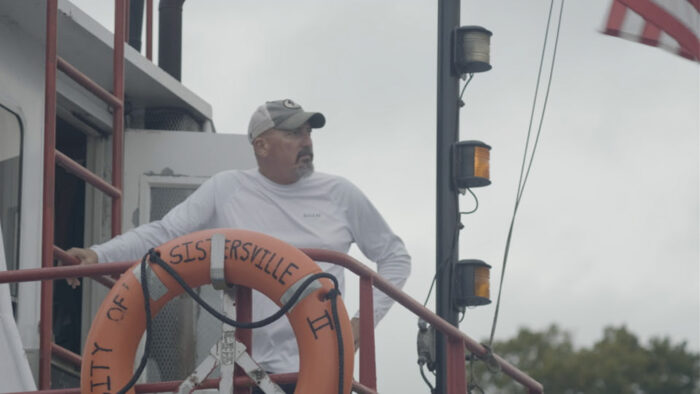
Former deckhand Tom Meek will be the next pilot of the Sistersville Ferry.Zack Harold/West Virginia Public Broadcasting
Listen
Share this Article
Crossing a river by ferry can be a special experience, and hard to come by. On the Ohio River, a retiring ferry captain passes the torch to his deck hand.
And Hurricane Helene destroyed roads and knocked out power and cell service across western North Carolina. But there was still a way to keep people in touch.
You’ll hear these stories and more this week, Inside Appalachia.
The Sistersville Ferry has been serving its Ohio River for over 200 years.
Photo Credit: Zack Harold/West Virginia Public Broadcasting
The town of Sistersville, West Virginia is home to the last ferry crossing in the Mountain State. The Sistersville Ferry has been serving this tiny Tyler County community for more than 200 years, and when it reopens next spring, there will be a new pilot at the helm.
Reporter Zack Harold stopped by to witness the last ride of Captain Bo Hause.
Blue Ridge Public Broadcasting Crucial During Flood
Flooding caused by Hurricane Helene has devastated communities across western North Carolina and east Tennessee.
Courtesy Photo
If you’re in an area that’s struck by a disaster, how do you get information? Especially if power and cell service has been knocked out? You might have to use an old-fashioned technology — the radio. Portable radios work on batteries, and don’t depend on the internet or cell reception.
When Hurricane Helene struck western North Carolina, our partner station, Blue Ridge Public Radio, became a crucial source of information. A few weeks after the storm, Mason Adams spoke with BPR’s News Director, Laura Lee.
Tony Award winning actor Michael Cerveris (center, in blue) stays busy. The former Huntington resident had a new show on Broadway and a new record with his Americana band, Loose Cattle.
Photo Credit: King Edward Photography
Tony Award-winning actor Michael Cerveris grew up in Huntington. Most recently, he was on stage in the musical “Tammy Fay,” which just left Broadway, but he’s better known for his starring roles in Sweeney Todd and the Broadway adaptation of The Who’s Tommy. He’s currently on HBO’s The Guilded Age, but his Americana band Loose Cattle has a new album.
Back in October, Producer Bill Lynch spoke to Cerveris.
------
Our theme music is by Matt Jackfert. Other music this week was provided by Sierra Ferrell, John Hartford, Tim Bing, Jeff Ellis and Loose Cattle.
Bill Lynch is our producer. Zander Aloi is our associate producer. Our executive producer is Eric Douglas. Kelley Libby is our editor. Our audio mixer is Patrick Stephens. We had help this week from folkways editor Nicole Musgrave.
You can send us an email: InsideAppalachia@wvpublic.org.
Buying health insurance can be overwhelming, but there are people who can help you figure it out — free of charge. HealthQ sits in as one 22-year-old speaks with an “independent assister.”
On this West Virginia Week, former governor and longtime U.S. senator Jay Rockefeller has died, West Virginia voted in the general election, and a new anthology explores science fiction and fantasy in Appalachia.
This week, a new generation is learning the story behind "Brown Hill," a song by influential bluegrass band The Lost and Found. Also, data centers are changing the landscape, and one project is planning to plow over an extremely rare stand of seed-producing American chestnut trees. And, small food producers embrace digital technology for the humble farm stand.
These Dreaming Hills is a new horror and science fiction anthology collecting stories from across Appalachia. Inside Appalachia's Bill Lynch spoke with editor Noah Ashley Blooms about the book.