West Virginia is the third most forested state in the country. The fall foliage projection map, a collaboration between the West Virginia Department of Tourism and the Division of Forestry, promotes the best places in West Virginia to see changing fall colors.
Author of the article, Michael H. Walker, says that discrimination against Appalachians can include a bias against things like the way we dress, the way we talk, and even the kind of homes we live in. This form of discrimination is not widely recognized and “these stereotypes simply further the idea that all Appalachian people are uneducated and unsophisticated, and are, therefore, inferior to the rest of our country’s citizens.”
It stretches across race lines – and the judgment of one’s language can reveal both classism- racism or both. This week’s episode of Inside Appalachia explores one of the ways Appalachians are judged – language.
On this episode, you’ll hear:
A conversation on the West Virginia Public Broadcasting podcast called, The Front Porch. In it, executive director and host Scott Finn talks about accents with his guests. Like Scott, conservative columnist Laurie Lynn, is a transplant to Appalachia. The two of them talk with Rick Wilson, of the American Friends Service Committee and a native of West Virginia. In this conversation from The Front Porch podcast, Rick shares a few tips on how to speak Appalachian. And just a small warning- Rick also shares some of his favorite Appalachian cusses.
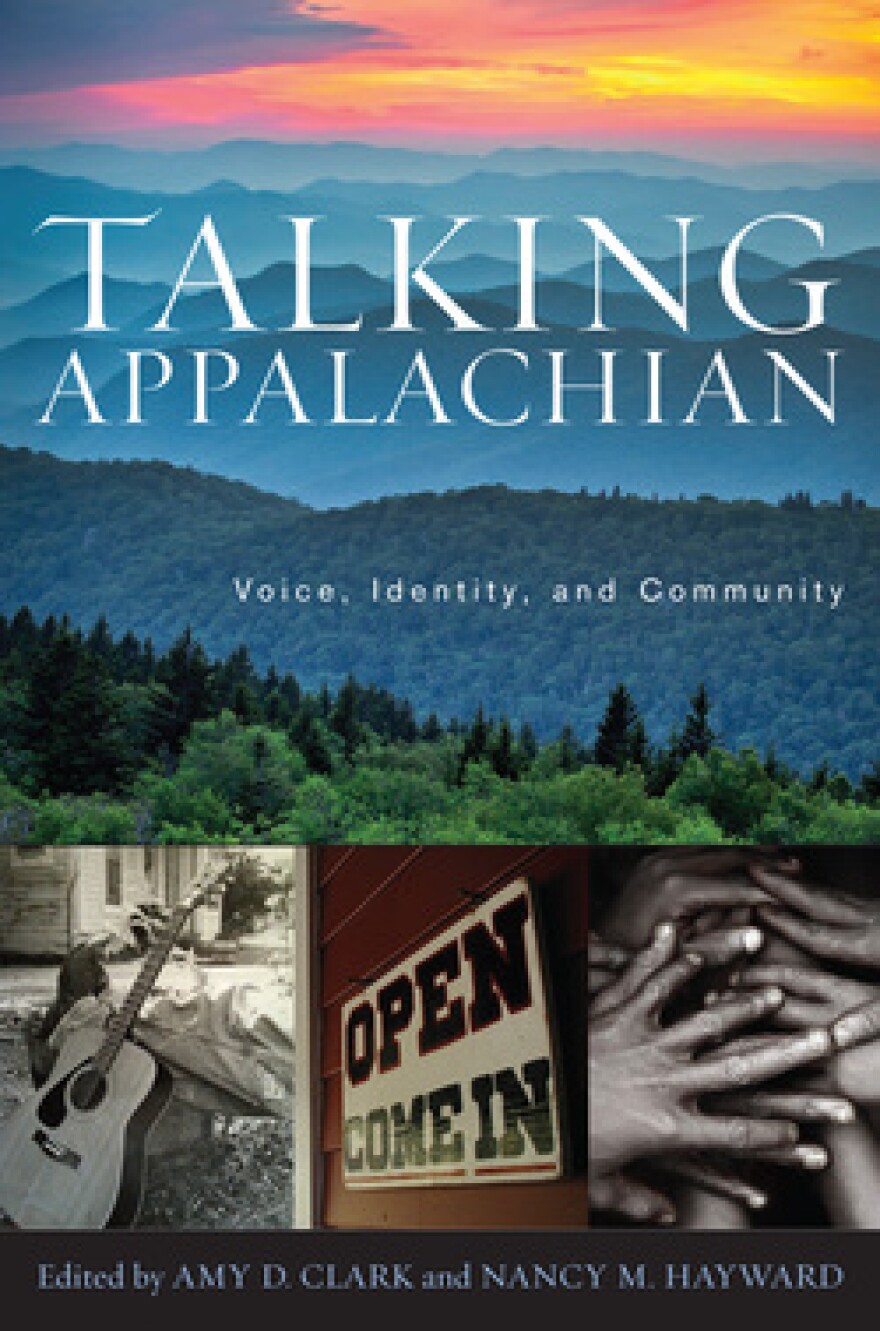
Amy Clark, the co-chair of the UVa-Wise Appalachian Studies Program, and the co-editor of a new book Talking Appalachian. Clark is a professor of English, at WVA’s College of Wise. She’s been there for about 15 years. Amy Clark writes about this issue in a new book called Talking Appalachian. WMMT’s Benny Becker talks with Amy about how Appalachian dialects came to be. In this interview, Amy also shares her personal journey of learning to embrace her voice.
Credit courtesy
/
Professor Amy Clark with her family.
Professor Amy Clark suggests one of the best ways to deal with judgments because of the way you talk is to know the history of the your dialect. So here are a few words and phrases that came to Appalachia hundreds of years ago with Scotch-Irish settlers. These are from an article written by Michael Montgomery from the University of South Carolina. He cataloged hundreds of phrases that came over from Scotland and Ireland.
How many do you know?
1) airish “windy, chilly: “It’s right airish out today.”
3) beal, bealing “an abscess, boil, festering sore: “Mary had a bealing on her neck.”
4) bonny-clabber “curdled sour milk.”
5) bottom(s), bottom land “fertile, low-lying land along a river or creek”: “The house was right out in the middle of a little bottom.”
6) chancy “doubtful, dangerous”: “It was a chancy thing to do.”
7) contrary (as a verb) “to vex, oppose”: “Don’t contrary him any more.”
8) creel “to twist, wrench, give way”: “His leg creeled under him.”
9) discomfit “to inconvenience”: “I hope it won’t discomfit you any.”
10) fireboard “mantelpiece”: “She got a big pistol and laid it up on the fireboard, and she said, ‘you see this gun. If anything takes place here tonight,’ she says ‘I’ll use this gun on you’.”
11) hull “to shell (beans or peas)”: “We hulled two bushels of butter beans last night.”
12) ill “bad-tempered”: “He was acting awful ill this morning.”
13) kindling “twigs, pine needles, and scraps of wood to start a fire”: “Before we began the fire, we made sure we had plenty of kindling.”
14) let on “to pretend”: “She let on that she didn’t care.”
15) mend “to improve physically”: “He’s mending very slowly.”
16) muley “hornless cow”: “Come on, Robert, let’s get our little muley-cow to work again.”
17) nicker “whinny”: “Sure enough in a few minutes four lank horsemen were dismounting at the gate amid much nickering of horses and yapping of hounds.”
18) palings “upright stakes (of a fence)”: “That’s what the mountain people called them, palings. They’re split out just like boards.”
19) piece “distance”: “It’s a far piece to town and back.”
20) redd up “to tidy up, get a place ready”: “I mean to wash and redd up the house before I do any special cooking.”
21) soon (adjective) “early”: “I hope that we can get a soon start in the morning.”
22) take up “begin”: “Has the meeting taken up yet?”
Credit courtesy
/
Cover of the Book, “Talking Appalachian”, which was co-edited by Amy Clark.
We had help producing Inside Appalachia this week from WMMT in Whitesburg, Kentucky and The Front Porch podcast.
Credit Courtesy Rick Wilson
/
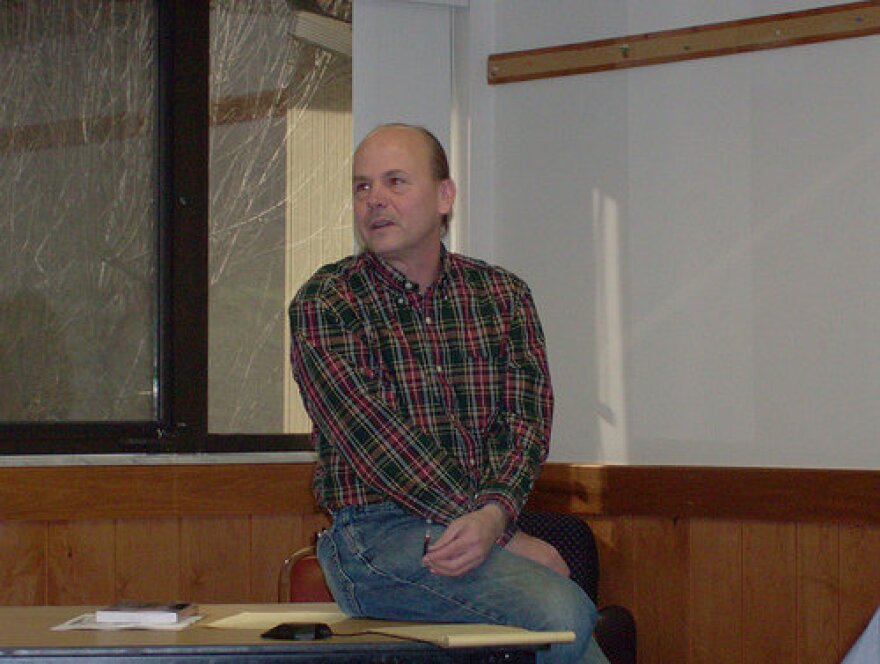
Rick Wilson is a regular guest on The Front Porch Podcast.
Music in today’s show was provided by Andy Agnew Jr., Ben Townsend, the Hillbilly Gypsies, and Dinosaur Burps. Our What’s in a Name theme music is by Marteka and William with “Johnson Ridge Special” from their Album Songs of a Tradition.
Our producer is Roxy Todd. Our editor is Jesse Wright. Our audio mixer is Zander Aloi.
Add WVPB as a preferred source on Google to see more from our team
One of the world’s rarest plants, the Peters Mountain Mallow, lives on only one mountainside, in the New River Valley along the West Virginia line. Last year, scientists counted just five plants still alive – and the recent drought means protecting it from extinction is getting tougher.
As developers rapidly propose data centers across Kentucky, their neighbors are struggling to find out what it will mean for them. For the Appalachia + Mid-South Newsroom, Sylvia Goodman reports that residents are calling for more transparency from developers and their own public officials.
On this West Virginia Week, plans for a new transmission line may be in trouble, a former state delegate is indicted, and the state has a new secretary of tourism.
This week, a new report finds the number of black lung cases is at its highest since the 1970s. The human cost is high. Also, the author of a new book says reintroducing nearly extinct animals back into the wild can boost damaged ecosystems, but they can't repair them. And, roadside attractions pay tribute to our enduring fascination with weird.