Alert (March 14, 2026): Due to recent high winds, our radio/TV tower in Bethany is not operational. Our engineers are working to resolve the issue. Alert (March 11, 2026): Our TV translator in Flatwoods is experiencing technical issues. Our engineers are troubleshooting the problem and expect it to be down for a couple days.
Thank you for your patience.
This week, we meet the woman behind the popular TikTok account “Appalachian Forager.” She makes jam from pawpaws and jewelry from coyote teeth. Also, we sit in on a master class in foraging for wild mushrooms. And, when a West Virginia pastor got assigned to a new church, folks tried to warn him.
Home » Inside an Appalachian Coal Legacy: Black Lung
Published
Inside an Appalachian Coal Legacy: Black Lung
Listen
Share this Article
Coal mining has touched so many aspects of life in Appalachia. The coal industry has provided more than just jobs — it’s helped build towns, bridges and it’s even provided money for many Appalachians to go to college. We also have a deep cultural connection to coal and its history.
Still, there’s no denying the coal industry has changed the landscape of our mountains, and infected many miners with a deadly disease known as black lung.
On this episode of Inside Appalachia, we look at this part of coal’s legacy, and the complicated, often broken or mismanaged system that’s meant to help miners and their families.
Just how massive is this problem in Appalachia? Well, the answer is complicated, as a recent NPR investigation discovered.
Nationwide, less than a hundred cases were reported to the government in the past five years. But NPR obtained data from 11 black lung clinics in Virginia, West Virginia, Pennsylvania and Ohio, which reported a total of 962 cases so far this decade. The true number is probably even higher, because some clinics had incomplete records and others declined to provide data.
In West Virginia alone, 186 cases of progressive massive fibrosis, or severe black lung, were diagnosed at federally-funded lung clinics since 2009. The total is likely higher because some clinics reported only one or a few years’ worth of data.
Late last year, NPR’s investigative reporter Howard Berkes looked into the underreported cases of black lung in a two part report. We check in with Berkes to find out what’s happened since the report aired.
Complicated Black Lung is Fatal
In this episode we hear the testimony of one former miner who suffers from advanced stages of Black Lung, Mackie Branham, age 39, of Elkhorn Creek, Ky. He worked hard to feed his family and now, as his life leaves him one breath at a time, he wonders about the cost.
Branham hopes for a lung transplant, which may give him five to 10 more years of life.
And we’ll check back in with former miner, Robert Bailey, who received a double lung transplant fifteen months ago. We first heard from Robert at a Black Lung Conference at Pipestem in June of 2014. Bailey’s doctor told him he needed a lung transplant, which meant he didn’t have much longer to live.
Credit Jessica Lilly
/
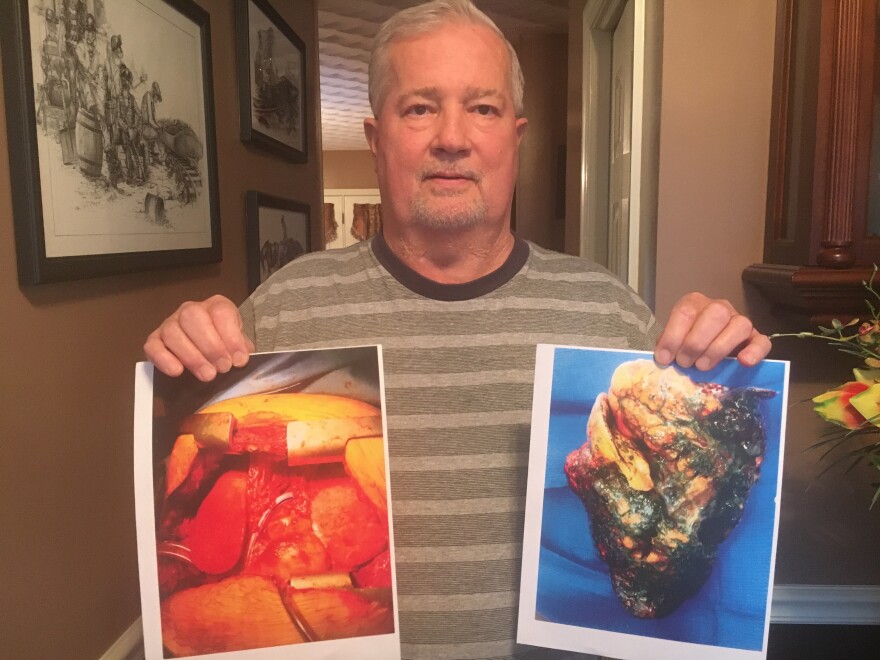
Robert Bailey holds up a picture of his new lungs and a photo of his lungs that were replaced
Could an End to Obamacare Affect Black Lung?
In 2010, when President Obama signed the Affordable Care Act into law, it included special provisions that make it easier for coal miners to get black lung benefits. Republicans introduced an alternative plan to replace Obamacare, but the first attempt failed to get support.
Still, this might not be the end of America’s health care story. In a recent visit to West Virginia, Vice President Mike Pence vowed to keep fighting to repeal the ACA. And as Kara Lofton reported back in January, if the ACA is repealed, gaining black lung benefits could become much more difficult for miners, effectively harming a group of people Trump promised to protect.
Former Kentucky Coal Miner, Gary Bentley
Credit Lance Booth
/
We also hear from former coal miner Gary Bentley. He spent 12 years as an underground coal miner in Kentucky before he left the industry in 2013. Bentley writes a blog called “In the Black,” for the rural news website “The Daily Yonder.” In his column, he shares stories from his career in the mines.
Inside Appalachia is produced by Jessica Lilly and Roxy Todd. Our audio mixer is Patrick Stephens. Glynis Board edited our show this week. Our executive producer is Jesse Wright.
On this West Virginia Week, we take a look at the dramatic ending of the state Legislature’s 2026 regular session, developing data centers and Easter eggs.
This week, we meet the woman behind the popular TikTok account “Appalachian Forager.” She makes jam from pawpaws and jewelry from coyote teeth. Also, we sit in on a master class in foraging for wild mushrooms. And, when a West Virginia pastor got assigned to a new church, folks tried to warn him.
Around this time of the year, some area churches get into the business of selling chocolate Easter eggs. These are the kind of eggs that have some weight to them. But one West Virginia church has become known far and wide for its chocolate eggs.
The West Virginia Department of Agriculture earlier this month issued an advisory to poultry owners about the rising number of avian flu cases in surrounding states. So far, it has infected only a small number of poultry farms in West Virginia. But in nearby Pittsburgh, the number of avian flu cases is high.