Alert (09/29/2026): Our Parkersburg TV transmitter is still undergoing maintenance and remains temporarily inoperative. We apologize for the inconvenience.
All our programming is available via our TV livestreams on our website and WVPB Passport. Thank you for your patience!
This week, author Silas House returns with a sweeping new novel. Also, some folks say, you have to fake it 'til you make it, even if you're trying to establish a state park. And, the story of the first Mothman sightings as written by a small town journalist in 1966.
Home » WVPB Podcasts » In Appalachia, Controversy and Mystery Still Surround Lakes Built by the Army Corps of Engineers
Published
In Appalachia, Controversy and Mystery Still Surround Lakes Built by the Army Corps of Engineers
Listen
Share this Article
In this week’s episode of Inside Appalachia, we visit communities impacted by creation of flood-control lakes. Like the Village of Lilly, where back in the 1940s, about 40 families were pushed off their land along the Bluestone River in Summers County, West Virginia. Many of these families had lived there for more than 200 years.
Inside Appalachia Host Jessica Lilly has deep roots to this community, as we hear in this episode.
Credit Roxy Todd/ WVPB
/
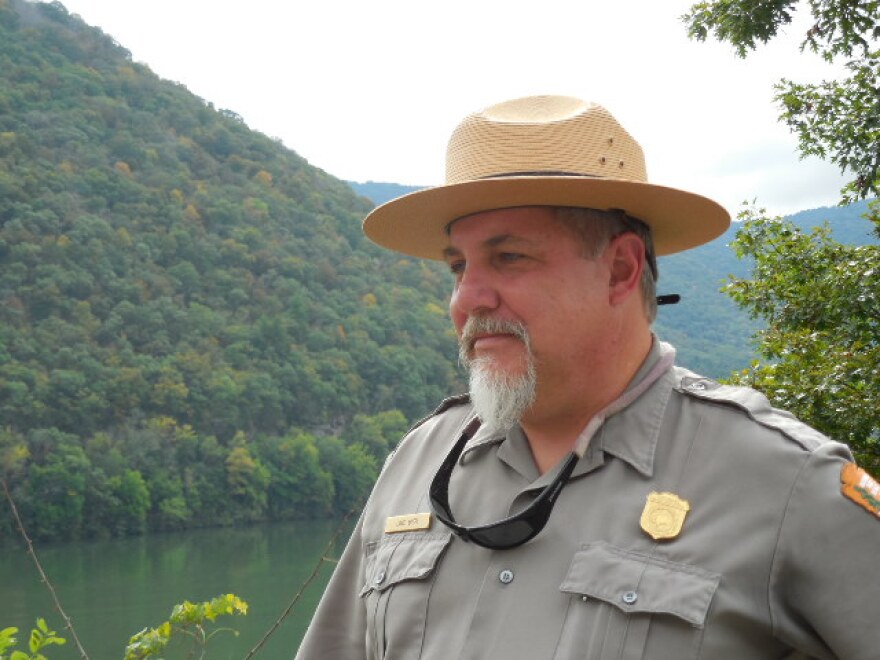
Dave Bieri, with the National Park Service
In Central Appalachia, there are more than 30 man- made lakes, built and maintained by the Army Corps of Engineers. Across the United States, there are more than 700 man-made lakes created by dams.
Some of these lakes were made to prevent flooding in populated areas, while others were built to create recreational activities.
Burnsville Dam
Mari Lynn Evans is a filmmaker who’s produced documentaries like The Appalachians, Coal Country, and most recently, Blood on the Mountain. She grew up with her grandparents in West Virginia. In the 1970s, they were forced off their land to make room for the recreational Burnsville Lake. She says when her grandparents had to leave their farm, they lost everything they knew.
“My grandparents who raised me had over 2,000 acres. They raised cattle and they raised vegetables for generations, and in 1977 the Army Corps of Engineers through eminent domain took all of that land, and took our home, and all of our outbuildings and took our silos, and it still hurts. It still hurts to lose your home,” Evans recalled.
Stonewall Jackson Lake
And we hear an archived recording from 1984, from a documentary that was produced by Michael Kline. Barbara Heavner talks about why she refused to leave her home in Lewis County, W.Va., when the federal government told her the Stonewall Jackson dam would put her house under water. Residents were paid for their property, but some people, like Mrs. Heavner and her son Bob, didn’t leave without a fight. We hear her recount the showdown she and her son had with a U.S. Marshall, who was tasked with physically removing the family from their property.
Stonewall Jackson lake was completed in 1990, and is now used for boating and fishing recreation. It also provides flood control for areas downriver of the West Fork River.
Although there is an exit off I-79 called the Roanoke exit, the town no longer exists. Along with Barbara Heavner’s farm and nursery it sits at the bottom of Stonewall Jackson Lake.
Red River Gorge
Some projects to build dams have come against pushback from historians and environmentalists. That’s true in Kentucky’s Red River Gorge, where a dam was almost built. In this episode we hear an excerpt of a radio documentary called Kentucky’s Red November, produced in 2016 by Charlie Baglan about a controversial project that almost flooded the Red River Gorge in Kentucky 50 years ago. We’ll hear why the fight to protect the Red River Gorge, and keep a dam from being built, turned into one of the nation’s earliest environmental controversies in the 1960s over a proposed dam in eastern Kentucky.
Credit USDA/ Daniel Boone National Forest
/
newspaper article about the Red River Dam controversy in KY
A few local citizens spoke out against the dam, but for the most part, residents of Powell County supported the project, because it would help with flood control for communities like Clay City.
By 1967, the project to create a lake in the Red River Gorge seemed like a done deal.
Credit USDA/ Daniel Boone National Forest
/
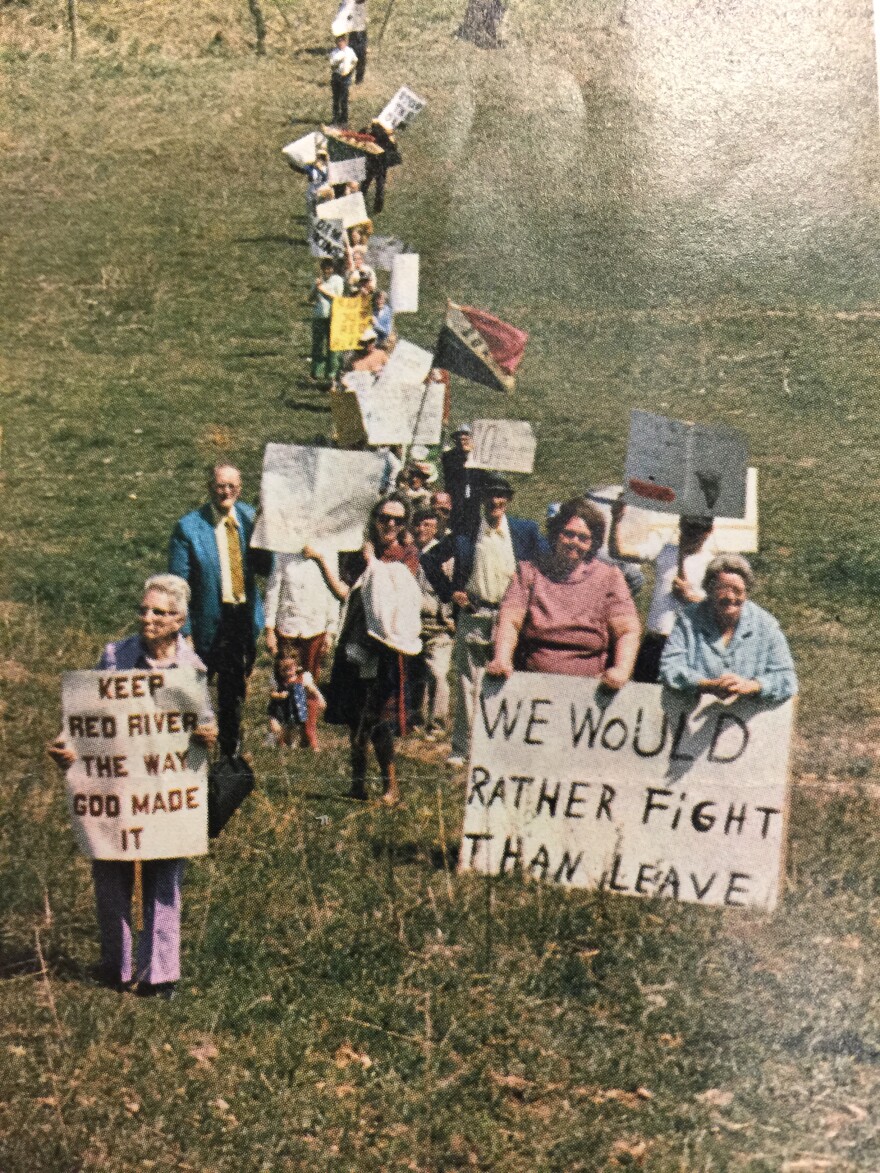
Hikers at the 1967 protest at the Red River Gorge. Some people recall there were about 800 people on the hike, some against the project to build a lake in the Red River Gorge. Others supported the project because it would help prevent flooding in Powell County. The dam was never built.
But then, the newly formed Cumberland Chapter of the Sierra Club helped organize a protest. One of the local residents who was working with the Sierra Club, Carroll Tichner, suggested they invite an avid outdoorsman who also happened to be a US Supreme Court Justice, William O. Douglas, to hike the gorge and help raise awareness. Well, it worked. Justice Douglas showed up. He agreed to visit Kentucky and make an appearance at the protest hike, in November 1967.
“I’d say there was 800-1000 on that hike, and it was probably 300 opposing it,” Tichner recalled.
We had help producing Inside Appalachia this week from Charlie Baglan, of Kentucky Afield Radio, a production of the Kentucky Department of Fish and Wildlife, Michael Kline and Berea College.
Music in this episode was provided by Blue Dot Sessions, Seth Partridge, Fog Lake, Dr. Turtle, Jake Schepps, and Dinosaur Burps.
Inside Appalachia is produced by Jessica Lilly and Roxy Todd. Glynis Board edited this episode. Our executive producer is Jesse Wright. Our audio mixer is Patrick Stephens. Claire Hemme helps with our digital correspondence. You can find us online on Twitter @InAppalachia. You can e-mail us at InsideAppalachia@wvpublic.org.
Add WVPB as a preferred source on Google to see more from our team
This week, author Silas House returns with a sweeping new novel. Also, some folks say, you have to fake it 'til you make it, even if you're trying to establish a state park. And, the story of the first Mothman sightings as written by a small town journalist in 1966.
Silas House is a major voice for Appalachia. The Kentucky native has written more than 15 books and served as the state's poet laureate. His latest book is The Tulip Poplars, a sweeping novel about the lives of four people as they navigate friendship and forbidden love throughout the 20th century. Inside Appalachia's Mason Adams spoke with House.
With the midterm elections approaching, Us & Them host Trey Kay takes the Dinner Party to Huntington, where eight West Virginians from different generations and political perspectives gather around the table. Half the guests are under 30, and while they disagree on immigration, foreign policy, the media and the direction of the country, they also discover some unexpected common ground.
As we’re counting down to the midterm election, Us & Them host Trey Kay has invited a new group of guests to a Dinner Party – but this time, the table is in Huntington. Kay’s guests are a mix of conservative and progressive voters, half of whom are under 30 and they share a wide-ranging conversation over a potluck meal. We listen to an excerpt from this episode where a number of guests weigh in on immigration.