Alert (09/10/2026): Our Parkersburg TV transmitter is undergoing maintenance for a few days and will not be operational. We apologize for any inconvenience.
All our programming is available via our TV livestreams on our website and WVPB Passport. Thank you for your patience!
Appalachians have always made use of the region’s wide variety of plants. A new book, called Appalachian Plants: In the Garden, In the Yard, and In the Wild, explores some of the history and lore of regional staples. It’s written by Linda Hager Pack and illustrated by Pat Banks. Inside Appalachia Host Mason Adams spoke with them.
Encore: Moving Past Addiction And Old Friends Coming Together To Sing After Decades Apart
Listen
Share this Article
This week, we’ll meet a man who has struggled with substance use disorder. Now, he’s a recovery coach.
We’ll also meet a woman who started a farm and culinary training program to help people in recovery, and we’ll learn about barn quilts in North Carolina.
And childhood friends who first started singing together 70 years ago show us why it’s never too late to begin again.
You’ll hear these stories and more this week, Inside Appalachia.
Southern West Virginia has been hit over the last two decades by declining coal jobs, depression and the opioid crisis. People have had to get creative to try to overcome this combination of challenges. We begin today’s show with a story about a business that’s getting national attention for what it’s doing to help. Fruits of Labor is part farm, part cafe and bakery, and part training program. And it consciously hires people in recovery or at risk. Jessica Lilly brought us this story.
Giving Back
In the Northern Panhandle of West Virginia, we visited another recovery program in Wetzel County. It’s seen success — but also faces an uncertain future. Its funding was set to expire this summer. Liz McCormick brought us the story, which was also produced by Ella Jennings and Chuck Kleine.
Crafting An Enduring Legacy
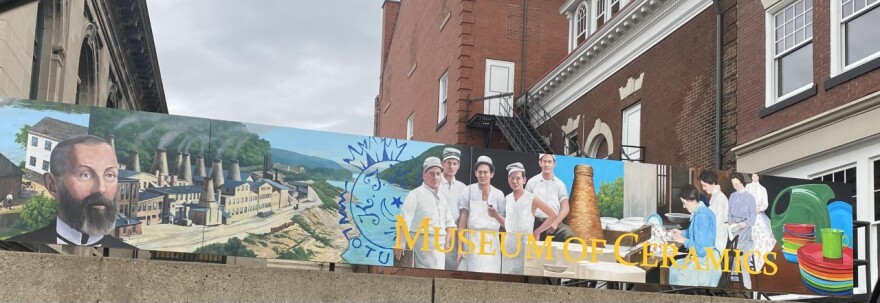
We went to East Liverpool, Ohio — once known as the pottery capital of the world for its dishware and ceramics factories. These days, the industry is mostly gone. But pottery is still central to the town’s identity. And locals are committed to passing that legacy down to a new generation. Capri Cafaro visited East Liverpool and had this story.
Museum of Ceramics in East Liverpool, Ohio
Big Quilts
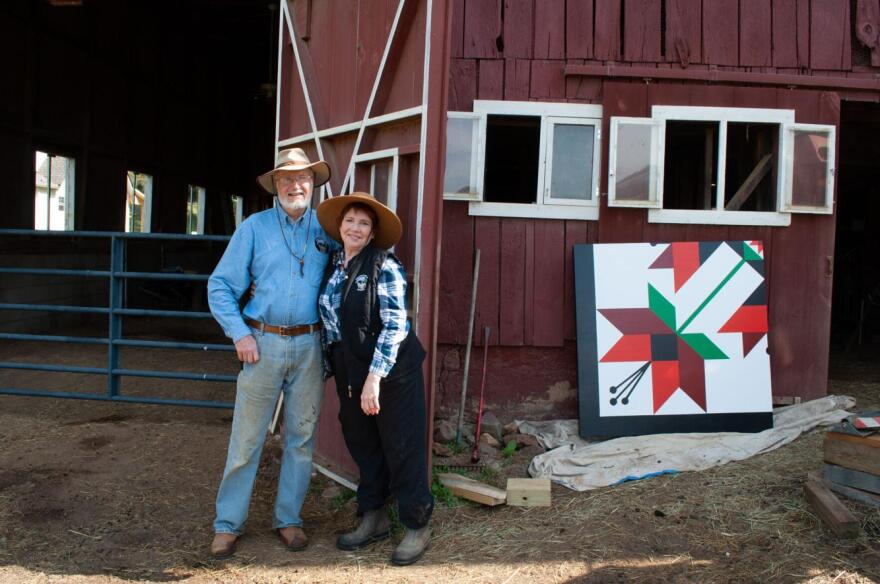
Driving around the mountains and foothills, you may have come across a quilt block painted on the side of a barn or a house. Despite their name, barn quilts can be found on just about any building — not just barns. There are at least 300 in western North Carolina alone. And a lot give insight to the people and places around them. Folkways Reporter Rachel Moore had this story.
Rachel Moore
/
West Virginia Public Broadcasting
Larry and Candace Wingo stand in front of their barn as it was being reinforced to sustain the weight of the couple’s 200-pound barn quilt. One of the four panels is pictured here.
More About Quilts
We just talked about quilts being painted on barns, but that art form comes from the actual tradition of people making quilts for their beds. For his day job, Shane Foster’s an optometrist in Athens, Ohio. But lately he’s also become a quilter — with help from a pack of friends he’s never actually met.
Getting The Band Back Together
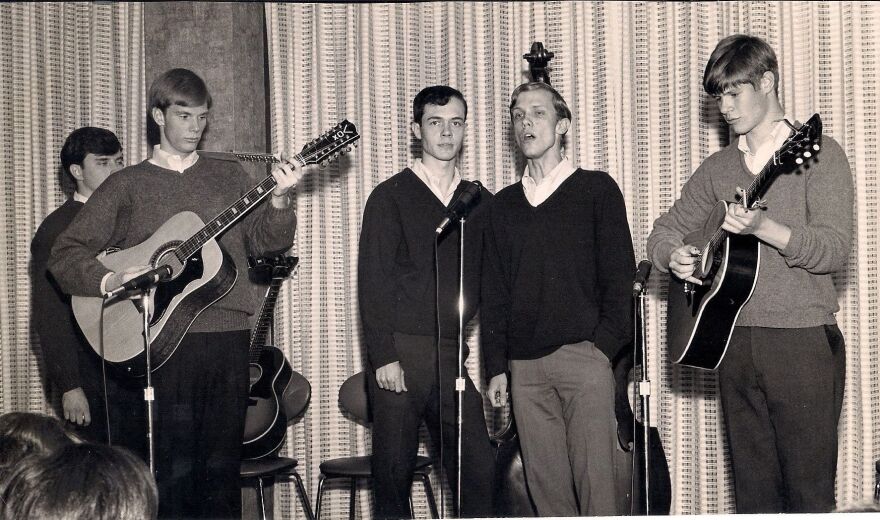
As we get older, people tend to fall into patterns, and it feels like we’re faced with a dwindling number of possibilities. But it’s never too late to reconnect with old passions — and start something new. Jean Snedegar shared the story of a band that formed in 1968, only to disband a few months later. But after more than a half century, and lives that took them in different directions, the four surviving band mates found each other again.
Courtesy
The group Prior Five performing in 1968.
——
Our theme music is by Matt Jackfert. Other music this week was provided by Chris Stapleton, Tyler Childers, Jesse Milnes and June Carter Cash.
Bill Lynch is our producer. Our executive producer is Eric Douglas. Kelley Libby is our editor. Our audio mixer is Patrick Stephens. Zander Aloi also helped produce this episode.
You can send us an email at InsideAppalachia@wvpublic.org.
Data center proposals are popping up in West Virginia – and in neighboring Pennsylvania, where one small community is juggling seven different potential projects. From The Allegheny Front, a public radio program based in Pittsburgh, we hear from that community and their concerns.
Many West Virginians may not remember the name Doris “Dorie” Miller, but he served on the USS West Virginia when it was attacked at Pearl Harbor. While Miller was never trained to fight, he raced to the deck on the day of the attack and fought back - shooting down at least one enemy plane. In 2020, a new aircraft was commissioned by the U.S. Navy and named for Miller. But recent stories have surfaced with talk of renaming it after President Donald Trump. We speak with Scott Womack, the commander of American Legion Post 100 in Monroe, West Virginia, to discuss the group’s recent resolution that the Navy should retain Miller’s name on the ship.
A new report from the Centers for Disease Control found that black lung rates are the highest they’ve been since the 1970s. The disease can be debilitating, even for young miners. Justin Hicks reported for the Appalachia + Mid-South Newsroom on the new CDC report. Longtime investigative reporter Howard Berkes assisted, continuing his years of reporting on black lung, as previously featured on Inside Appalachia. Following the story’s release, Inside Appalachia Host Mason Adams reached out to dig deeper.
On this West Virginia Week, the state signs a memorandum of understanding about nuclear energy, the Public Service Commission disputes need for a transmission line, and 9/11 is remembered.