On this week's premiere broadcast of Mountain Stage, guest host David Mayfield welcomes Duane Betts & Palmetto Motel, John Pizzarelli, Peter Case, Mollie O’Brien & Rich Moore, and Jedd Hughes.
Home » WVPB Podcasts » Coal’s Legacy in Appalachia: As Mining Companies Close, Water Systems Fail
Published
Coal’s Legacy in Appalachia: As Mining Companies Close, Water Systems Fail
Listen
Share this Article
The coal industry has done a lot for central Appalachia. It’s created jobs, and it’s helped many families afford college. Coal has also created a very strong sense of pride. But as jobs in the coal industry have declined, so have the opportunities in Central Appalachia. On this episode of Inside Appalachia, we explore one of the legacies of of the industry: crumbling water infrastructure.
In communities across the coal fields of Appalachia, people know not to use the water. On this show, we first go to Martin County, Kentucky, where residents brush their teeth with bottled water. Customers of the Martin County Water District have been receiving notices since 2002 telling them that high levels of certain contaminants have rendered their water unsafe to drink.
Credit WVPB
/
Credit Jessica Lilly
/
Charles “Pat” Parker is considered the “grandfather” of water systems in the Wyoming County. He’s helped bring safe drinking water to people across southern W.Va. many times in the middle of the night, as a volunteer.
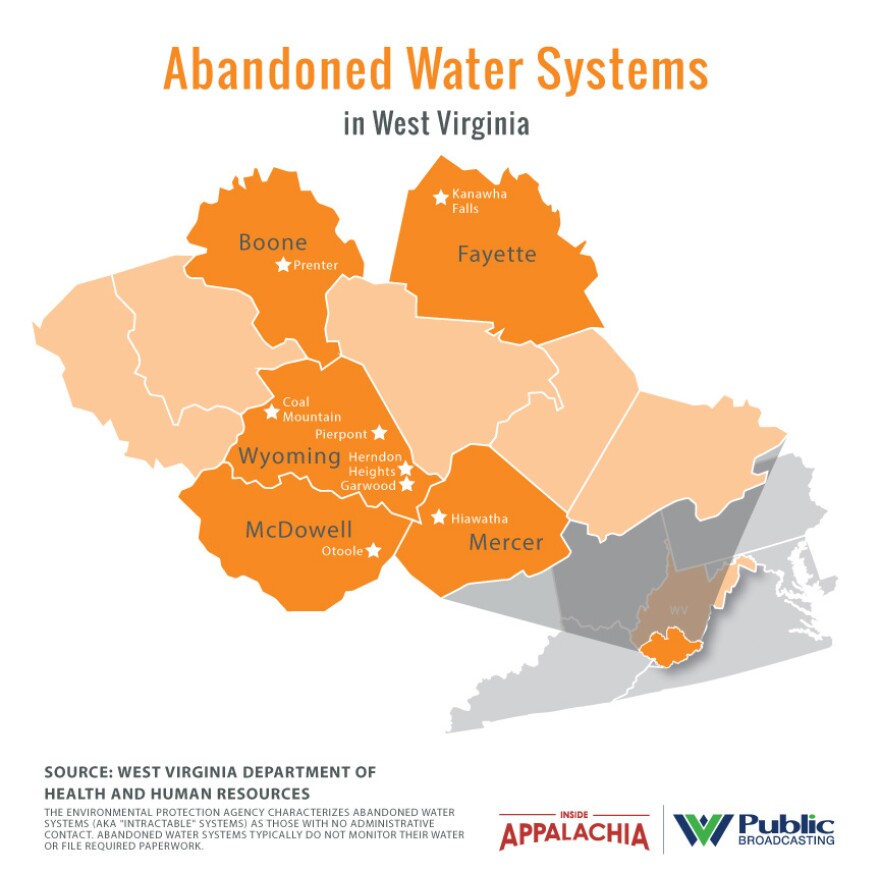
We talked with some of the remaining residents of once-bustling company towns to find out how they deal with water that often isn’t available and that they suspect is contaminated. One woman in Garwood, West Virginia, regularly delivers packs of donated bottled water to her neighbors because her water system is “intractable,” an Environmental Protection Agency label that means that no one is responsible for the upkeep of the system.
And a 17-year-old in Brenton, West Virginia, tries to cheer his community up through motivational vlogs – even though inconsistent and contaminated water makes it difficult for his mother to run her hair salon.
We also chat with Paul Ziemkiewicz, the director of the West Virginia Water Research Institute, who tells us about the risks of drinking untreated water, as well as the water operators who are on the ground trying to make the best out of a low-resource situation.
What’s In a Name?
Do you know which state and county the Coal River starts in, and where it ends up? Listen and find out!
Inside Appalachia is a production of West Virginia Public Broadcasting. This week’s episode was produced with the help of WMMT in Whitesburg Kentucky and the Ohio Valley ReSource. Special thanks to David Foster and the West Virginia Rural Water Association. Music in today’s show was provided by Lobo Loco, Montana Skies, and Doctor Turtle. Suzanne Higgins edited our show this week. Patrick Stephens is our audio mixer. Jesse Wright is our executive producer.
Editor’s Note: A previous version of this story included a map of intractable water systems with mislabeled states. It has since been taken down.
Add WVPB as a preferred source on Google to see more from our team
A plan to funnel millions of dollars in oil and gas royalties toward conservation efforts is getting support from an unexpected group. From The Allegheny Front, we learn about fracking proposals in southeastern Ohio – and what WVU researchers say could be the impact on wildlife.
Across the country, old railroads have been converted into multi-use trails for folks to get out and enjoy nature. Chris Schulz has more on an ambitious vision to connect communities in West Virginia to Pittsburgh via rail trail.
Prices at fuel pumps have surged since the United States went to war with Iran. But the Middle East conflict is also having major impacts on international shipping and supply chains. Those issues are taking a major toll on Appalachian corn farmers.
In an effort to attract more horse racing competitors this year to West Virginia, the state Legislature increased the funding cap to $2 million for certain races – and neighboring states are taking similar action. When Golden Tempo won the Kentucky Derby on Saturday, his owner, trainer and jockey won an estimated $3.1 million winning purse. For the Appalachia + Mid-South Newsroom, Justin Hicks reports much of that growth can be attributed to increased gambling on historical horse racing games.