Southern West Virginia has rich but often overlooked musical traditions. Chris Haddox is a WVU professor of sustainable design, but he's also spent years uncovering more information on those overlooked musicians. We spoke with him to learn more about his effort to shine a light on the musical talents of local miners, now with the help of a grant from the Mellon Foundation.
Students' art will help raise awareness around opioids via the attorney general's office.Courtesy of the Attorney General's office
Listen
Share this Article
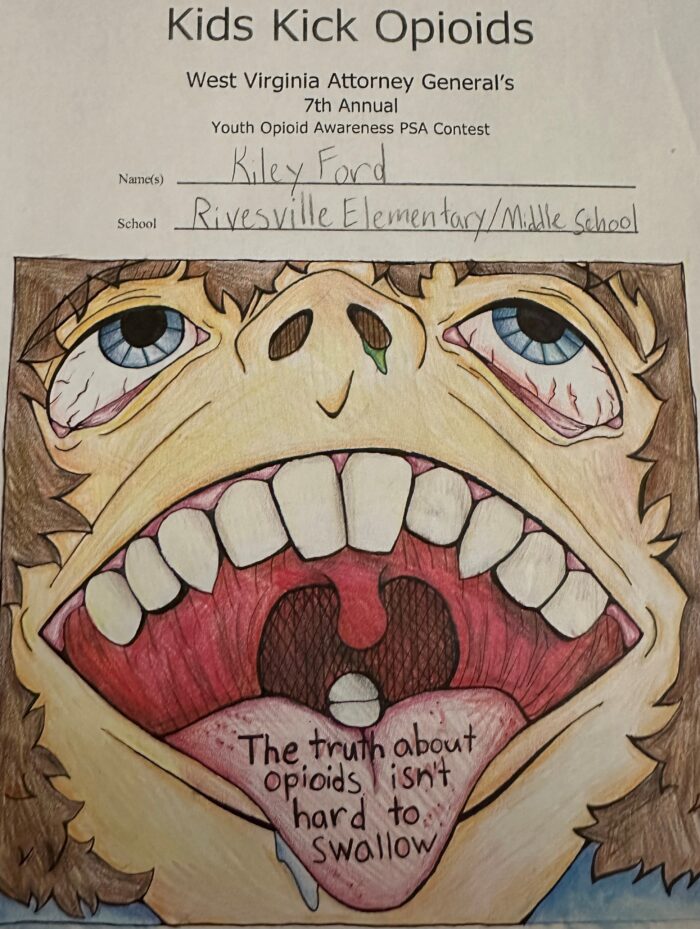
Attorney General Patrick Morrisey announced Kiley Ford from Rivesville Elementary & Middle School in Marion County as the winner of this year’s Kids Kick Opioids contest.
The contest received more than 2,000 entries from students at 66 middle and elementary schools across West Virginia. The submissions included a mix of drawings, poems and other designs aimed at promoting awareness.
Ford’s winning design features a drawing of an animal-like being with bloodshot eyes, its mouth open and tongue sticking out. A pill is visible inside the mouth, and the words “The truth about opioids isn’t hard to swallow” are written on the being’s tongue.
The design will soon appear in newspapers across West Virginia as the attorney general’s next public service announcement.
The West Virginia Board of Pharmacy, West Virginia Association of School Nurses and the Capitol Police helped judge the contest.
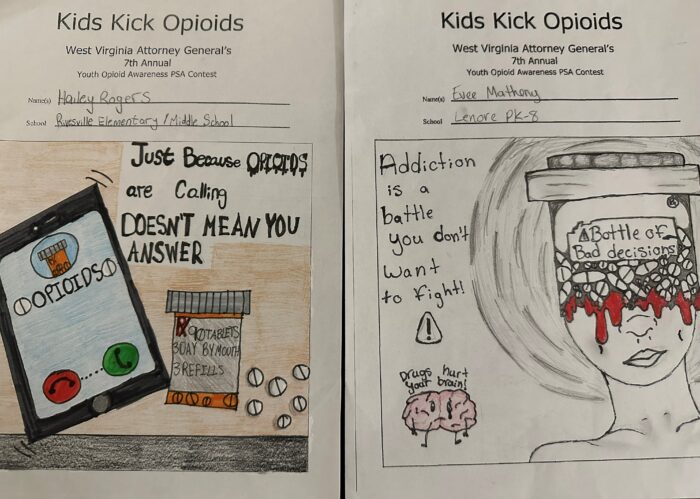
Judges also recognized Evee Matheny from Lenore PK-8 School in Mingo County and Hailey Rogers also from Rivesville Elementary & Middle School as the statewide runners-up. Their designs will appear with Ford’s on the attorney general’s website.
Judges recognized winning entries from 65 students overall. Those designs will be displayed in the State Capitol in the fall.
The winning submission to the Kids Kick Opioids competition.
Add WVPB as a preferred source on Google to see more from our team
Schuyler Mitchell, assistant news director at nonprofit newsroom Mother Jones, found that at least $1 million in opioid settlement funds have been used to purchase ALPR surveillance systems across the country.
As one of the hardest hit states in the country's opioid crisis, communities across West Virginia have started spending their portion of the roughly $1 billion in settlements from pharmaceutical companies and distributors. Schuyler Mitchell, assistant news director at nonprofit newsroom Mother Jones, reported last month on the use of the funds to purchase automated license plate readers, or ALPRs, from companies like Flock. She spoke to Chris Schulz about her findings.
Through settlements from various lawsuits with opioid manufacturers and distributors, West Virginia stands to gain about $1 billion over the next 10 to 15 years. Attorney General JB McCuskey is changing how any future settlements will be managed.