Alert (09/29/2026): Our Parkersburg TV transmitter is still undergoing maintenance and remains temporarily inoperative. We apologize for the inconvenience.
All our programming is available via our TV livestreams on our website and WVPB Passport. Thank you for your patience!
This week's premiere broadcast of Mountain Stage honors the lives of artists who we lost over the past few years. On this "In Memoriam" episode, you will hear archived performances by Jill Sobule, Todd Snider, Chip Taylor, Justin Townes Earle, and more.
There’s a town in Kanawha County, West Virginia where some locals say living there is a “blast.”
As part of our occasional series, “What’s in a Name,” we take a look at the history and folklore of the names of Appalachian places. The town in question, Nitro, West Virginia, grew out of the explosives industry and was home to a factory that helped supply the U.S. Army with gun powder during World War I. Ken Thompson volunteers at the World War I museum in the city of Nitro.
According to Thompson, Nitro was established in 1917 by the federal government to manufacture nitrocellulose, a highly flammable compound formed by bringing cellulose from trees or plants into contact with it to nitric acid. It is also known as “guncotton,” because of its explosive characteristics.
“It was to support the war effort for WWI,” he explained. “A lot of people were under the impression it was nitroglycerin. It was not. It was nitrocellulose. That was added to the other components to make the gunpowder smokeless.”
Credit Historical Photos Courtesy of the Nitro Convention and Visitors Bureau.
/
Historical Photos Courtesy of the Nitro Convention and Visitors Bureau.
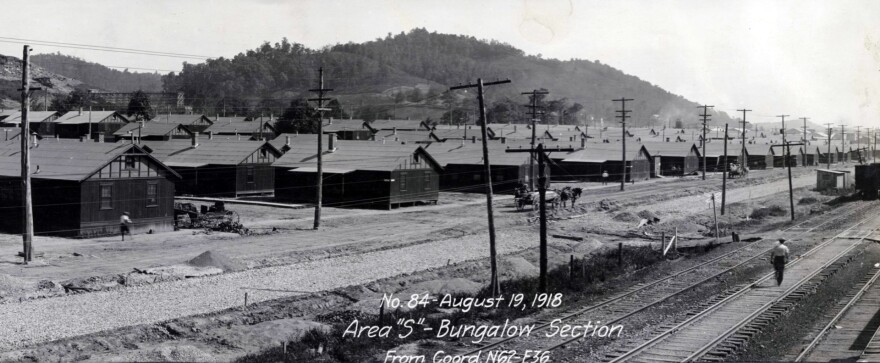
Area S Bungalow Section. August 19, 1918.
It took the federal government about 11 months to build the town from 1917 to 1918, and approximately 100,000 people representing 41 nations participated.
Nitro’s construction coincided with one of the coldest winters in recorded history, Thompson said.
One of the town’s builders would go on to become famous: Clark Gable.
“His dad told him ‘son go get a job,'” Thompson said. “Well, he was one of those 100,000 came through Nitro. He worked as an electrician helping to build some of the Nitro bungalows.”
You can learn more about the town and the former manufacturing facilities there — as well as see artifacts from WWI on display at the museum.
Add WVPB as a preferred source on Google to see more from our team
Generations ago, kudzu was introduced to Appalachia to help control erosion and provide forage for cattle. But then, it kind of just took over. Kudzu is an invasive plant that chokes out native greenery. Some people are fighting back. Folkways Reporter Eliza Benbow spent time with the kudzu warriors in western North Carolina.
Inside Appalachia Host Mason Adams met with author Barbara Kingsolver at her home outside Abingdon, Virginia, a couple weeks before her new novel "Partita" was set to publish.
On this West Virginia Week, a mine operation in Kanawha County gets a WARN Notice, three Wyoming County Schools will remain closed until next week, and we learn the origins of the Flatwoods Monster.