America continues to wrestle with racial division, but music has often been a space where those barriers are challenged. In this episode of Us & Them, host Trey Kay revisits a 1960s moment when a band refused to perform unless a mixed-race couple was allowed to dance — and paid the price for taking that stand. It’s a story about courage, consequences and the uneasy intersection of music and race in America.
Senators have approved a bill that was the subject of intense debate in the House earlier in the session—getting rid of the state’s Women’s Commission– and once again, the chamber’s female members took a stand supporting the measure.
House Bill 2646 was approved by members of the House in early March on a 58 to 41 vote. Its sponsors included more than half a dozen female Republican members of the chamber who argued the Women’s Commission duplicates the efforts of many other state agencies and its work training women to run for political office was unnecessary.
Those same arguments were repeated in the Senate Thursday, also from female Republican members, including Sen. Patricia Rucker.
“I believe the Women’s Commission is long past the time that it’s needed and I’m grateful to say that I got here without their help and actually until I got here I never even knew that the commission existed,” Rucker said. “I can say that in the Eastern Panhandle they’ve been pretty much nonexistent.”
Created in the 1970s, the commission is a small bi-partisan program housed in the Department of Health and Human Resources. Ending the program would save the state about $150,000 a year.
Credit Will Price / West Virginia Legislative Photography
/
West Virginia Legislative Photography
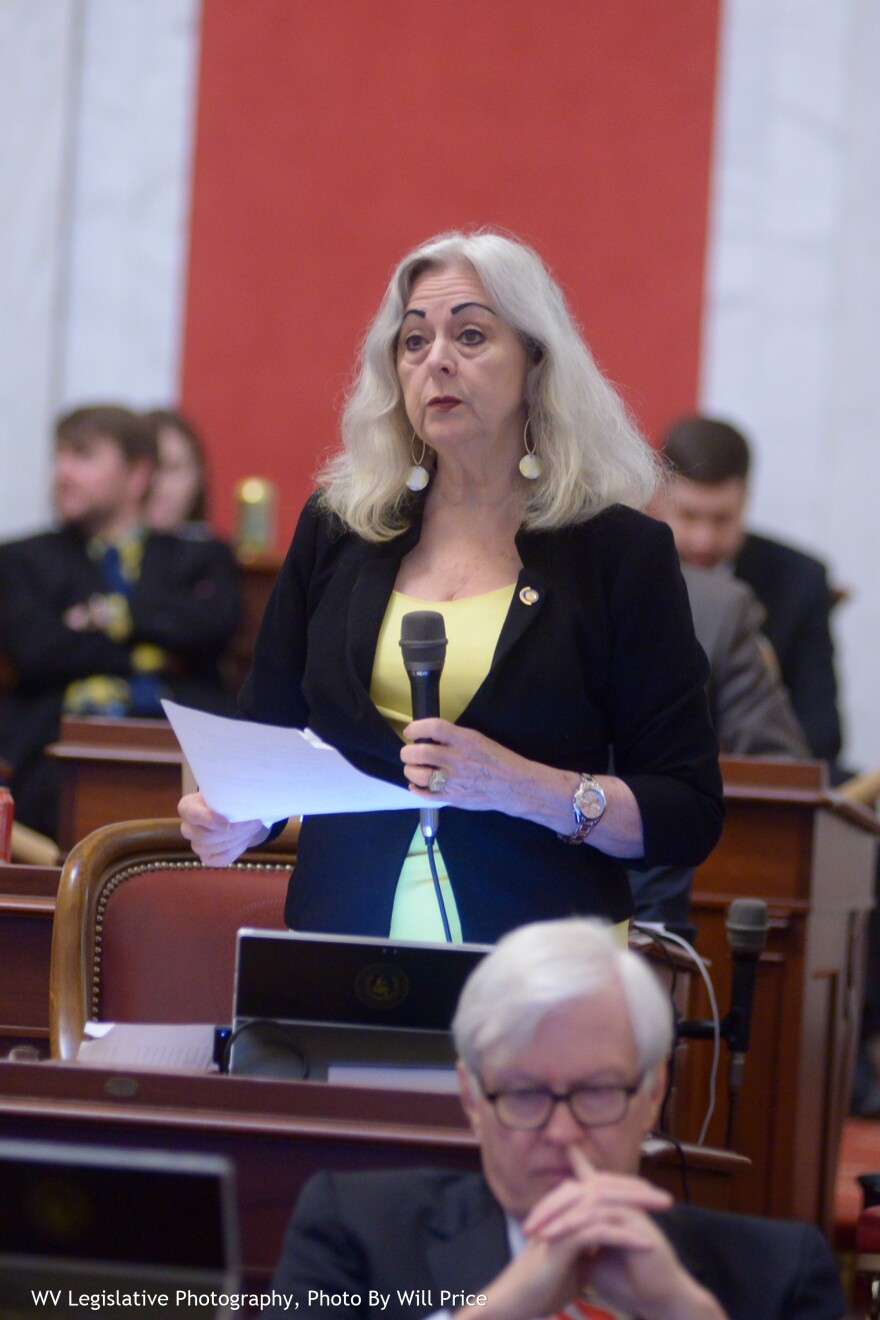
Sen. Sue Cline on the Senate floor Thursday.
“The women’s candidate trainings are performed by parties and private organizations that I fully support and hope to see continue, not only for women, but for any individual hoping to seek public office,” Sen. Sue Cline said.
“I’m not convinced that providing candidate training for anyone regardless of gender is something the state should be paying for.”
Of the 34 members of the West Virginia Senate, three are women, even though the gender makes up 51 percent of the state’s population. Still, Cline said their services in terms of political activity are not necessary.
“Men don’t need a commission to help them run for office or host candidate trainings so why do women need that,” Cline said.
No member of the Senate spoke against the bill, but in the House several Democratic members argued the disparity in female representation in public office is reason enough to continue to fund the program.
Senators approved the bill on a 24 to 10 vote.
The bill to end the Women’s Commission on June 30 of this year heads back to the House before it will go to the governor for a signature.
Add WVPB as a preferred source on Google to see more from our team
Sen. Eric Tarr, R-Putnam, expressed his support for the bills, but also urged his colleagues to look towards a complete overhaul of how the state funds schools.
House Bill 4412 would require certain websites to verify that an individual is 18 years of age or older to prevent minors from accessing harmful content.
The struggle against racial discrimination has hundreds of years of history in the United States. On the next episode of Us & Them, Trey Kay looks at the intersection of music and race in the 1960s. It’s about a band that took a stand against racism – and musicians who suffered the consequences.