America continues to wrestle with racial division, but music has often been a space where those barriers are challenged. In this episode of Us & Them, host Trey Kay revisits a 1960s moment when a band refused to perform unless a mixed-race couple was allowed to dance — and paid the price for taking that stand. It’s a story about courage, consequences and the uneasy intersection of music and race in America.
More Than 180 Years Later, 'Eelway' To Help American Eel Return Further Upstream
Listen
Share this Article
At the end of Vineyard Road in Falling Waters, West Virginia, there is an old, stone and brick structure on the Potomac River. This small, historic building is a hydroelectric power plant owned by Cube Hydro Partners based in Maryland. Beside the structure is ‘Dam #5.’
The dam, owned by the National Park Service, stretches the width of the river – from the West Virginia side to the Maryland side. It is 20 feet tall and was originally built in the 1830s.
While the dam provides electricity, it has also had an unintended consequence.
“Almost 85 percent of the American eel’s upstream habitat has been lost due to dams,” David Sutherland, coastal program biologist with the U.S. Fish & Wildlife Service, said. “So, there’s basically been a coastwide decline in American eel populations.”
Credit Liz McCormick / West Virginia Public Broadcasting
/
West Virginia Public Broadcasting
Dam #5 at Falling Waters, W.Va.
This decline in American eel is why Sutherland and other officials started an initiative 15 years ago called the American Eel Restoration Project. The project works to install things called “eelways” – like byways, but for eels.
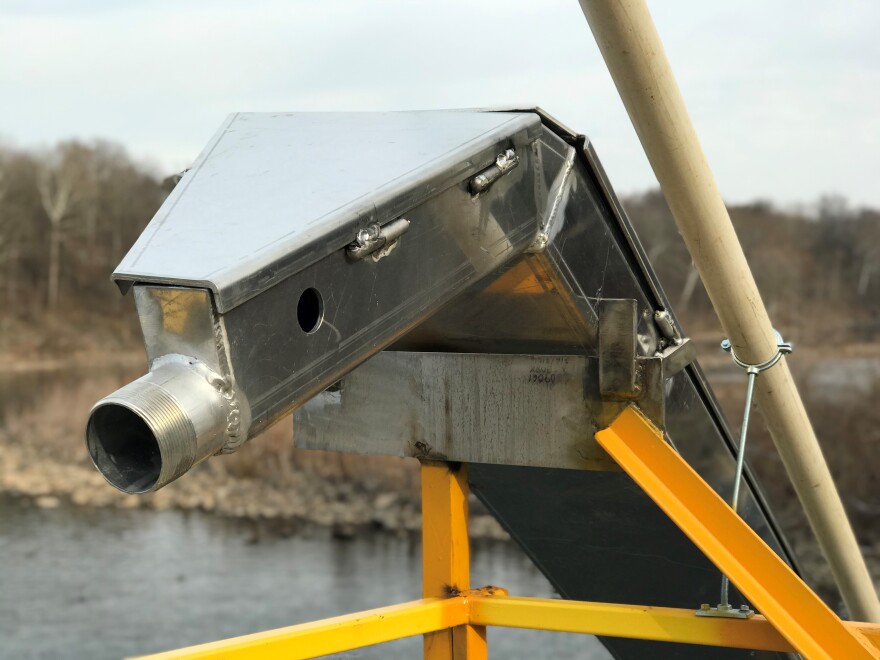
An eelway is almost operational at Dam #5. It is an aluminum ramp that is 65 feet long, and it has been secured to the side of the power plant. The ramp will have water running through it, and eels will be able to climb it. Once they reach the top, they will slide down a PVC pipe into a 250-gallon water tank.
“We’ll either be able to monitor them; they’ll be captured in a mesh bag, or if the mesh bag isn’t in there, they’ll be able to migrate right through the tank and upstream through a pipe and then back to the river,” Sutherland said.
The eels are unharmed when caught, and they are always released, Sutherland said.
Credit Liz McCormick / West Virginia Public Broadcasting
/
West Virginia Public Broadcasting
The eelway will empty into this 250-gallon water tank. A pipe will connect the eelway to the tank, and then another pipe will connect the tank to the river.
The American eel lives most of its life in freshwater, and then migrates back into saltwater to lay their eggs. By the time the eels reach Dam #5 in Falling Waters, they’ve journeyed for 4 to 7 years from the Sargasso Sea, which is located in the Atlantic Ocean.
In the Potomac River, they will grow and mature. Sutherland said the further upstream eel can travel, the safer they are.
“Historically, 25 to 50 percent of the biomass in these headwater streams, upstream of Dam #5 here, used to be American eels. They’re primarily female eels; they metamorphose by the time they get up this far. They’re maturing, becoming silver eels and they’re ready to be out migrating with upwards of 9 million eggs.”
But without access to these headwater streams, these eels have been more susceptible to predators like flathead catfish, walleye, or blue catfish.
That’s why an eelway is important for their survival, especially if a historic dam like Dam #5 is unlikely to be removed.
Credit Liz McCormick / West Virginia Public Broadcasting
/
West Virginia Public Broadcasting
The top of the 65-foot-long eelway at Dam #5.
The American eel does more for our water than we might realize. American eel help to transport larvae of the freshwater mussel, which help to clean water.
A single mussel can filter 10-15 gallons of water every day, according to the U.S. Fish & Wildlife Service. But baby mussels can’t travel far without hitching a ride on a fish’s gills, and the American eel offers an appealing one.
“American eels are critical for the ecosystem services they provide, especially with their relationship to freshwater mussels,” Tanner Haid, Eastern Panhandle Field Coordinator for the West Virginia Rivers Coalition, said.
Haid points out that West Virginia is a headwater state, meaning the water here flows out to many other people in states around us.
He said it’s for this reason that opening more travel ways for American eel and by extension, freshwater mussels, is vital to keeping our water clean.
“No matter where you are in our state, our water is connected to tens of millions of people. So, we have to acknowledge that role and do everything we can to protect that water at the source, and do these sort of habitat restoration projects to protect critical species,” Haid said.
Credit Liz McCormick / West Virginia Public Broadcasting
/
West Virginia Public Broadcasting
The eelway is secured to the side of Cube Hydro’s power plant.
Once complete,the eelway at Dam #5 is expected to have cost about $150,000. That covers designing, construction, and installation. Sutherland said it will be the first year-round eelway in West Virginia.
5,000 to 10,000 eels are expected to migrate through it a year.
Dam #5’s eelway will also effectively open about 8,000 more river miles to the American Eel, according to Sutherland.
The eelway is expected to be operational by early spring 2020.
**Editor’s Note: This story was edited on Dec. 6, 2019 to correct the amount of water filtered daily by freshwater mussels.
Add WVPB as a preferred source on Google to see more from our team
Three years after the Norfolk Southern train derailment in East Palestine, Ohio, some of those who joined a successful $600 million class action lawsuit have been paid. But some have not. Also, Gov. Patrick Morrisey pushes for his tax cut and the House of Delegates debates elections and employment bills.
After weeks of deep freeze, temperatures are expected to spike into the 50s and 60s across the region Tuesday and bring significant thawing and runoff.
Thursday’s decision came following a two-day hearing held in December at the DEP headquarters in Charleston where the citizen groups argued for the release of all redacted information in the site’s air quality permit application.
The "Do Not Drink" distinction means residents of the Town of Wayne can use their city water supply for all normal purposes except for cooking and drinking.