This week, data centers are rapidly expanding into rural parts of Appalachia, and folks say they are having trouble finding information about these projects. Also, artificial intelligence is disrupting human art, including fiber arts like crochet. And folks are pushing back, like they always have — with song.
Home » Stories » 'I Won't Move. I Love Greene County.' – Dave Hathaway's Struggle to Stay, Part One
Published
'I Won't Move. I Love Greene County.' – Dave Hathaway's Struggle to Stay, Part One
Listen
Share this Article
Dave Hathaway is a coal miner in Greene County, in the very southwestern corner of Pennsylvania. Apart from a brief stint living in Colorado as a child, he’s lived his whole life there, and he’s never really thought much about leaving.
So, when he was laid off in late 2015, he figured he had to find a way to stay there.
The question of what will happen with coal miners and the communities that depend on them has become pointed in recent years, as thousands of mining jobs have been lost in Appalachia and around the country.
The case of Dave Hathaway shows how difficult it can be for miners to find work that can approximate the kind of earning power and stability coal brought them, while fulfilling one important requirement: being able to stay in the place you call home.
Hathaway spent a year looking for work. He put in hundreds of online applications, and tried unsuccessfully to join a union.
He only had one iron-clad rule in his job hunt: he wouldn’t leave Greene County. His family and his wife Ashley’s family are in the area; his son Grant, 11, lives there, too.
Grant lives with his mother nearby, but he has a room at his dad’s house in Waynesburg. It’s crowded with toys, video game paraphernalia, and Grant’s collection of 2,000 football cards, including the boy’s most prized possession–a Marcus Mariota rookie card.
Living in Greene County means Hathaway can take Grant turkey hunting, play cards with Grant, and go to his son’s wrestling meets, where Hathaway, a former wrestler, could call out holds and maneuvers from the side of the mat.
Credit Reid Frazier
/
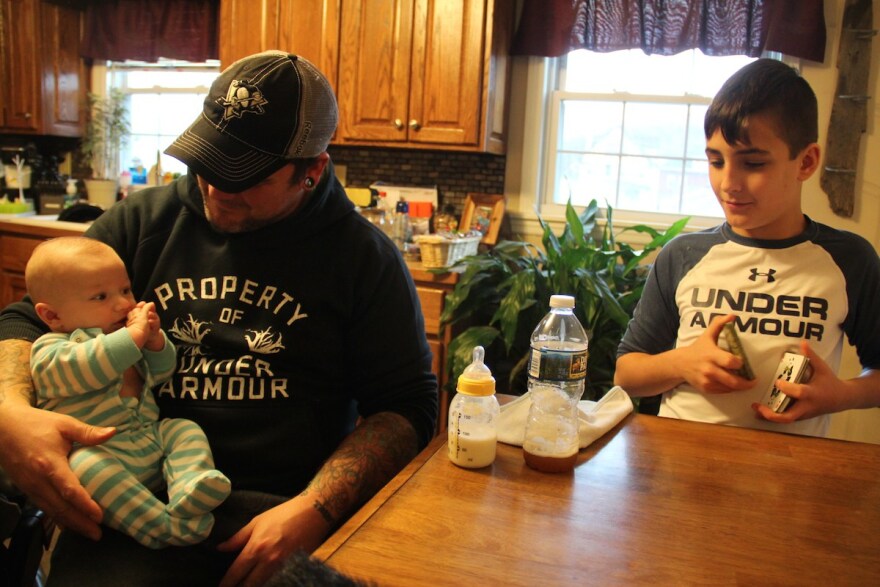
Dave Hathaway with his sons, Deacon and Grant. Hathaway had one iron-clad rule in his job hunt: he wouldn’t leave Greene County.
Steady Drain Out of Appalachia
Greene County has been the biggest coal-producing county east of the Mississippi for years. And Hathaway grew up in a coal mining family. His father, and his father’s father were coal miners.
“Pretty much everyone you knew was a coal miner. Everyone’s dad was a coal miner,” Hathaway says.
He eventually became a coal miner himself, taking a job at the Emerald Mine in Waynesburg, Pa. in 2007.
He at first was skeptical that he’d ever like it. But eventually, he thought of the job as the greatest in the world. He loved the camaraderie of working with his union “brothers”. The mine was a place to get paid well for doing hard work.
But then bad times came. Coal began to lose market share to natural gas. Coal production reached a 30-year low in 2015, and the number of U.S. coal miners fell from 90,000 in 2012 to 50,000 in 2016, according to the Bureau of Labor Statistics.
And at the end of 2015, Hathaway lost his job, too. The Emerald mine closed.
Over the years, many have left Appalachia in search of work. The population in Greene County, like much of the Appalachian coal region, peaked in 1950, at 45,000, and since then it has slowly declined. Greene County is now home to just 37,000 people, and every year, that number gets lower and lower.
Ashley Hathaway gave birth to their son, Deacon, in August, 2016. After a few months, she went back to work, at the coal company’s purchasing department (the couple met at the mine), and Dave watched Deacon at home. He called himself the ‘manny’, and joked that he was a pro at changing diapers and feeding Deacon with a baby bottle.
Next week on The Struggle to Stay, we’ll see how Dave copes with being unemployed, and what he does to stay in Greene County.
Music in the audio version of this story was provided by Marisa Anderson.
Add WVPB as a preferred source on Google to see more from our team
Inside Appalachia this week explores data centers and artificial intelligence (AI). As part of this special episode, host Mason Adams spoke with Dan Parks, a journalist who writes a Substack called Country Roads News. He's been covering data center development in Tucker County. We listen to an excerpt.
Marshall University and Huntington Tri-State Airport are set to become a premier hub for cutting-edge aerospace training and innovation thanks to a $3 million award from the Economic Development Administration (EDA).
Southern West Virginia has rich but often overlooked musical traditions. Chris Haddox is a WVU professor of sustainable design, but he's also spent years uncovering more information on those overlooked musicians. We spoke with him to learn more about his effort to shine a light on the musical talents of local miners, now with the help of a grant from the Mellon Foundation.
The online system allows businesses to apply for permits, pay fees, and track applications through a single account as part of the governor's Speed to Build initiative.