Mills Kelly is a lifelong hiker and Appalachian Trail scholar. He shares the trail’s history and more on "The Green Tunnel Podcast." He’s also written several books, including his most recent, called "A Hiker’s History of the Appalachian Trail." Inside Appalachia’s Bill Lynch spoke with Kelly to learn more.
Fallingwater One of "10 Homes That Changed America"
Listen
Share this Article
Southwestern Pennsylvania’s famous Frank Lloyd Wright home Fallingwater will be featured in a new PBS program called 10 Homes That Changed America. The crew out of Chicago started production there last week.
“Part of our goal here is to start a conversation about architecture. We’re not trying to be the final word,” said Dan Protess, the PBS program’s producer.
Protess put together a panel of advisors from academia to help decide which homes would be featured on the show. Fallingwater was a natural choice since Frank Lloyd Wright is one of America’s most famous architects.
Credit Glynis Board / WVPublic
/
WVPublic
“It is earthed into this rock on the hillside and perilously projecting out over a waterfall. Everything about the house refers to the site when you’re outside of it. And then when you go inside, you still feel like you’re outside,” said Baer
The show’s host, Geoffrey Baer, said when Wright built this house in 1937, he blew up certain ideas about Modern Architecture: “One of the tenants of Modernism was that you could take a glass box and put it anywhere—it was ‘universal’ architecture. And Frank Lloyd Wright utterly rejected this idea. This house could not be anywhere but here.”
Credit Glynis Board / WVPublic
/
WVPublic
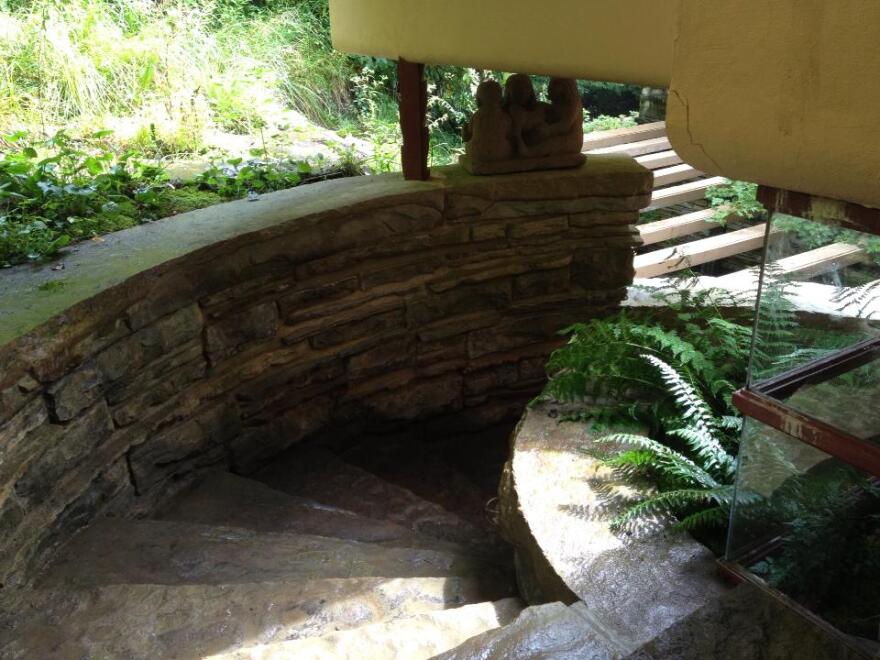
Stone floors are waxed so that they look like the wet stream bed beneath the house, the walls are made from rock quarried from the area, stairways bend and wrap around corners and some lead right into a spring or terminate hovering over the stream bed.
Baer said it’ll be a challenge to compress the story of the house into a 5-minute segment for their program. 10 Homes That Changed America is slated to be broadcast in 2016.
Credit Glynis Board / WVPublic
/
WVPublic
Wright called it “organic architecture.” He coined the phrase when he wrote these words in 1936: “So here I stand before you preaching organic architecture: declaring organic architecture to be the modern ideal and the teaching so much needed if we are to see the whole of life, and to now serve the whole of life, holding no traditions essential to the great TRADITION.”
A piece of art displayed on the grounds of Fallingwater that might represent all of us who wish we could be living there.
Final cost: $155,000 (Included $8,000 architect’s fees, and $4,500 for installed walnut furnishings) equivalent to about $2,656,744.60 today.
Square footage: The main house uses 5,330 square feet. (2885 sq. ft. interior; 2445 sq. ft. terraces) while the guest house uses 1,700 square. feet.
Paint Colors: Wright’s desire to create a unified and organic composition limited the color palette at Fallingwater. Only two colors were used throughout: a light ochre for the concrete and his signature Cherokee red for the steel. PPG Pittsburgh Paints has worked with Fallingwater to develop eco-friendly paints that withstand the environmental challenges of the site. They have also created a series of colors inspired by the building and its surroundings. For more information click here.
Visitation: 4.5 million people since opening our doors in 1964, with 160,950 in 2011.
Preservation: The Western Pennsylvania Conservancy has preserved Fallingwater since 1963, with a major structural repair in 2002 strengthening Fallingwater’s cantilevers to prevent collapse and future deflection.
Surroundings: Surrounded by the WPC’s 5,000 acre Bear Run Nature Reserve.
Credit Glynis Board / WVPublic
/
WVPublic
A lucky resident at Fallingwater.
Add WVPB as a preferred source on Google to see more from our team
Mills Kelly is a lifelong hiker and Appalachian Trail scholar. He shares the trail’s history and more on "The Green Tunnel Podcast." He’s also written several books, including his most recent, called "A Hiker’s History of the Appalachian Trail." Inside Appalachia’s Bill Lynch spoke with Kelly to learn more.
The Greenbank Observatory is offering a limited chance to go behind the scenes to check out its Search for Extra Terrestrial Intelligence (SETI). SETI tours are offered to small groups – ages 12 and up – several times a month through October. We caught up with the Observatory’s news manager to find out more about the tours – and what exactly scientists there are looking for.
On this West Virginia Week, the air around the site of a chemical leak near Institute is determined safe, the state reaches a settlement with Roblox, and Charleston photographer Perry Bennett represents Team USA in Iceland.
This week, in author Willie Carver, Jr.’s new book, he reconsiders a negative childhood experience with a neighborhood girl who might have just been looking for a friend. Also, a southwestern Virginia community rang the alarm after more and more of its children were diagnosed with cancer. A local journalist is trying to unravel the cause. And, the city of Asheville has a new crusading reporter. He’s a puppet.