Alert (09/10/2026): Our Parkersburg TV transmitter is undergoing maintenance for a few days and will not be operational. We apologize for any inconvenience.
All our programming is available via our TV livestreams on our website and WVPB Passport. Thank you for your patience!
This week, one thing about Appalachians: we can get competitive. We’re proud of our local food. Love a good hunt. And enjoy competition with friends. We learn the rules and celebrate our victories. You'll hear these stories and more this week, Inside Appalachia.
In an open seminar at the Berkeley Medical Center in Martinsburg, Ebola preparedness was the focus of discussion. It’s been in the headlines across the country for a while now, but should West Virginians really feel at risk of contracting the disease? Doctors in the state say West Virginians have little to fear.
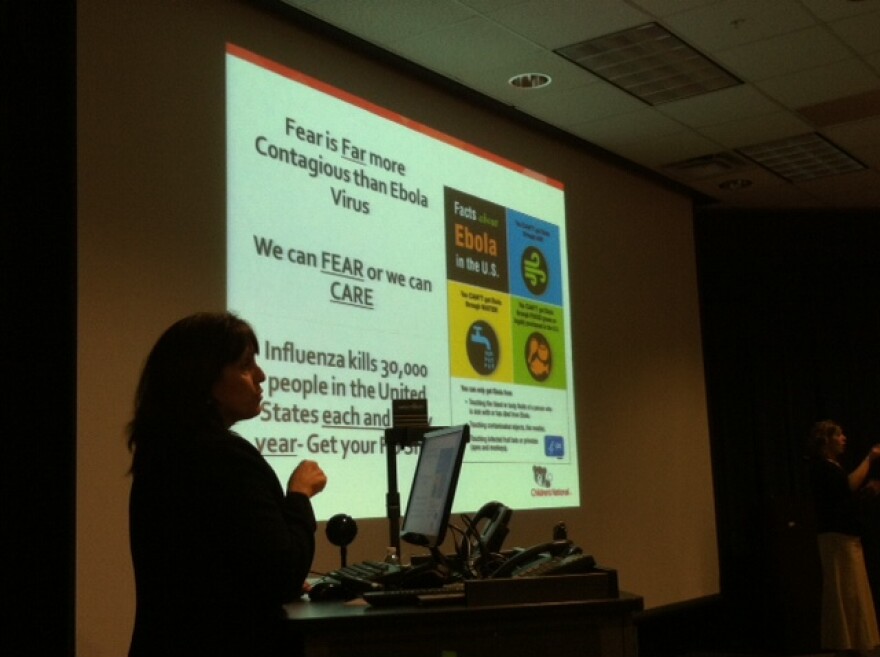
To help the public understand what’s really going on with Ebola, a public seminar hosted by the University Healthcare Berkeley and Jefferson Medical Centers was held at the West Virginia University Robert C. Byrd Health Sciences Center in Martinsburg.
The first half of the seminar explained Ebola and the second, how prepared area hospitals are to handle it. Wayne Selzer is one of the 100 community members who attended the seminar.
“Level of preparedness can never be high enough, and the best level of preparedness is self-preparedness,” said Selzer, “So more seminars like this, along with public involvement as well will help calm who have fears against those with no training whatsoever.”
Dr. Matthew Simmons, the infectious disease specialist at Berkeley Medical Center, was one of the speakers. He says he felt like the seminar helped calm any fears the community might have, but they don’t need to feel like they have to be prepared.
Credit Liz McCormick / West Virginia Public Broadcasting
/
West Virginia Public Broadcasting
Dr. Roberta DeBiasi, chief of the Division of Pediatric Infectious Diseases at Children’s National Medical Center.
“There’s very little that a person in the community has to do to protect themselves from Ebola at this point, because the risk of transmission is so low,” noted Simmons.
Dr. Roberta DeBiasi, the chief of the Division of Pediatric Infectious Diseases at Children’s National Medical Center says you only have to worry about the virus if you’re showing symptoms.
“It really is very, very important as to where you have been, because it’s really not a widespread epidemic. It’s not at all spreading in the United States,” said DeBiasi, “So unless you had those symptoms, and you were in contact, like you were a nurse or a doctor and took care of a patient who had Ebola, then we would not worry that you had Ebola virus.”
DeBiasi tried to help put it into perspective that more people die from influenza in the US than Ebola.
“I think it’s just human nature, if it’s unusual we’re a little more nervous about it, even if it’s not really a thing you should be worried about,” said DeBiasi.
The final message the doctors gave the audience was simply…to stay calm.
Add WVPB as a preferred source on Google to see more from our team
On this West Virginia Week, weekend storms may help clear the smokey air, Huntington City Council approves Flock cameras and how Fentanyl may have made its way into the country.
On this West Virginia Week, the state is under a flood watch through Sunday, the fire in Parkersburg is under investigation and a class action against the state’s foster care system will move forward.
...
Paramedics in rural counties of West Virginia can help patients access healthcare and stay connected to providers -- an effort to prevent acute illness and improve health outcomes.