


'Haunted' Town Already Celebrating Spooky Season
Halloween is still several weeks away, but one West Virginia town is already celebrating the season.
Continue Reading Take Me to More NewsAlert (09/29/2026): Our Parkersburg TV transmitter is still undergoing maintenance and remains temporarily inoperative. We apologize for the inconvenience.
All our programming is available via our TV livestreams on our website and WVPB Passport. Thank you for your patience!




To Educate, Inform, and Inspire by Telling West Virginia's Story

Mountain Readers Week will be held Oct. 5-9, 2026! Celebrate and foster a love of reading in children across West Virginia.
Nominate an exceptional West Virginia K-12 teacher today!

On Demand

On Demand

Stream original productions from WVPB
Watch locally produced documentaries & more.

On Demand
On Demand




West Virginia Morning

Inside Appalachia
West Virginia Week
Mountain Stage
Us & Them
The Legislature Today
The Legislature This Week

Send us your comments and questions.

Stream our board meetings.

Check out the latest WVPB news.

Sign up for our newsletter and get weekly updates.

Meet the WVPB staff.

WV Educational Broadcasting Commission, the WVPB Foundation, and the Friends of WVPB.

Come work with us!

Read our annual report and learn how we educate, inform and inspire with your support.

Sponsor impactful and engaging media and entertainment.

Use your IRA to make a gift to WVPB.

Become a member with your gift of $1,000 or more.

Make WVPB part of your legacy.

Manage your membership account.

Learn how you can Protect and Sustain West Virginia Public Broadcasting.
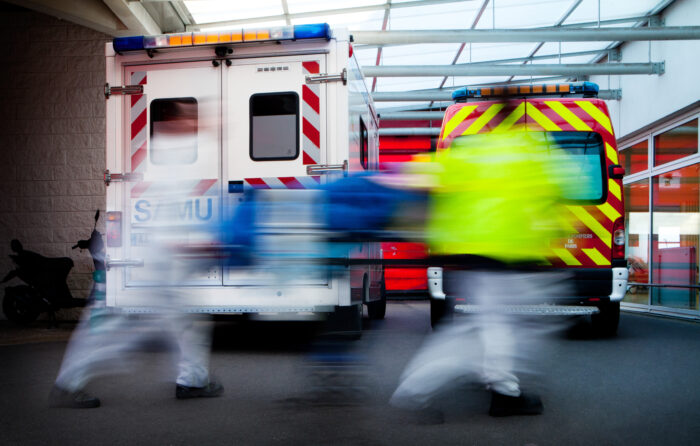
A $1 million initiative through the Rural Health Transformation Program aims to help rural EMS agencies expand access to healthcare in rural and underserved areas of West Virginia.
It focuses on connecting patients with care earlier – before chronic illnesses become acute, reducing unnecessary hospital stays and improving healthcare outcomes.
Secretary of Health Dr. Arvin Singh talked with Maria Young to explain how the program is designed to work – and who it will focus on first.
The following has been lightly edited for clarity and length.
Young: This morning I wanted to talk with you a little bit about the plan for paramedics in rural communities.
Singh: Yeah, so the fund that I think you’re mentioning, it’s called the EMS Community Paramedicine Fund. It’s a little over a million dollars. The purpose of this is to help the EMS providers expand their role beyond emergency transportation and to become more of an integrated part of the healthcare system, and examples I could give are like on-scene assessment and treatment, chronic disease support, hospital discharge follow-up, and then connecting people to their primary care and different community resources.
The initial implementation focuses on Region One, which involves McDowell, Mercer, Monroe, Wyoming, Summers, and Raleigh. And the goal there is to create a regional model that eventually could be expanded across West Virginia over time.
Community paramedicine, which is what we’re talking about, helps bring health care services closer to patients, particularly in places where access is limited, like some of the counties we talked about. It does not replace hospitals, physicians, or clinics, but it just creates another layer of support that helps people receive care earlier and stay connected to the system.
Young: Part of the whole rural transformation fund approach, it seems to me, to be taking a really hard look at preventative measures -- treating obesity before it becomes true obesity, diabetics taking better care and making better choices on the front end before things become critical. It sounds like the paramedic role can play a part in that as well. Is that a fair thing to say?
Singh: I think you hit the nail on the head right there. Because this program is really, really about upstream prevention. It’s a major part of it. We know many of the healthcare challenges you know well, diabetes, heart disease, you don’t have to be an expert, obesity, hypertension, those don’t develop overnight, they develop over years. And if we only engage people once they’re in a crisis, we’re playing catch up, and that’s part of the problem.
Community paramedicine gives us another way to reach people earlier. A paramedic may identify someone struggling to manage their diabetes, taking medications incorrectly, maybe even missing appointments, facing barriers, as we’ve talked about, like transportation, and they can help connect that individual, as I mentioned, to those resources that could include nutrition support and other upstream preventative ideas before emergencies happen.
And again, it’s not about paramedics replacing physicians, it’s about creating more touch points. So, yeah, I think you’re hitting the nail on the head about the preventative pillar within rural health transformation.
Young: I’m sure that you understand that for a lot of the communities, there is a great deal of trust in their local community hospital, and the idea of a plan B is a little scary. What would you say to those folks?
Singh: It’s a good question, and I completely understand that concern. Community hospitals are often among the most trusted institutions in rural communities. I’ve had the blessing to visit Roane [and] Boone Memorial, where they are that pillar. And this program is not about replacing hospitals, and it’s not a signal that we’re walking away from hospitals. I want to be very clear on that.
In fact, paramedicine works best when it’s connected to local hospitals, the goal is to strengthen those relationships and help patients stay connected to care. What we’re trying to address in the reality that many patients face barriers between visits, whether that’s transportation, medication issues, chronic disease management, or honestly, simply trying to figure out where to go for help, the most.
Add WVPB as a preferred source on Google to see more from our team

The $26.5 million grant from the U.S. Department of Agriculture will help construct the West Virginia State University Agriculture Complex that will house laboratory space for the university, as well as the state Department of Agriculture.
Continue Reading Take Me to More NewsThe Public Service Commission of West Virginia wants to ensure that if discontinuation of the current landline system is approved, an adequate service will be continue to be available to both new and existing customers.
Continue Reading Take Me to More NewsFayette, Harrison and Kanawha counties have been approved for individual assistance from the Federal Emergency Management Agency (FEMA).
Continue Reading Take Me to More NewsWest Virginia has seen the largest population decline in the nation - nearly 1.5% - and many of those leaving are young people. In an episode that aired last month, Us & Them host Trey Kay heard from some young people who think they may stay in the state to launch their futures. This month, Kay talks with those who say living their dreams may well require moving away from the Mountain State. We listen to an excerpt from the latest Us & Them.
Continue Reading Take Me to More News