This week, a new roleplaying game gives folks in the workplace a chance to be a mythical Appalachian monster. Also, southeast Ohio’s Nelsonville Music Festival celebrates its 20th anniversary in June. We talk with the founder about what keeps people coming back. And, members of a Ukrainian Catholic church in Wheeling, West Virginia, make pierogies for their community every week. What makes them so good?
Home » Stories » Cicadas Are Coming and Researchers at Marshall Want Your Help Tracking Them
Published
Cicadas Are Coming and Researchers at Marshall Want Your Help Tracking Them
Listen
Share this Article
Scientists are telling us that this is the year of the Cicadas. The noisy insects emerge in West Virginia every so often, this bunch haven’t been to the state in 17 years and some Marshall professors want your help tracking them.
Two Marshall University Science professors are giddy about the idea of cicadas coming to the state this summer. They’re looking for help in tracking the next wave called Brood V cicadas.
The Cicadas Arrival.
Jayme Waldron is an assistant professor in biological science. She said the bugs should start emerging from the ground anytime now in West Virginia, Ohio, Maryland and Pennsylvania.
“They’re going to come out, the males are going to be making a sound, calling or singing to attract mates and over a period of 6 weeks the adults are going to reproduce,” Waldron said. “The females are going to deposit their eggs into twigs and branches in the trees.”
Credit Clark Davis / West Virginia Public Broadcasting
/
West Virginia Public Broadcasting
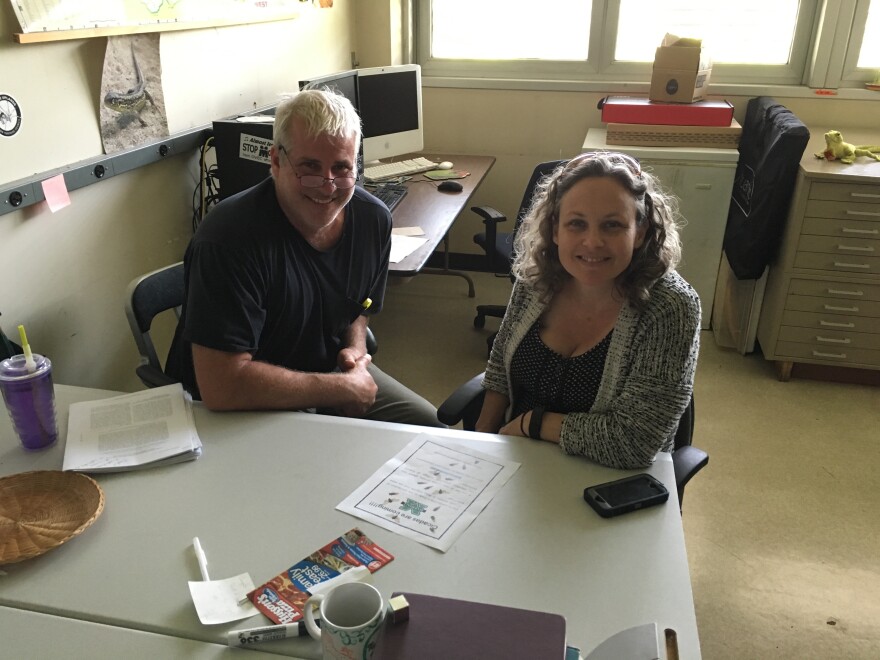
Marshall Professors Shane Welch and Jayme Waldron.
Waldron said the adults will die which you’ll see on the ground in late June.
“And then as soon as the eggs hatch in the tree they’ll fall down to the ground and burrow underground for the next 17 years, which is really neat and when they’re in that stage they’re going to be feeding on fluid from the trees through the roots,” Waldron said.
Waldron, is studying the Cicadas with a graduate student and Shane Welch, another assistant professor at Marshall.
The Cicadas Role.
Waldron and Welch both say that the bugs aren’t bad for most of the environment, except small trees possibly.
“If you think about it from an ecological perspective it’s really a nutrient pulse, so there coming up out of the ground and in some areas we’re going to have maybe a million per acre,” Welch said. “So we’re talking maybe a hundred bodies per square meter.”
This means wildlife will feed off the bugs when they fall to the ground. And insects are tasty morsels for animals like young turkeys.
The cicadas will be prevalent throughout much of the state.
Tracking the Cicadas.
Both Welch and Waldron began tracking Cicadas with a project at Clemson University in South Carolina before coming to Marshall. They’re hoping to implement the same method in West Virginia. It’s called citizen scientists, and that’s where you come in.
So there coming up out of the ground and in some areas we're going to have maybe a million per acre. – Shane Welch, Assistant Professor of Biological Sciences
They want people to visit science.marshall.edu. There, you will find a link to the cicada project. Citizen Scientists will be asked what state they’re in, county, whether you heard them or saw them, whether there were a lot, few or just one and then the public can leave a comment and/or upload pictures of the bugs.
Researchers were satisfied with the project in South Carolina. They were able to track the cicadas to 250 different locations in the state thanks to data from the public. Because these are 17-year cicadas this presents one of the few opportunities available to study them. You see, different types of cicadas come at different times. The group that was studied in South Carolina was 13-year cicadas.
The professors say they’ve already received a few updates on the web site of sightings in the state.
Add WVPB as a preferred source on Google to see more from our team
The WVPB News Department was honored with Overall Excellence in the Radio Small Market category. Us & Them, which is hosted by Trey Kay, was honored with Excellence in Diversity, Equity, and Inclusion for the episode Us & Them: Black West Virginians With Substance Use Disorder Face Unique Challenges. Regional winners automatically move on to the national round for consideration.
Monsters in the workplace? Maybe. Carnegie Mellon University in Pittsburgh is developing a team building game using Appalachian cryptids like Bigfoot and the Flatwoods Monster. Inside Appalachia’s Mason Adams spoke with Jessica Hammer, associate professor and director of the university’s Center for Transformational Play, to learn more.