Alert (09/29/2026): Our Parkersburg TV transmitter is still undergoing maintenance and remains temporarily inoperative. We apologize for the inconvenience.
All our programming is available via our TV livestreams on our website and WVPB Passport. Thank you for your patience!
This week, ballads tell stories about all kinds of real-life events, but after Hurricane Helene, one group of ballad singers felt some topics were still too raw. Also, the author of a book on ancient Ohio credits a former grad student with introducing him to the region’s mysterious earthworks. And, the legacy of Affrilachian poet Norman Jordan includes a summer camp for teens to study their heritage.
"Philip likes the fact that music doesn't just exist on paper now and that these early pieces can be realized in different ways." ~Michael Riesman
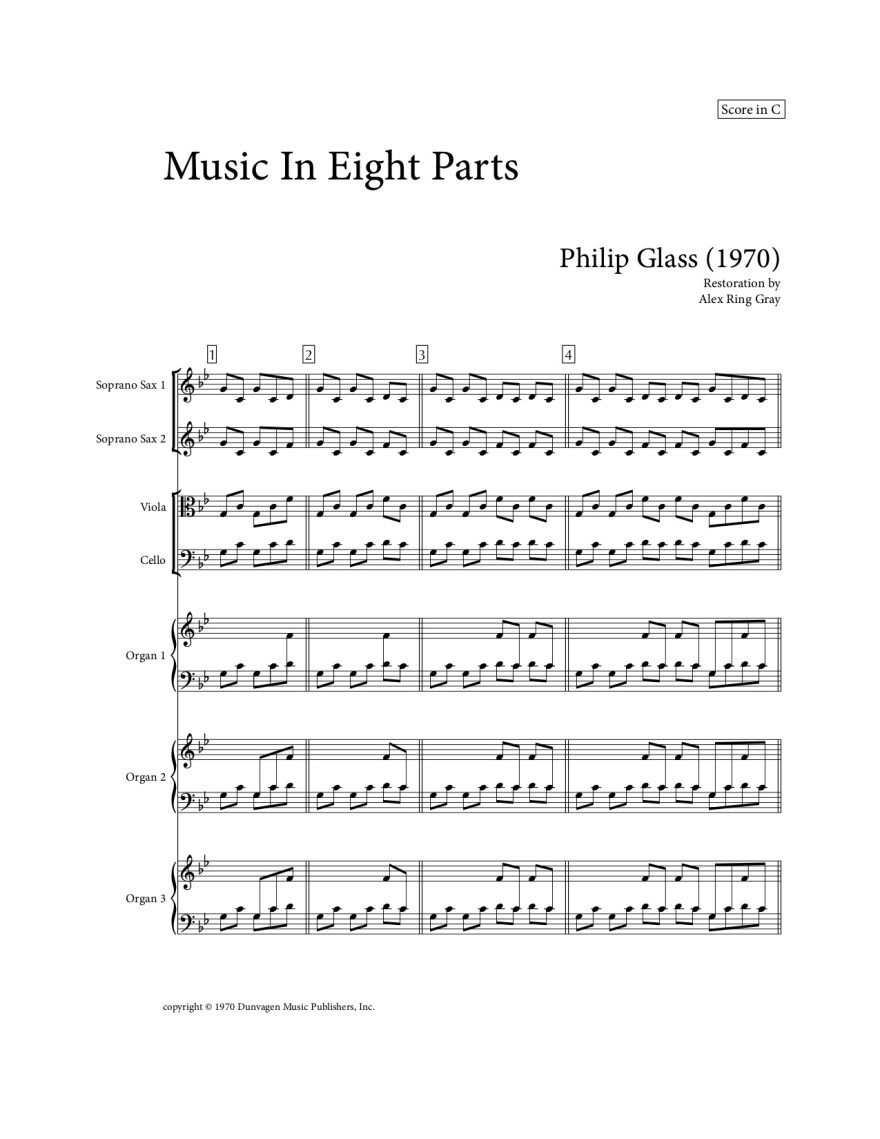
Philip Glass’ Music For Eight Parts journey from missing or lost, to the current recording, feels like an elaborate plot by a master novelist.
Michael Riesman, Musical Director for the Philip Glass Ensemble, tells the story.
Philip Glass always knew that teaching and the groves of academia were not for him. After his studies with Nadia Boulanger and Ravi Shankar in Paris, he returned to New York in March of 1967, so focused on composing that he realized that he needed his own ensemble to learn and perform his rigourous compositions.
Glass also knew that, in order to sustain his making a living through composing, that he had to work to support the ensemble. Cab driver, plumber and mover, Glass wore many hats and paid his dues – and then some.
Credit Courtesy of Dunvagen Music Publishers.
/
Music In Eight Parts, referring to the number of musical lines, was written in 1969, dated January of 1970 on the score and performed, according to then intern Alex Gray “twice at the Guggenheim and twice at the Walker Art Center in Minneapolis.” Ultimately, Glass had to sell the autograph score to make ends meet and did not remember to whom it was sold.
Fast forward to 2017 when the score resurfaced and went on auction at Christie’s. It sold for $43,750 and now is with Dunvagen Music, Glass’s publisher.
The Philip Glass Ensemble has changed over the years and this piece needed some updating if it was to be added to the current repertoire. Step in Michael Riesman, director of the PGE.
Ecletopia host Jim Lange interviewed Michael Riesman on June 2, 2020, about the tale of Glass’s lost piece and other topics.
Listen to a more in depth version of the interview:
02_mreisman_music_in_8_parts_longer.mp3
Riesman tells the tale of the lost piece with all its twists and turns.
Here are some additional excerpts from the interview.
03_mriesman_trans_to_12_parts.mp3
Riesman speaks on how this piece was a transitional piece in the Glass oeuvre.
04_mriesman_vilified_and_loved_farfisa_organs.mp3
Riesman's thoughts on being both vilified and loved, and the Farfisa organs of the PGE.
05_mriesman_keeping_place_in_score.mp3
Riesman is honest about losing your place while performing and getting back on track.
Credit Courtesy of Dunvagen Publishers.
/
Glass’ handwritten shorthand part for Music For Eight Parts.
This week, ballads tell stories about all kinds of real-life events, but after Hurricane Helene, one group of ballad singers felt some topics were still too raw. Also, the author of a book on ancient Ohio credits a former grad student with introducing him to the region’s mysterious earthworks. And, the legacy of Affrilachian poet Norman Jordan includes a summer camp for teens to study their heritage.
When Hurricane Helene tore through western North Carolina in 2024, it took lives and upended communities. A community of ballad singers lost a place where they could share their tradition, but what was lost could be restored.