


Aluminum Plates For Deep Space Win W.Va. 'Coolest' Contest
Aluminum plates that helped keep astronauts on the Artemis II rocket safe won the first ever Coolest Thing Made In West Virginia competition.
Continue Reading Take Me to More NewsAlert (09/29/2026): Our Parkersburg TV transmitter is still undergoing maintenance and remains temporarily inoperative. We apologize for the inconvenience.
All our programming is available via our TV livestreams on our website and WVPB Passport. Thank you for your patience!




To Educate, Inform, and Inspire by Telling West Virginia's Story

Mountain Readers Week will be held Oct. 5-9, 2026! Celebrate and foster a love of reading in children across West Virginia.

Nominate an exceptional West Virginia K-12 teacher today!

On Demand

On Demand

Stream original productions from WVPB

Watch locally produced documentaries & more.

On Demand

On Demand






West Virginia Morning

Inside Appalachia

West Virginia Week

Mountain Stage

Us & Them

The Legislature Today

The Legislature This Week

Send us your comments and questions.

Stream our board meetings.

Check out the latest WVPB news.

Sign up for our newsletter and get weekly updates.

Meet the WVPB staff.

WV Educational Broadcasting Commission, the WVPB Foundation, and the Friends of WVPB.

Come work with us!

Read our annual report and learn how we educate, inform and inspire with your support.

Sponsor impactful and engaging media and entertainment.

Use your IRA to make a gift to WVPB.

Become a member with your gift of $1,000 or more.

Make WVPB part of your legacy.

Manage your membership account.

Learn how you can Protect and Sustain West Virginia Public Broadcasting.
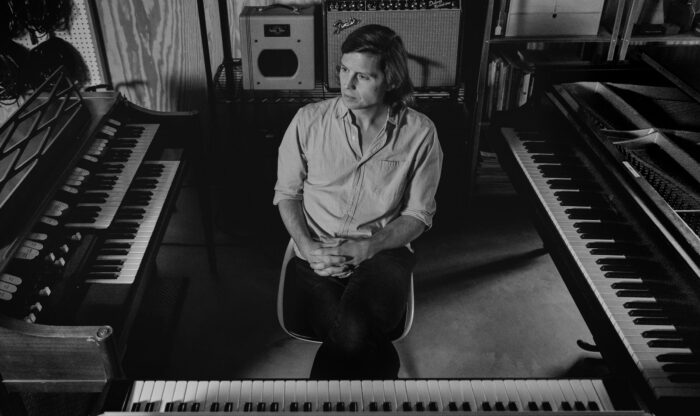
“More than anything, this record was about making many little decisions.”
Erik Hall has done something remarkable, even Herculean in scope. By himself, he has home-recorded Steve Reich’s Music For 18 Musicians. The score calls for more than 18 players, in some cases doubling on other instruments. The sheer scope of this task is beyond daunting; let alone the skill required to play this unrelenting music with rhythmic precision. Hall downplays the difficulties and challenges; describing the experience as very enjoyable and even spiritually immersive.
Who is Erik Hall?
To answer that, first we must answer who is Steve Reich and what is Music For 18 Musicians?
Steve Reich, born 1936 in New York, is an internationally recognized composer of Minimalism. Fellow “minimalists” include Philip Glass, La Monte Young and John Adams, among others. Minimalism, in the Reichian sense, is generally the use of repetitive short melodic figures, an often slow harmonic rhythm, echo-like canons and continuous percussive ostinati.
However, Reich differs from his colleagues in the rhythmic vitality of his works. After all, he was a drummer in a jazz band and often his music seems to swing. Or at least grooves.
Music For 18 Musicians, composed in 1976, is a true turning point in Reich’s compositions and 40-odd years later, it remains one of the masterworks of the style. ECM released a recording in 1978; a touchstone still influencing generations of musicians and composers. Slipping outside the concert hall and into rock music, luminaries such as David Bowie, Brian Eno, Peter Gabriel and Robert Fripp have all cited Reich as an influence. (This author included.)
However, for the majority of listeners, this piece, and others like it, sounds like the “record is stuck.” I completely understand this response. It repeats and doesn’t seem to change at all.
But, it does.
Perhaps those listeners cannot discern the subtle changes occurring within the music. Take the opening, “Pulses,” for example. Marimbas and pianos “pulse” in continuous motion as 12 individual chords unfold. These chords are not played by a lush string section, but rather bass clarinets, violin, cello and four women’s voices articulate them in rapid-fire staccato succession. Like an approaching storm or a swarm of bees, it is truly an unearthly sound.
Right from the start, we’re hearing something different. The traditional expectations of symphonic or chamber music are absent. Where’s the first theme? Is this the introduction? The listener is not, to quote a phrase, “in Kansas anymore.” The audience, not on familiar ground, may find this unsettling.
Indubitably so, because Steve Reich has done what all great, seismic-shifting composers do: change the definition of music and how to listen to it.
Personal note: I distinctly remember my first listening to Music For 18 Musicians. It was like floating on a warm, undulating ocean wave or drifting down a wild winding river in a pilot-less boat. For me, and I’m sure for many others, it was simply a transformative experience.
Erik Hall, from his website, “is a musician, composer and record producer in southwest Michigan.” In 2020, Hall recorded all the parts for Music For 18 Musicians in his home studio.
When I read that Erik Hall recorded this masterwork alone in his home recording studio, I couldn’t believe it. All this was done by overdubbing in real time, section by section, without loops or quantization: meaning no help from digital software which can generate perfect loops or correct wonky rhythms. Then to realize he covered all the parts himself, even the voices, I was floored.
If the 1978 ECM recording is analogous to a freighter, then Hall’s version is a sailboat. Or from an imposing monolith to a intricately carved sculpture: lighter in weight, transparent, energetic, warm and grooves like dance music. He has taken this seminal minimalist work, given it a new personality with a joyful new interpretation. The groove, the feel and the spiritual experience remains intact.
I spoke to Erik Hall on April 9, 2024.
More Reich performances:
Falling Angels: https://www.numeridanse.tv/en/dance-videotheque/falling-angels
Biophony Solstice 2024: https://biophony.metropolisensemble.org/projects/biophony-solstice-2024
Add WVPB as a preferred source on Google to see more from our team

Aluminum plates that helped keep astronauts on the Artemis II rocket safe won the first ever Coolest Thing Made In West Virginia competition.
Continue Reading Take Me to More NewsFor LGBTQ youth in Appalachia, estrangement from their families of origin can be a common and heartbreaking experience. So, some LGBTQ people rely on “chosen family." In Roanoke, Virginia, the culture of ballroom offers the safety and stability of family, along with traditions that are handed down — traditions like vogueing. Mason Adams reported this Folkways story, in collaboration with Brad Kutner and Kelley Libby.
Continue Reading Take Me to More NewsMountain Stage is changing locations for its final two live events of 2026. The Sunday, Nov. 15 show will now take place at the Charleston Theater at the Convention Center, and the Sunday, Dec. 6 show will be held at the Capitol Theater in Downtown Charleston.
Continue Reading Take Me to More NewsDuring spooky season, popular attention turns toward ghosts and goblins – or if you live in Appalachia – cryptids. For the Appalachia + Mid-South Newsroom, Bill Lynch, producer of Inside Appalachia, brings us the story of the Flatwoods Monster.
Continue Reading Take Me to More News