This week, a Japanese Shinto garden took root in southwestern Virginia because of family connections spanning geography and generations. Also, in Whitesburg, Kentucky, a new mosaic uses recovered objects to honor the town’s people after the flood of 2022. And, the young adult novel Verity Vox and the Curse of Foxfire mixes historical fact with spooky Appalachian folklore.
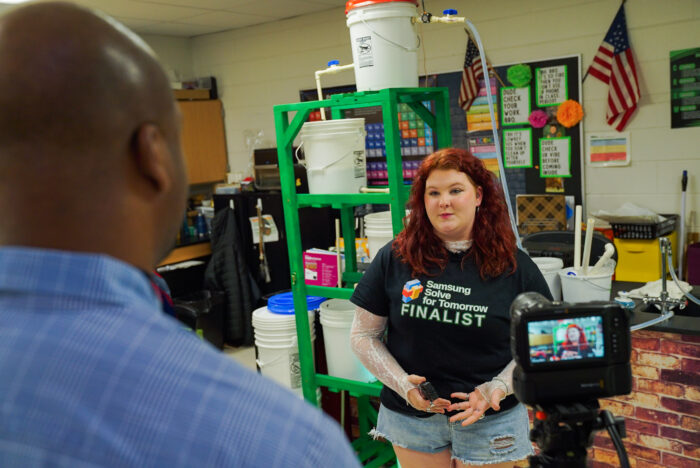
Student Kelsee Lester stands in front of the award-winning water filtration system created by the students of Huff Consolidated Elementary and Middle School in Wyoming County.Courtesy of the West Virginia Department of Education
Listen
Share this Article
A team of middle school students who set out to solve water problems in their local community have won a national Science, Technology, Engineering and Mechanics (STEM) award
Huff Consolidated Elementary/Middle School in Wyoming County was named one of the winners of Samsung’s 16th annual Solve for Tomorrow STEM competition.
The Huff Consolidated team is designing an affordable water purification system with an estimated cost of around $300 powered by a high-tech network which turns everyday items into smart devices that can monitor water quality.
“This means families and communities can afford to treat their own water while we work on larger infrastructure solutions,” Brittany Miller-Baker, Huff Consolidated science and social studies teacher and team coach, said.
“When we were selected, we didn’t really know what to do, and we had tested some bottled water. We thought about it, and then we decided we were going to try to design some kind of system,” Kaden Thomas, an 8th-grade student at Huff Consolidated, said. “People are suffering daily. I think that it opens our eyes to our future and what we can do as part of the community, and what we can influence the community to do.”
In a video pitch submitted as part of their application, students explain that while southern West Virginia has faced environmental challenges for decades, they are the generation finding solutions.
“We’re using science and technology to prove that we don’t have to choose between economic survival and environmental health,” one student said in the video.
The team was named winner of the Community Choice Vote and earned the school $110,000 in classroom technology and resources.
“Seeing students rise to the challenge of addressing a real issue in their community through classroom learning is inspiring. These students are passionate about STEM and dedicated to making a difference, both of which are paving the way for actionable change,” state superintendent Michele Blatt said. “I’m grateful that Ms. Miller-Baker is bringing this to life in her classroom by inspiring a future generation of leaders, scientists, chemists and geologists, and I am proud of how well these students represented the Mountain State. Congratulations to everyone involved on a job well done. ”
Editor’s Note: A previous version of this story incorrectly identified the subject of the accompanying image as teacher Brittany Miller-Baker. The girl photographed is Kelsee Lester, a student at Huff Consolidated and a member of the award-winning team.
Add WVPB as a preferred source on Google to see more from our team
It’s thunderstorm season, but not all of them are the same. For the Appalachia + Mid-South Newsroom, Bill Burton and meteorologist Tawana Andrew break down what we know – and what we don't – about the climate and weather in the region. This week, they examine different types of thunderstorms.
A federal judge declined Friday the state’s request to dismiss a lawsuit brought by West Virginia’s largest overdose prevention group, Solutions Oriented Addiction Response of West Virginia (SOAR.)