

Headline Acts Announced For America250 Celebration At Capitol
Three concerts and a fireworks display are planned for the Fourth of July weekend on the state Capitol grounds.
Continue Reading Take Me to More News


The winning stories from the 2026 WVPB PBS KIDS Writers Contest are now available to read!
Nominate an exceptional West Virginia teacher today!

On Demand
On Demand

Watch locally produced documentaries & more.

On Demand

On Demand

West Virginia Morning
Inside Appalachia
West Virginia Week
Mountain Stage
Us & Them
The Legislature Today
The Legislature This Week

Send us your comments and questions.

Stream our board meetings.

Check out the latest WVPB news.

Sign up for our newsletter and get weekly updates.

Meet the WVPB staff.

WV Educational Broadcasting Commission, the WVPB Foundation, and the Friends of WVPB.

Come work with us!

Read our annual report and learn how we educate, inform and inspire with your support.

Sponsor impactful and engaging media and entertainment.

Use your IRA to make a gift to WVPB.

Become a member with your gift of $1,000 or more.

Make WVPB part of your legacy.

Manage your membership account.

Learn how you can Protect and Sustain West Virginia Public Broadcasting.
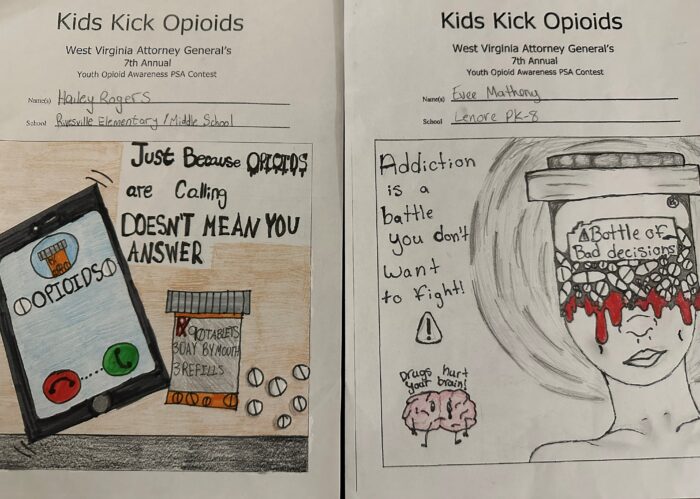
Attorney General Patrick Morrisey announced Kiley Ford from Rivesville Elementary & Middle School in Marion County as the winner of this year’s Kids Kick Opioids contest.
The contest received more than 2,000 entries from students at 66 middle and elementary schools across West Virginia. The submissions included a mix of drawings, poems and other designs aimed at promoting awareness.
Ford’s winning design features a drawing of an animal-like being with bloodshot eyes, its mouth open and tongue sticking out. A pill is visible inside the mouth, and the words “The truth about opioids isn’t hard to swallow” are written on the being’s tongue.
The design will soon appear in newspapers across West Virginia as the attorney general’s next public service announcement.
The West Virginia Board of Pharmacy, West Virginia Association of School Nurses and the Capitol Police helped judge the contest.
Judges also recognized Evee Matheny from Lenore PK-8 School in Mingo County and Hailey Rogers also from Rivesville Elementary & Middle School as the statewide runners-up. Their designs will appear with Ford’s on the attorney general’s website.
Judges recognized winning entries from 65 students overall. Those designs will be displayed in the State Capitol in the fall.
Add WVPB as a preferred source on Google to see more from our team

The West Virginia First Foundation (WVFF) is launching a needs assessment study to determine the best places and ways to spend opioid settlement money.
Continue Reading Take Me to More NewsThe suit – filed with the help of the ACLU of West Virginia – argues the moratorium violates Title II of the Americans with Disabilities Act and Section 504 of the Rehabilitation Act.
Continue Reading Take Me to More NewsThe suit is the latest in years of legal action to try and recoup damages for the effects of the opioid crisis from the companies seen as primarily responsible.
Continue Reading Take Me to More NewsThe suit alleges the company conspired with opioid manufacturers to deceptively market opioids and manipulate public perception regarding their safety and addictive potential.
Continue Reading Take Me to More News