Artificial intelligence, or AI, is a hot topic right now. It seems everyone is using it – even if they sometimes don’t realize they are.
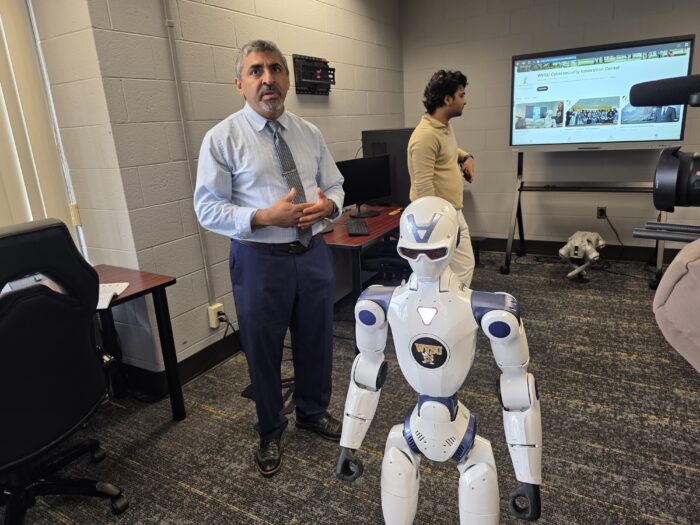
Recently, news director Eric Douglas saw a presentation as part of the Higher Education Policy Commission’s STAR lecture series with Professor Ali Al-Sinayyid, an assistant professor and director of the West Virginia State University Cybersecurity Innovation Center. He invited Al-Sinayyid into the studio to discuss AI further.
Next week, we’ll have more of this interview discussing how to best use AI to get your desired results.
This interview has been lightly edited for clarity.
Douglas: Let’s take it to brass tacks for a second. What is artificial intelligence?
Al-Sinayyid: Artificial intelligence is something that we had before, but we didn’t feel it. Today it’s under the spotlight right now because everybody’s using it, plus there is a huge marketing behind it.
So artificial intelligence is something that we’ve done in image recognition for CCT cameras, for even in your computer sometimes you have an image recognition so you can log in. Recommendation systems, something that we have in Walmart, in all the super stores, that’s even in Netflix.
If you want to watch a movie, then they’re going to predict what the next movie (will be) and they recommend it to you.
Douglas: Because you watched this.
Al-Sinayyid: Because you watched this, then you’re going to have this. And in the market, everyone bought a milk, he bought a bag of cookies with it. So that they now they move the cookies from their original aisle close to the milk so you can buy it.
Before the AI, it was something called automation, which is basically we’re going to automate the work for the machine. We’re going to describe it to the machine; we’re going to tell it how to do it, the steps exactly, logically, and we’re going to tell it when to do it. Now, the AI here, what has really become more familiar to the normal people, to the normal users, that is generative AI.
Now we start having ChatGPT and the people felt that they are talking to a human and not any human. He’s a polite. His goal to satisfy you and he is gonna try to give you an answer no matter what. Now put underline on “no matter what” because even sometimes he is gonna give you some wrong facts, some wrong information. And the reason why because he is complying to your order.
Now again, it is a machine. In a human interaction if you say, “Hey, would you please bring me water?” And you didn’t specify the temperature of water, I can get you hot water if you want cold water and so on. The same thing in ChatGPT.
In human interactions, there is a follow-up question. “How would you like it?” In ChatGPT, since he wants to satisfy you, he will not have a follow-up question. He will just bring you water.
Now, I believe artificial intelligence is a double-edged sword. You can use it to benefit your life. You can use it to ruin your life if you believe it or if you did not instruct it well. Just like the old-time automation, if you don’t give correct, logical, clear instructions in how to do it, they might make a mistake. They might do it wrong. Especially the AI right now with the machine learning, they have the prediction capabilities.
Douglas: In the public discourse at the moment, there’s a lot of “AI is going to take over the world. AI could kill us within the decade.” That was a former AI engineer who said that. Is AI going to kill us?
Al-Sinayyid: This is a question that because I’m dealing with AI and robotics and cybersecurity, you cannot imagine how many people ask me this question every time in the street, in school, even in the house. Even my wife actually, she asked me, so is AI good or bad?
Number one, I cannot answer that because it’s futuristic. And there is no evidence so far, no facts, no documented events happen that can justify or can verify or can support the idea that AI is going to kill us. That’s very simple. Again, I am a logical person. I don’t want to just talk about theories because theory is something that we cannot prove. We just expect but we cannot prove.
So for me, at this very moment, there is no evidence to state that AI is going to kill us. When the computer started, do you remember the fuss around it? “Oh, the computer is going to take our jobs, the computer going to rule the world, the computer going to take over the world. We are going to sit down in the house and we do nothing and the computer is going to do our laundry.”
This was like 20, 25 years ago? But today, you cannot walk without a computer in your pocket, which is, I refer to the cell phone. It is a small computer, correct? You cannot do your work without a computer.
One of the things that I always do in recruiting activities to computer science and cybersecurity, when I have a group of students, high schoolers, I ask them, I say, listen, I have 5 bucks in my bucket. I dare you, I challenge you, if you find one job today, they don’t use a computer. And guess what? I still have five bucks in my pocket.
Douglas: I’m sure.
Al-Sinayyid: If you ask my opinion, should we ask this question or should we do something else? I say we should do something else. And by something else, I mean we should learn from it. Is it going to harm us or is it going to do us good or it might not do anything, correct? These are options.
I believe the best way for all these scenarios is to learn how to use it. Keep this idea as negative one in our mind, let’s just know what AI is. Let’s just start knowing how to use it, how we can get full advantage of it, how we can get the benefits of it. That’s I believe the most important thing right now to ask.
Douglas: Is there anything we haven’t discussed?
Al-Sinayyid: Please use it in learning. It’s a beautiful tool for learning. And by that I mean, if you want to learn something about a topic that you didn’t know before, this is the best platform for you. And the reason why, because it will work as a place that gathers the information for you and have something like a conversation learning and it can follow up with you and it can handle if you want more examples.
A prompt that you can use and I hope the audience use it, “Teach me as if I’m seven years old.” It’s just beautiful. And the reason why, because he will assume no knowledge from you whatsoever. And he’s going to start from really beginning. And then afterward, you can actually control the conversation and the learning process by saying, “Yeah, I know this, skip it.” Or “Give me more examples here.” And in that case, you will learn a new skill, you will increase your knowledge through using the AI.
Douglas: You made that point in the lecture the other day about good uses and bad uses, learning, finding out new things versus letting it make decisions for you.
Al-Sinayyid: You will not do that to the screwdriver, correct? It’s a tool. So, it’s not something that is smarter than us, something that is better and can make better decisions than us, that’s wrong. It’s a beautiful tool, right? However, it’s not the final tool. Why? Because it’s going to open the door for you, it gives you the resources and the references, then you can move on to your journey. But at least it’s a good start. It’s a very good start, especially if you want to have this knowledge, not really deep. If you want to know the surface, just scratch the surface of it, that’s totally great. It’s beautiful.
Now, of course, legal, health, medicine. No, It’s a big no-no. You can use it to say, “I have these symptoms. What is the possibilities and what kind of doctor I should contact?” He can just lead you to the way to get real help. Legal; “Okay, so I have this kind of case. I don’t know what to do. What kind of attorney, what kind of steps I should do?” But not like, “Would you please go to the court and do the trial?” No way, no way.
Of course, research. Is it plagiarism? I believe it is plagiarism if you use AI and then you claim that it’s yours, I believe it is plagiarism. And the student, that’s another dilemma. Right now, the students always look for convenience. They always try to just finish their homework really fast. But they forgot the purpose, unfortunately. I mean, I used to be a student and I know exactly how I felt. So I just want to finish the homework. And it’s a bonus if I get full marks.
Douglas: Well, I mean, we’re old enough to remember the Cliff’s Notes. I don’t have time to read this entire book. Give me the summary and a couple key points that I can create a research paper on.
Al-Sinayyid: And because of that, they missed the whole purpose of learning. They don’t learn. Right now, they just follow a procedure: write this, put this down, write this, so they are going to be very good in copy and paste, but not in the topic itself.