Alert (09/29/2026): Our Parkersburg TV transmitter is still undergoing maintenance and remains temporarily inoperative. We apologize for the inconvenience.
All our programming is available via our TV livestreams on our website and WVPB Passport. Thank you for your patience!
This week, author Silas House returns with a sweeping new novel. Also, some folks say, you have to fake it 'til you make it, even if you're trying to establish a state park. And, the story of the first Mothman sightings as written by a small town journalist in 1966.
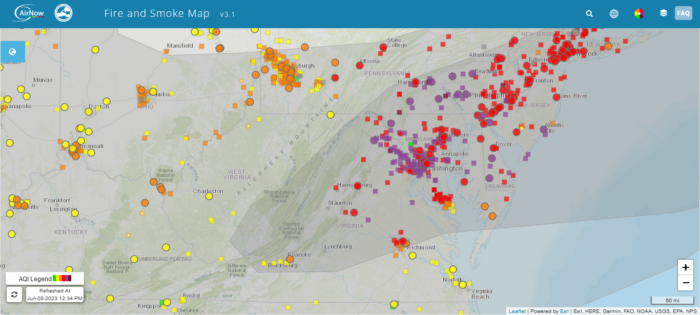
The smoke arrived in West Virginia over the past few days, as metropolitan areas like New York City and Washington D.C. experienced orange skies due to air pollution.AirNow Fire and Smoke Map digitally altered to show West Virginia's border.
Listen
Share this Article
Officials are encouraging vigilance as smoke from intense Canadian wildfires makes its way south on changing wind patterns.
The smoke arrived in West Virginia over the past few days, as metropolitan areas like New York City and Washington D.C. experienced orange skies due to air pollution.
Wildfire smoke contains fine particulate matter, known as PM2.5, which are microscopic solid or liquid droplets that can be inhaled and cause serious health problems, according to the U.S. Environmental Protection Agency (EPA).
PM2.5 is considered unhealthy for “Code Orange” and sensitive groups once the Air Quality Index surpasses 100, according to AirNow, a website that publishes air quality data. The chart measures from green to maroon with green being good and maroon being hazardous for all.
Director of Environmental Health with the American Lung Association (ALA), Kevin Stewart called this “an extensive event.”
“There are more than 150 wildfires, most of which are out of control in Quebec, that are leading to this event,” Stewart said. “And we do know that there are air pollution plumes that are coming out of Canada, affecting states, the whole way from the Ohio Valley to New England to the Carolinas. So this is not a small event.”
The above image is a screenshot of the Fire and Smoke Map taken at 12:35 p.m., June 8, 2023. Click here to view the map in real time.
“I’ve seen a succession of events where New England and New York City were affected first, then Pennsylvania, New Jersey, then Maryland and D.C. and I think West Virginia is bringing up the rear here in terms of this part of the country, especially probably more than the north, the Morgantown area,” Steward said.
According to the Air Now Fire and Smoke Map, West Virginia’s panhandles are experiencing the majority of particle pollution in the state, especially in the Eastern Panhandle, where Shepherdstown has been issued a code red warning for “unhealthy” air quality.
Stewart said air pollution levels can change just 50 miles away, or a couple of zip codes away. She said it is important to pay attention to local air quality by checking resources like Airnow.gov to check the air quality in your particular zip code.
“We want people to pay attention to the air quality,” Stewart said. “We also want people to pay attention to members of their families, their loved ones who are in sensitive groups. That includes children, senior citizens, people who have chronic lung disease or heart disease. If anyone’s experiencing, you know, any minor symptoms, it’s important to be in touch with a physician to make sure that you’re getting the proper care and treatment.”
The Canadian smoke is a complex mixture of “piny fine particles” that can get into the deepest parts of the lungs and cross into the bloodstream.
“But we also are aware that there are chemicals in the smoke that are air toxins, it’s just not good to be breathing them. It’s not that they’re necessarily going to cause an immediate health effect,” Stewart said. “But it’s also true that any type of air pollution that includes air toxins from burning things isn’t a good idea to be breathing, it adds to your lifetime cancer risk and other problems like that.”
Dr. Albert Rizzo, the chief medical officer for the American Lung Association, said his association and the EPA are tracking two particles of particular respiratory health concern: the particle matter itself and ozone.
“The particle matter is the one that really goes up when we have wildfires, such as we are having in Canada, and those wildfires send these small particles about maybe a 30th of the size of a hair throughout the air hundreds of miles away, so it can affect large populations of individuals,” Rizzo said. “It tells us that the particle matter now is at a level where not only will people who have underlying lung conditions like asthma or COPD may notice that they’re having a harder time outside coughing, feeling some chest tightness or wheezing.”
Much like air quality on a day-to-day basis, winds and temperatures also change, sending particles with them. Dr. Rizzo said according to multiple reports the smoke could be around for a few weeks.
“It depends on the winds, the temperatures, things of that nature,” Dr. Rizzo said. “You have a lot of mountains in West Virginia, so that can make a difference as well. I think the important thing it tells us is, you got to be on guard, you got to be aware of what’s changing on a daily basis, especially if you’re one of those patients who are at risk because of your lung condition.”
Dr. Rizzo said the best course of action for those with underlying conditions is to limit exposure to the outdoors until the air quality improves. They can do that by limiting outdoor activities and keeping air conditioners on to recirculate air so that particles do not enter the home.
“Individuals who have this should try to make sure they have enough of their medication on hand, especially what we call rescue inhalers if they can get to a mask and are able to use them during times when they’re outdoors,” Rizzo said.
According to Stewart, West Virginia sits on the edge of the main pollution plume, but varying wind patterns could change that. To check the air particle pollution in your area, visit Fire.airnow.gov.
“So far, thank God, West Virginia isn’t in that area, but at the same time, it doesn’t mean you’re not affected by it, you know. There’s still some increase in air pollution as a consequence of it,” Stewart said. “And it might not be this week, but as long as those wildfires continue, in Quebec, you know, all it will take is another different weather system, and you might be at the brunt of it, depending on which way the wind flows.”
For more information, visit lung.org/wildfires or call 1-800-586-4872 or 1-800-LUNG USA.
Add WVPB as a preferred source on Google to see more from our team
West Virginia Attorney General JB McCuskey has launched a broad investigation into many of the state's leading environmental groups, demanding a decade of internal records involving their fundraising and climate change advocacy as part of a probe into “alleged unfair or deceptive acts."
As people take a greater number of medications across years or decades, experts say the risk for adverse drug interactions increases. One way to advocate for yourself? Keep a list of your meds handy. We listen to the latest story from health series, HealthQ, a collaboration between Nashville Public Radio and KFF Health News, with reporters Cara Anthony and Blake Farmer.