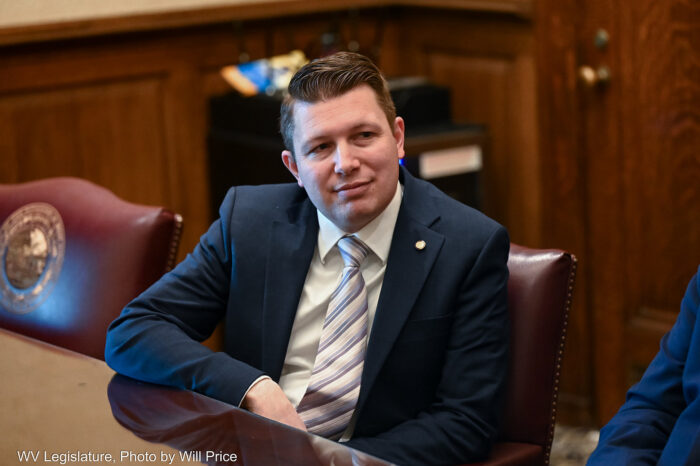
Del. Tristan Leavitt, R-Kanawha, was in Canaan Valley Sunday night for the legislative interim meetings. He watched the WVU baseball game, celebrated Flag Day and called it a day.
At the same time, a group of domestic terrorists that planned to attack the UFC fights at the White House in Washington, D.C. added his name to an assassination list. Leavitt was the only state-level West Virginia politician on the list. The state’s congressional delegation members were all named.
Leavitt found out about it on his way back to Charleston when a New York Post reporter called him. He said he was surprised, but not surprised, at the same time. He pulled over in Flatwoods to read the criminal complaint.
“I mean, there is an element of, alarm, I suppose, at seeing and thinking, ‘OK, wow.’ People taking these levels of action is a sad, sad commentary, and you know, there is a level of scariness about it, for sure,” he said.
Leavitt said he blames things like this on the heated rhetoric in the country as a whole. He thinks the answer is to come face to face and discuss disagreements, rather than being angry and siloed.
He sat down with News Director Eric Douglas Wednesday to talk about his reactions.
This interview has been lightly edited for clarity.
Douglas: Were you at the UFC fight?
Leavitt: I had no connection to the UFC fight at all. I think these plotters had just, for whatever reason, identified specific public officials they had issues with, and there’s not a clear connection between that and the UFC fight at all.
Douglas: Ultimately, these plotters who were planning violence against the UFC fights at the White House identified you as somebody that they were going to assassinate.
Leavitt: Yeah, it came up in the context of Israel, so you know the criminal complaint that includes me is one of five criminal complaints that was released to five individuals that they arrested. The other four just referenced the members of the West Virginia congressional delegation. All four members of them were on there, and then this particular complaint in Nebraska for Mr. Alvarez also included that my name was one of those that they had pictures for, and it suggests having received funding from Israel. I don’t know for the other officials, I have not ever.
I took a trip to Israel last November, I had a really amazing opportunity through the America Israel Education Foundation, and I’ve always been someone who likes to do first-hand research and draw my own conclusions, and so it was a really remarkable trip. I posted about it on my social media, and so I don’t know if it’s from that that the individual identified me or from something else, because of my kind of whistleblower career and other efforts representing kind of high-profile individuals, but I was shocked to see my name on there.
Douglas: You thought maybe it had some connection to data centers?
Leavitt: One part of the criminal complaint references that these individuals had conspiracy theories about Jeffrey Epstein, and one of the things that referenced was a belief that data centers would take all of the water from all of our natural resources, and obviously that’s a hot debate right now.
I sit on the West Virginia House of Delegates Energy and Public Works Committee, and up at Canaan Valley, the data centers continue to be a hot topic, but that was only one of several issues that seemed to motivate this larger group. Our names came up in the context, me and the congressional delegation, in the context of Israel and other issues.
Douglas: What did it feel like to see your name?
Leavitt: I was pulled over at Flatwoods and tried to read through and understand what I could, so you know it’s some of the other work that I have done has also brought some kind of threats before. But to have a specific plot like this is a reminder that the tensions have really, really risen in our country. So, on the one hand, it’s surprising, but on the other hand it’s kind of not surprising, given how our dialogue has become.
Douglas: As a human, as a father, the fact that somebody singled you out because they disagree with you, for whatever reason, whatever issue it was. What was that first moment like before you had a chance to intellectualize it?
Leavitt: Honestly, my first moment was, “Oh man, my wife is not gonna be happy.” That was my first thought. These are sometimes why good people don’t go into politics, right? It’s a toxic environment. But no, I mean, there is an element of alarm. There is a level of scariness about it, for sure.
Douglas: So, let’s talk about that temperature, the rhetoric of conversation right now, and there’s 100 reasons for it. What do we do? How do we tone things down and sit down across the table from each other and have a reasonable conversation without it boiling up into red faces and yelling and assassination plots?
Leavitt: I think the exercise is the answer, right? I think actually sitting down is part of the solution. Too often, people are in their silos, they get all their news from their silo, their social media. The algorithm rewards us with what we want to see, essentially. And so I think just getting out and talking to other people and having open, candid, honest conversations is really meaningful. I think that’s the biggest way to dial it down, and it’s harder to have those conversations sometimes on national topics.
I will say part of what I love about being in the legislature is that my day job, I’m an attorney, I represent people who expose problems in government, usually federal employees, and that usually ends up, those are scandals, essentially. And so the heat rises very quickly, but to be able to focus not just on uncovering problems but on solving them here in the state, that’s what requires people to sit around a table and say, “OK, you view it a little differently than I do,” or “We want to solve the same problem, here’s the solution I have, here’s the solution you have. Where do we need to compromise? What do we need to do?” But just not enough of those conversations happen, because people either avoid politics altogether, or they approach it from a very team sport perspective.
Douglas: We always used to say that you don’t talk about religion or politics, but I’ve heard it said that maybe that’s part of the problem. We forgot how to have discussions about religion, about politics, about sensitive issues. We forgot how to have those discussions civilly.
Leavitt: I think that’s very true. There is a larger dynamic where you know the places we would have had those conversations, say 30 years ago: people used to, in your fraternal lodges and your community organizations, that’s where you would say, “Well, I might totally disagree with Tristan politically, but he seems like an OK guy. He’s sincere, he’s honest, he has a family,” but we have a lot fewer of those contexts. There are some community situations where we can, but I think for a lot of people their only interactions sometimes are with people that view the world the same way they do, by and large, and so it really reduces the opportunities for those conversations.
Douglas: Even in West Virginia, there’s division and finger pointing.
Leavitt: Human nature is we’re all individuals, we’ve all had different experiences, we’re going to have different approaches. There is a phenomenon where people have kind of merged under one party here in the state, but there’s still a lot of different coalitions that make that up, and it’s the same at the national level, and so with an end approaching of Trump’s presidency, you see some of [those] different elements of his coalition fracturing, and Israel has been one of those fracturing issues.
But here in the state, there’s not a unified caucus either on certain issues, and so to me, the key thing is you identify the issues that most people agree on and you try and move forward on those things and that’s what helps to move the ball forward. We should all be able to agree that we need a better education system, that our educational outcomes are rather abysmal. And we all want to see access to clean drinking water increased, or there’s a host of issues that, as human beings, we can agree on, regardless of what our politics are. I think that regardless of party label, what is incumbent on us as anyone who wants to try and advance the dialogue and bring temperatures down, let’s start with, “What are the things that we can all agree on?” and move from there.