Alert (09/29/2026): Our Parkersburg TV transmitter is still undergoing maintenance and remains temporarily inoperative. We apologize for the inconvenience.
All our programming is available via our TV livestreams on our website and WVPB Passport. Thank you for your patience!
This week, author Silas House returns with a sweeping new novel. Also, some folks say, you have to fake it 'til you make it, even if you're trying to establish a state park. And, the story of the first Mothman sightings as written by a small town journalist in 1966.
The Legislature Today: Final Hours Live Blog, March 14
Share this Article
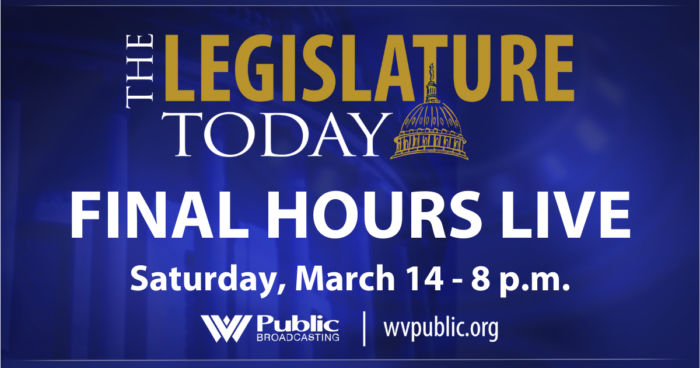
Watch our live TV broadcast of The Legislature Today: Final Hours on WVPB-TV, The West Virginia Channel, with the PBS app or on YouTube, 8 p.m.-midnight, March 14.
Scroll further down this page on Saturday, March 14, for our live updates. Learn about The Legislature Today.
Another regular session of the West Virginia Legislature ends on March 14 at midnight. All evening, the West Virginia Public Broadcasting newsroom will follow along as the House of Delegates and the Senate work to even out differing approaches to legislation and the state budget for the 2027 fiscal year.
This year, legislators introduced 2,771 bills; that’s up about 300 from last year. But only about 10% to 12% of bills introduced each year become laws. The final number for this session remains unknown until the gavel falls at midnight, but both chambers approached this session intending to move forward with greater deliberation.
Scroll further down this page to read more.
Final Hours Live Stream
Live Updates
Follow along with our live updates throughout the day on March 14, 2026.
In its original form, House Bill 5537 would have repealed obsolete and outdated sections of the Education code. However, Friday night Sen. Ryan Weld, R-Brooke, moved to amend the bill to include language that is popularly known as “Raylee’s Law.” The amendment stated that county boards may not approve home instruction for a currently enrolled public school student if there is a pending child abuse or neglect investigation against a custodial parent or guardian.
The House, however, did not work its way through all of the amendments before the midnight deadline on March 14 and adjourned sine die without concurring on HB 5537.
Prior to the deadline, the amendment to include “Raylee’s Law” was the focus of the House’s action, with at least three competing amendments pending in the lower chamber. With time running out, there were motions made to limit debate.
Del. Elliot Pritt, R-Fayette, pleaded with his fellow delegates to meet the moment before them and address “Raylee’s Law” directly. With less than half an hour pending in the regular session, and at least three amendments still pending, the House of Delegates spent about 10 minutes debating procedure to determine limits on debate on the amendments.
“We have an opportunity here tonight to do something to protect children,” Pritt said. “We have tried this for four years. If we amend this bill or change it in any way, this bill dies tonight. I do think it’s probably the outcome that some in this room want, and that’s fine. That’s their prerogative. I respect that, but what I can’t respect is that we have something to protect children that are in harm’s way. That is a fact. And I’m very sorry if that fact is very uncomfortable for some of you to deal with. Just because it’s uncomfortable does not mean it’s not true. And so I’m pleading with you. I am pleading with you to please reject these amendments as quickly as we can so we can send this bill back to the Senate and it can go downstairs for his [Gov. Patrick Morrisey’s] signature. Thank you very much. I’ve never so strongly in my life each of you for the personal, emotional connection that each of us have.”
In contrast, Del. Adam Burkhammer, R-Lewis, excoriated the mechanisms and legality of Weld’s amendment in favor of his own amendment.
“If we really want to protect kids, we write good law, because the law before you is not going to protect one single child. It will not function. It won’t. You’re trying to attack homeschoolers,” he said. “I’ve drafted an amendment that the gentle lady already offered, and it is before you that will protect children. And I don’t care what time it is, our job is to write good law, and we need to write good law, and we need to protect kids. And this garbage of kicking this same bill around for the last four years, it didn’t pass because it’s bad law. This is good law, and it tells you that when there’s imminent danger to a child and the county superintendent is making the report, and that parent is removing that child from that school, there will be an investigation. I cannot imagine that we think somehow we’re going to protect kids by writing legislation that putst some 10 day grace period in it and says, don’t even go check on the kid. Terrible law.”
Del. Shawn Fluharty, D-Ohio, struck back with vigor.
“The language before you has passed this body on two occasions. It was within bills. It was never sent back to us from the Senate. It was finally sent back to us from the Senate tonight. We sat on it for eight hours. You voted on it, you’ve already passed it, and now all these amendments, but we know damn well why. This is abhorrent behavior, disgusting government.”
House Bill 5381, relating to developing a comprehensive energy development policy and plan for the Office of Energy, has completed action.
Del. Evan Hansen, D-Monongalia, said that the bill returned by the Senate did not allow the state to consider renewable energy in its development future.
“This is a vote about electric rates,” he said. “This is a vote about whether we as a body, can pick and choose what type of energy is allowed in our energy plan, not to consider all types of energy, fossil fuels, coal and gas, all types of renewables, including wind and solar, not to presuppose that you know what’s best for the people of West Virginia, or what’s going to be cheapest.”
Hansen said the Senate’s amendments will continue to have West Virginia rate payers paying higher electric bills because they’re locked into a system that doesn’t accept innovation.
Del. Scot Heckert, R-Wood, stood to clarify that the amendment did not prohibit renewable sources of energy from the development plan, but did not prioritize them.
There has been active discussion on House Bill 4198 throughout the session. The bill would create the E-Verify Safe Harbor Act and require employers in the state of West Virginia to verify the employment of an individual through a system called E-Verify. This system works by providing electronic verification that an employee is authorized to work in the United States through the U.S. Department of Homeland Security. There was an amendment to exempt businesses with 25 employees or less, but it failed.
There was another amendment to make the E-Verify system mandatory only for state employers but allow private employers to have the option to use documents like W-2s – unless that employer has a violation. A second violation could lead the business to be temporarily suspended, and a third violation could lead to revocation of the license. Using E-Verify would protect the employer if an illegal worker somehow was not identified through that process.
The Senate Judiciary Committee offered an amendment. On third reading, Sen. Eric Tarr, R-Putnam, voiced his concerns with the bill as it stands, suggesting it was a system to “entrap” West Virginia employers if they might have hired an illegal immigrant. Sen. Robbie Morris, R-Randolph, offered an amendment to step the program into use while leaving it optional for employers to use, which passed.
The bill passed 31 to 3. It goes now to the House of Delegates to see if that body accepts the amendments.
Senate Bill 182 caused some consternation in the House of Delegates when it returned from the upper chamber with the House’s amendments stripped out. The bill relates to annexation by minor boundary adjustment.
Del. Joe Funkhouser, R-Jefferson, explained that his amendments allowed counties veto over all forms of annexation.
“The county is elected by everyone in the county, and the municipalities are only elected by the municipalities,” he said.
There was concern that roads would be annexed as part of a tax increment finance district, leaving county residents paying for city improvements.
The House refused to concur on the Senate’s changes and requested the upper chamber to recede from its changes to the bill.
Both chambers have agreed to House Bill 4106, allowing constitutional carry for 18- to 20-year-olds. The bill has been ping-ponging from chamber to chamber this evening after the House refused to concur with a Senate title amendment.
Senators paused the action on the chamber floor early Friday evening to discuss and vote on a measure honoring Democratic Sen. Mike Woelfel of Cabell County who has announced he will not be seeking reelection.
Senate Resolution 67 recognizes Woelfel’s service over three terms since 2014, including his previous role as minority whip and his current role as minority leader. As one of only two Democrats in the Senate, several colleagues acknowledged his ability to work with people from different backgrounds representing different perspectives and his passion for higher education, health care and helping children.
There were a number of jokes – including a reference to Woelfel as a 1960s hippie and a “cool dude” – with the promise of more jokes to come when votes conclude.
Del. Ian Masters, R-Berkeley, stood in opposition to Senate Bill 4, saying the Senate broadened the language of harassment to the point of being unconstitutional, violating the First Amendment rights of the public.
Senate Bill 4 gives law enforcement the authority to arrest bystanders if they feel threatened and provides a “halo” around the officer of 30 feet. The officer is required to give the public a single warning.
The House rejected the Senate’s amendment to the bill. It now goes back to the Senate to see if that chamber will recede.
The Senate has accepted House of Delegates amendments to Senate Bill 392, a personal income tax reduction bill. The original bill included a 10% income tax reduction, but the House had reduced that cut to 5%. The Senate had also included an additional tax on vaping products, but the House removed that increase.
During his State of the State address, Gov. Patrick Morrisey requested a 10% personal income tax cut. In his version of the budget, the governor included a 5% cut. He also adjusted state revenue estimates to reflect a 5% cut. Estimates suggest the tax cut will amount to about $65 a year for the average West Virginian but it will cost the state about $125 million.
The bill has completed legislation and heads to the governor.
The House of Delegates reconvened around 2:15 p.m. to receive and concur on bills from the Senate.
The House concurred on about 13 bills.
Dels. John Williams, R-Monongalia, Adam Vance, R-Wyoming and Bob Fehrenbacher, R-Wood, all stood to say farewell to the lower chamber.
At least two committee chairs have stood to recognize the work of their staff, an action often reserved for the final moments of a session when the chamber is preparing to adjourn sine die.
The House recessed around 2:55 p.m. until 3:30 p.m.
The West Virginia Senate began their final floor session of the 2026 regular session around 11 a.m. They have been receiving messages from the House of Delegates and have not taken up bills on third reading yet.
Changes To Instructional Days
Senate Bill 890 passed with a House amendment. It reduces the school minimum instruction time from 180 days to 900 hours. That is a reduction of approximately 14 days. The standard school year length has been set at 180 days for some time now. The original bill reduced the schedule by 23 days.
Sen. Mike Oliverio, R-Monogalia, stood to object to the bill, noting that the bill does not adjust the teacher contract. He said teachers have contacted him asking what they will do in the extra days students are not present.
The Senate had considered a change to the school schedule that would have codified specific time for teachers to plan and prepare for instruction, but the bill stalled in committee.
The bill passed and returns now to the House of Delegates to concur with changes. It has an effective date of July 1, 2027.
Senate Bill 944 expands the categories of eligible federal law-enforcement officers authorized to enforce state laws to include any component of the Armed Forces of the United States. That would include the West Virginia National Guard or National Guard from another state, as well as Military Criminal Investigative Organizations.
Del. Chris Anders, R-Berkeley, questioned who military personnel would report to and the general need for such an allowance.
“I understand the reasons for the bill, but based upon reasons of federalism, and protection, and I think we’re getting too close to treading on the Posse Comitatus Act. I will be a no,” he said.
House Judiciary Chair Del. JB Akers, R-Kanawha, explained that the authorization would only be under request of local law enforcement. He gave an example of coordinating a sexual assault investigation where the alleged perpetrator was a military member overseas with prior criminal action in West Virginia.
“The local law enforcement wanted the federal law enforcement or military personnel to assist in the local investigation by providing with evidence and investigation for the overseas assault,” he said. “This is something they said that would allow them to have a cooperative agreements and to hopefully solve that crimes.”
SB 944 passed 87 to 4 with eight members absent.
Other Bills Passed
Senate Bill 947 would provide free birth certificate copies to homeless individuals under 18. The bill passed without debate and with unanimous approval from the delegates present.
The West Virginia Department of Education estimates that more than 15,000 students experienced homelessness during the 2024-2025 school year. What qualifies as homeless can range from sharing housing of other persons or living in a hotel, to living in a car or other substandard housing conditions.
Senate Bill 985 changes the allowable kratom products to only include the natural leaf of the plant -- whole, crushed or powdered – and excludes synthetically manipulated or chemically concentrated kratom products. According to the Drug Enforcement Administration (DEA), kratom is a tropical tree native to Southeast Asia, and consumption of its leaves produces both stimulant effects in low doses and sedative effects in high doses. The bill also passed with unanimous consent from the delegates present.
Senate Bill 1026 would increase criminal penalties and fines for the willful interruption, molestation or disturbance of religious worship. Akers pointed to a Senate amendment that clarifies the bill does not prohibit conduct as protected by the First Amendment.
The bill passed 97 to 0 with two members absent.
The House of Delegates adjourned around noon and plans to return at 1 p.m.
Senate Bill 927 clarifies the Commissioner of Agriculture’s authority to regulate bees. Notably, the bill would allow the Commissioner’s rules on the regulation of apiaries to preempt ordinances or regulations of cities, counties and other political subdivisions.
Several delegates stood in opposition to the loss of local control and spoke against a provision in the bill that would limit civil liability related to keeping bees.
Jennings received a laugh on the floor at the start of his statements against the bill as he removed his hearing aid that was causing interference with his microphone.
“Sorry, it’s causing some buzzing in my ear,” he said.
Jennings was concerned about the allowance of bee hives in cities and the inability of local municipalities to meaningfully regulate them.
“I think that you should be able to, the city or the HOA should be able to say, ‘No, you can’t have them in our small yards,’” he said. “Just giving it so it’s carte blanche where everybody can just have a bee stand – I love the bee, the honey too – but not like this. So I’ll be a no.”
Del. Daniel Linville, R–Cabell, opened his statements on the bill by identifying himself as a beekeeper. He emphasized that honeybee best management practices already existed and were readily available on the Department of Agriculture’s website, and the legislature would have oversight on any other rule changes the department might promulgate after passage of the bill.
Linville said that the range of bees already outstrips municipal boundaries.
“Honeybees go two miles in any direction from the beehive,” he said. “So until and unless a municipality could regulate honeybee hives two miles outside of their boundary, you’re going to have all of the same activity.”
In conclusion, Linville said that honeybees were nothing to be afraid of.
“Honeybees are critical, but beyond that, they’re really not aggressive, and they do a lot of really good things for you,” he said. “So I think that the concerns here probably are a little bit overstated.”
Senate Bill 899 establishes a pathway for principal certifications for teachers with a minimum of 15 years of classroom experience.
Del. Henry C. Dillon, R-Wayne, questioned the need for the alternative certification pathway. He argued he had no issue being accepted into or completing his principal certification program.
“When I completed my administrative certificate and principalship over a decade ago, I completed that through Marshall, through an online program. I didn’t have any problem getting into that program,” Dillon said. “It’s really not clear here what problem we’re solving. These programs have been a certification in principalship and administration for quite some time. ”
Dillon remained unconvinced that there was a shortage of applicants for school administration in the state.
House Education Chair Del. Joe Statler, R-Monongalia, explained to the House that the bill’s intention was to give counties another tool to best lead the state’s schools.
“We need greater leadership in the school systems today. We need people that’s very aware of what their surroundings are and what they’re doing,” he said. “I believe this is just another way to allow 15 years. Although they could take the training that the delegate is talking about, this allows them to do mentorship on job training, where they can work with the principals, where they can work with the superintendents.”
SB 899 passed the House 88 to 5 with six members absent and returns to the Senate for their concurrence.
Medical Psilocybin or Shrooms?
Senate Bill 906 would permit the lawful prescription of crystalline polymorph psilocybin under U.S. Food and Drug Administration (FDA) recommendations.
Rolland Jennings, R-Preston, expressed concern about allowing what he called “shrooms” to be sold in the state.
“I don’t know much about this, but in my county, we used to have a hippie fest and shrooms drop people after people,” he said. “We had to set up tents there just to intubate and keep people alive. So I would hope that anything that has shrooms in it would not be approved.”
Del, Adam Burkhammer, R-Lewis, laid any question about recreational use to rest.
“We’re talking about drugs that contain pharmaceutical compounds or organic substances of psilocybin that would be approved by the FDA, so that they would have went through all of the trial processes. There would be an approval of those, and then it would be able to be a prescription medication. We are not legalizing any recreational street drugs.”
In 2023, the FDA published a first draft of guidance for clinical trials with psychedelic drugs for potential treatment of medical conditions, including psychiatric or substance use disorders. Since then, clinical trials have been ongoing and new drug applications are expected to be submitted to the FDA as soon as later this year.
The House of Delegates convened just before 10 a.m. with 23 bills on third reading ready to be considered.
During the introduction of guests that normally precede the floor action, Del. Scot Heckert, R-Wood, addressed the chamber with a letter from Cheryl Lynn Hess, the wife of the late Del. Larry Kump, R-Berkeley.
She thanked the delegates for their emotional and financial support after Kump’s passing.
Kump died at the end of February while serving his fifth term as a delegate.
After the completion of introduction of guests, the House began to take up messages from the Senate. After bills pass both chambers, they are returned to their originating chamber to give the primary chamber the opportunity to concur with or reject any changes made in the secondary chamber.
So far this morning, the House of Delegates has refused to concur with at least five of their bills that the Senate amended. They include House Bill 4765, a pay raise for teacher, school personnel and state police. Del. Pat McGeehan, R-Hancock, gave the reason for refusal to concur as a “defective title.”
The lower chamber also refused to concur with House Bill 5398, relating to dates of deposits for oil and gas well plugging.
“The Senate amendment adds two unrelated bills into the original bill and therefore violates the Constitutional single object rule,” McGeehan said.
The House is now back to their own calendar and reading bills on third reading.
Original Post – Published March 9, 2026 Last Updated March 12
60 Days Of Capitol Buzz
In this panoramic view of the West Virginia Capitol rotunda, taken on Jan. 28, 2026, we get a sense of the hustle and bustle of lawmakers and lobbyists throughout the 60-day regular session. The rotunda is located in the center of the building, flanked on either side by the House and Senate chambers. Throughout a legislative session, stakeholders set up tables here to lobby lawmakers to support their causes. But these halls are often empty by the final night, as much of the session's action by that point is in the House and Senate chambers. (Photo Credit: Eric Douglas/West Virginia Public Broadcasting)
The House passed the TEAM-WV bill to establish a private, independent nonprofit aimed at driving state economic development. It also passed the “Skills at Work Act” for 16-18-year-old co-op students.
Senate Bill 1 was the first piece of legislation passed and sent to the governor. Senate President Randy Smith, R-Preston, promoted the bill as a method to provide private capital to existing small businesses, when they may not qualify for a bank loan.
The Budget And Morrisey’s Goals
The budget is the only piece of legislation lawmakers are constitutionally required to pass each session. This year, the legislature ended up passing the budget earlier than anticipated.
Gov. Patrick Morrisey introduced his budget during his State of the State address based on a 5% personal income tax cut but then challenged the legislature to make it a 10% cut. The Senate passed its budget first, incorporating the tax cut and then offering a separate bill to increase it. In contrast, the House of Delegates initially passed its own budget bill with no tax cut. Ultimately, the two chambers came together and passed a compromise budget bill, Senate Bill 250.
This version does reflect a 5% cut. As Del. Vernon Criss, chairman of the House Finance Committee, pointed out when he was explaining the compromise legislation to House members, the governor sets the revenue the legislature can spend against, and Morrisey’s revenue estimate already reflected that cut. So, the legislature had no choice but to accept that cut.
Add WVPB as a preferred source on Google to see more from our team
On this West Virginia Week, our voter's guide is out, and it has all the information you need to know about the upcoming general election in the state. Also, another lawsuit targets the state's public school funding formula. And, a million dollar giant troll is making its way to the woods of West Virginia.
Silas House is a major voice for Appalachia. The Kentucky native has written more than 15 books and served as the state's poet laureate. His latest book is The Tulip Poplars, a sweeping novel about the lives of four people as they navigate friendship and forbidden love throughout the 20th century. Inside Appalachia's Mason Adams spoke with House.
Ryan Saxe, superintendent of Berkeley County Schools, said the suit is about whether West Virginia school funding system adequately supports what school districts are responsible for providing their students.