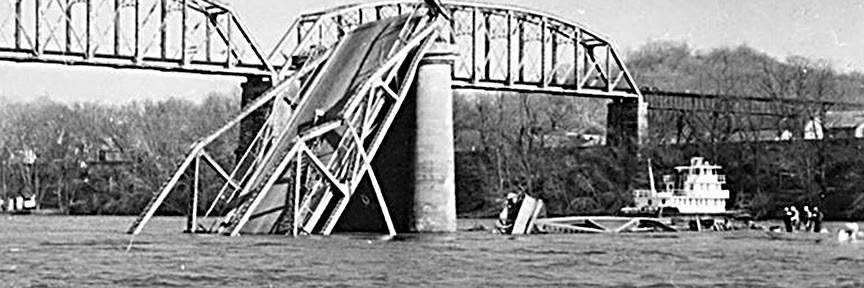
On Dec. 15, 1967, the Silver Bridge connecting Point Pleasant, West Virginia to Gallipolis, Ohio, collapsed – and led to new national standards designed to prevent such a tragedy from ever recurring.
The late afternoon accident sent vehicles full of families and holiday shoppers plunging into the Ohio River. Forty-six people lost their lives.
The cause was determined to be the failure of a single link of chain – and, the lack of a series of backup chains which many bridges of the time had.
The Silver Bridge had been constructed using steel eyebars, which supported the bridge from above like a giant bicycle chain. While many eyebar bridges of the time had several chains on either side to provide redundancy, the Silver bridge had only one chain on each side of the span to hold up the bridge decking.
“Now, today, they have techniques where you can get cameras, and you can see places where you couldn’t have seen in 1967. But in 1967 nobody really ever faulted the bridge inspectors for missing anything, just because it wasn’t part of the routine to check for that,” said state historian Stan Bumgardner in an earlier interview with West Virginia Public Broadcasting.
“It would have been virtually impossible, they would have had to have been looking for a needle in a haystack,” he said.
The magnitude of the loss led to the Federal Highway Administration adopting National Bridge Inspection Standards in 1971.
In recognizing the anniversary, Gov. Patrick Morrisey said it is a solemn reminder of the lives lost and lessons learned.
“That moment changed how our nation approaches bridge safety, inspection, and accountability,” Morrisey said.
He also said the anniversary brings about a renewed commitment to the ongoing work of maintaining safe and reliable infrastructure.