


Fourth Annual Women Warriors Summit To Feature High Profile Speakers
The fourth annual Women Warriors Summit will take place at the Marshall Health Network Arena in Huntington on Friday, Oct. 23, 2026.
Continue Reading Take Me to More NewsAlert (09/29/2026): Our Parkersburg TV transmitter is still undergoing maintenance and remains temporarily inoperative. We apologize for the inconvenience.
All our programming is available via our TV livestreams on our website and WVPB Passport. Thank you for your patience!




To Educate, Inform, and Inspire by Telling West Virginia's Story

Mountain Readers 2026 has concluded! Please fill out our volunteer post-survey.
Nominate an exceptional West Virginia K-12 teacher today!

On Demand

On Demand

Stream original productions from WVPB

Watch locally produced documentaries & more.

On Demand

On Demand






West Virginia Morning

Inside Appalachia

West Virginia Week

Mountain Stage

Us & Them

The Legislature Today

The Legislature This Week

Send us your comments and questions.

Stream our board meetings.

Check out the latest WVPB news.

Sign up for our newsletter and get weekly updates.

Meet the WVPB staff.

WV Educational Broadcasting Commission, the WVPB Foundation, and the Friends of WVPB.

Come work with us!

Read our annual report and learn how we educate, inform and inspire with your support.

Sponsor impactful and engaging media and entertainment.

Use your IRA to make a gift to WVPB.

Become a member with your gift of $1,000 or more.

Make WVPB part of your legacy.

Manage your membership account.

Learn how you can Protect and Sustain West Virginia Public Broadcasting.
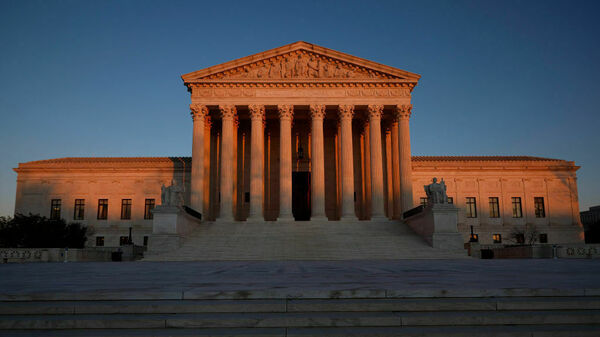
The Supreme Court of the United States (SCOTUS) is expected to rule on West Virginia v B.P.J., for which it heard arguments in January.
In 2021, the mother of a then-11-year-old transgender girl who wanted to join her middle school’s girls’ cross-country track team filed a federal lawsuit after the state legislature passed the “Save Women In Sports Act.”
The bill stipulates participation for sports events to be based on biological sex of the athlete at birth. B.P.J. was assigned male at birth. She has publicly identified as a girl since the third grade.
B.P.J., now 15 years old, won the West Virginia Class AAA girls shot put championship recently with a personal best throw of 38 feet, 11.75 inches, according to results reported by the West Virginia Gazette-Mail.
The lawsuit argues that the exclusion of transgender athletes violates the federal statute Title IX, which bars discrimination against a person on the basis of sex.
In January 2023, U.S. District Court Judge Joseph Goodwin ruled that West Virginia’s ban on transgender athletes competing in female school sports was constitutional and could remain in place. But a month later, the Fourth U.S. Circuit Court of Appeals in Richmond, Virginia, issued a preliminary injunction that B.P.J. could continue practicing with her team while they deliberated. The Fourth Circuit ultimately ruled in April 2024 that the 2021 law violated Title IX.
Then-West Virginia Attorney General Patrick Morrisey filed an emergency appeal in 2023 asking the U.S. Supreme Court to allow the state to enforce the law while the Fourth Circuit considered the case. The justices declined at the time but agreed to hear the case on appeal in January 2026.
At least two justices have already publicly sided with West Virginia while dissenting from the earlier emergency appeal. Justice Samuel Alito wrote a dissenting opinion, joined by Justice Clarence Thomas, that a federal appeals court should not have blocked a state law.
“I would grant the State’s application,” Alito wrote. “…in the circumstances present here—where a divided panel of a lower court has enjoined a duly enacted state law on an important subject without a word of explanation, notwithstanding that the District Court granted summary judgment to the State based on a fact-intensive record—the State is entitled to relief. If we put aside the issue of the State’s delay in seeking emergency relief and if the District Court’s analysis of the merits of this case is correct, the generally applicable stay factors plainly justify granting West Virginia’s application.”
Each year, the high court begins to hear cases in October before concluding their session in late June or early July. According to SCOTUSBlog on X, the decision on West Virginia v B.P.J. could be issued as soon as Monday. But with decisions in seven other cases still pending, a second opinion day is expected.
Add WVPB as a preferred source on Google to see more from our team

Ryan Saxe, superintendent of Berkeley County Schools, said the suit is about whether West Virginia school funding system adequately supports what school districts are responsible for providing their students.
Continue Reading Take Me to More NewsA new study ranks West Virginia in the middle of the states when it comes to measures of freedom.
Continue Reading Take Me to More NewsWith the midterm elections approaching, Us & Them host Trey Kay takes the Dinner Party to Huntington, where eight West Virginians from different generations and political perspectives gather around the table. Half the guests are under 30, and while they disagree on immigration, foreign policy, the media and the direction of the country, they also discover some unexpected common ground.
Continue Reading Take Me to More NewsAs we’re counting down to the midterm election, Us & Them host Trey Kay has invited a new group of guests to a Dinner Party – but this time, the table is in Huntington. Kay’s guests are a mix of conservative and progressive voters, half of whom are under 30 and they share a wide-ranging conversation over a potluck meal. We listen to an excerpt from this episode where a number of guests weigh in on immigration.
Continue Reading Take Me to More News