This week, we reflect on Dolly Parton’s passing and her legacy in the region. Also, the Adaptive Climbers Festival at Kentucky’s Red River Gorge feels like home for climbers with disabilities from around the world. And, a new book spotlights Appalachian plants and encourages readers to get in touch with nature.
Sanctions Loom Over Justice Companies In 2 Federal Courts
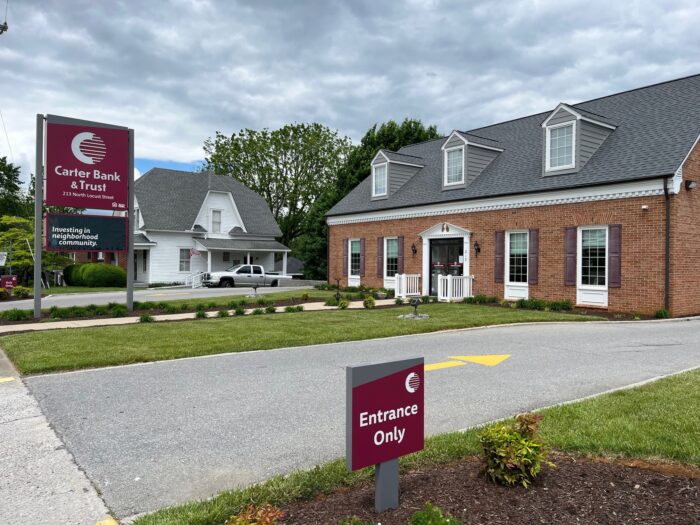
Carter Bank, shown here in Floyd, Virginia, is one of Gov. Jim Justice's biggest creditors.Curtis Tate / West Virginia Public Broadcasting
Listen
Share this Article
A company owned by Gov. Jim Justice faces possible contempt in federal court over failure to pay for mine safety violations. Another federal court has found the governor’s son in contempt for failing to appear at a hearing last week.
Southern Coal agreed to pay $5 million in MSHA fines in 2020, and has paid roughly $4 million.
However, the Justice-owned company has said it has no assets and cannot pay the balance. Southern Coal did make a payment of $10,000 on July 12, according to court documents.
U.S. Attorney Christopher Kavanaugh responded this week that Southern Coal has offered no evidence of an inability to pay and that the company has not sought bankruptcy protection.
Southern Coal has said its assets are collateral for nearly $300 million owed to Virginia-based Carter Bank. In June, the Justice family reached a settlement with the bank, one of its biggest creditors.
A federal judge in Alabama, meanwhile, has held the governor’s son, Jay Justice, in contempt.
Chief U.S. District Judge R. David Proctor of the Northern District of Alabama last week declared Jay Justice and Bluestone Coke, a company the family owns, in contempt for violating three previous orders.
Among other missteps, Justice and Bluestone failed to appear in person for an Aug. 21 hearing.
Proctor had earlier directed the parties into mediation.
A federal judge in Alabama has held the governor’s son, Jay Justice, in contempt.
Proctor gave Justice and Bluestone until Sept. 11 to comply with the court’s orders, including paying plaintiffs’ fees, responding to discovery requests and submitting dates for mediation.
Failure to cooperate or participate could result in penalties, an order of default, or “other appropriate sanctions,” Proctor ordered.
Meta, parent company of social media platforms Facebook and Instagram, has agreed to introduce restrictions for younger users including time limits and content controls.
The ACLU-WV said students in Lincoln County receive a worse education than their parents and grandparents did — and that by some measures the schools are worse off than the system a court already found unconstitutional.
A federal judge declined Friday the state’s request to dismiss a lawsuit brought by West Virginia’s largest overdose prevention group, Solutions Oriented Addiction Response of West Virginia (SOAR.)