This week, a new report finds the number of black lung cases is at its highest since the 1970s. The human cost is high. Also, the author of a new book says reintroducing nearly extinct animals back into the wild can boost damaged ecosystems, but they can't repair them. And, roadside attractions pay tribute to our enduring fascination with weird.
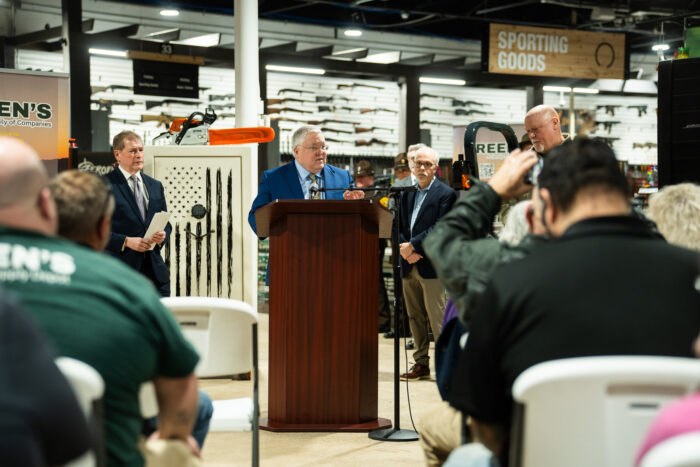
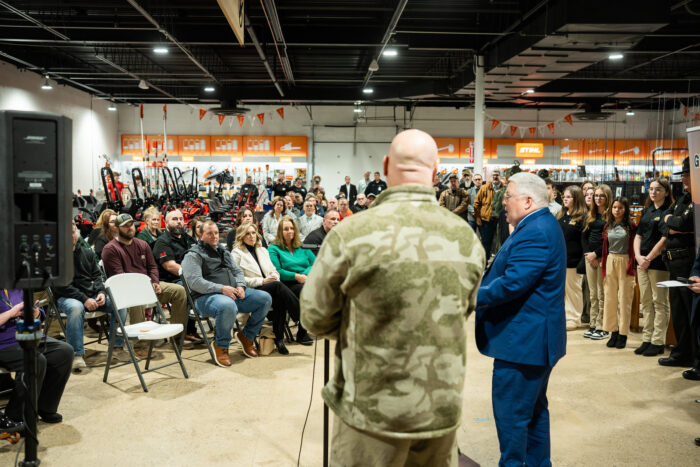
Gov. Patrick Morrisey addresses a crowd he says will have more money to spend from their paychecks if his 10% tax cut proposal goes through.WV Governor's Office
Listen
Share this Article
Before a packed house at the Green’s Supply Depot in Parkersburg, Gov. Patrick Morrisey made his case for a 10% state income tax cut.
“West Virginia is ready for more income tax cuts,” Morrisey said to a cheering, working class crowd.
In order to continue winning at the “backyard brawl,” he said, West Virginia needs to remain competitive with nearby states.
“We have to have stronger economic policies, lower taxes than Ohio and Kentucky and Pennsylvania, than Virginia and Maryland,” Morrisey said. “One of the ways you do that is when you end up making the right, fiscally responsible decisions, you’re in a position where you can then return that money back to the people, and that’s what we’re doing.”
Many in the crowd at Green’s Supply Depot in Parkersburg cheered the governor’s message of lower income taxes.
He already has a 5% tax cut built into his proposed state budget. Now he’s putting some pressure on lawmakers to do even more.
“We made a lot of the tough choices, right? And that’s critical. And then we’ve asked the legislature to work together with us to get the remaining 5%,” Morrisey said. “For this to become law, I need the legislature’s help, and so we want to collaborate with them.”
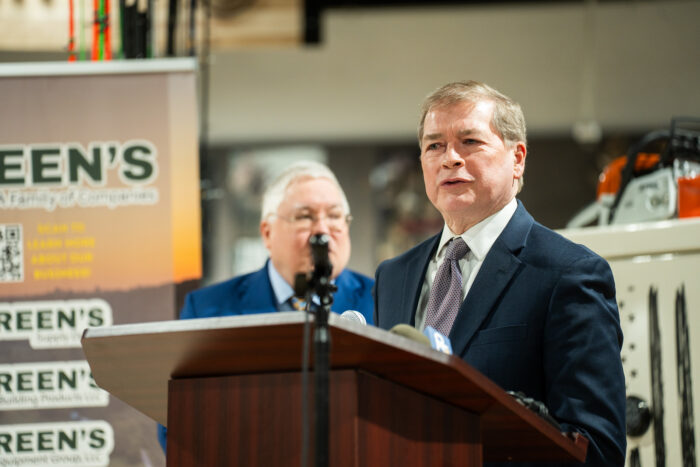
To help make his case, Morrisey turned to Grover Nordquist, founder and president of Americans for Tax Reform, a national nonprofit that advocates for low or no taxes.
Grover Nordquist, founder and president of Americans for Tax Reform, told the crowd that lower taxes historically bring economic growth and more jobs.
“America began as a tax revolt, so most people think of tax cuts as a national issue,” he told the crowd.
“But when somebody decides where to work and start a company, where to invest to build a factory or a power plant, once they’ve decided to do it in the United States, there are still 50 decisions to make. Which state? And West Virginia is leading among the states that have decided to go to zero on the income tax,” Nordquist said.
That, he added, will make a difference for families at a very personal level.
“State by state, families decide where to live. Kids decide whether they leave the state after they graduate from high school or college, and a lot of that’s based on our jobs,” he said.
Doing that, he said, will attract more business, create more jobs and give everyday people more of their own money to spend.
Morrisey believes there is growing support in the legislature for the 10% cut he wants – but it may take a lot to get it passed. Especially during an election year, when lawmakers are more inclined to spend.
“A lot of times, people want to take money, especially during election years, they want to spend it. I’m going to ask everyone today, let’s get the word out all across Wood County, the Mid-Ohio Valley, across West Virginia, we must prioritize having a 10% across the board income tax cut,” Morrisey said.
Morrisey said lower taxes will bring in more jobs, higher paying jobs, and put more money in the pockets of hard-working West Virginians.
Add WVPB as a preferred source on Google to see more from our team
On this West Virginia Week, plans for a new transmission line may be in trouble, a former state delegate is indicted, and the state has a new secretary of tourism.
County commissioners from the state's largest counties, by population, are set to meet virtually next week to discuss their unique issues including ballooning per diem jail costs.
Marshall University and WVU will provide grant writing and subject expertise with the goal of leveraging $450 million in federal and private funding for water infrastructure projects.
PSC staff completed their report by saying that should the applicant NextEra decline a minimum 60-day delay, they recommend the application be dismissed for lack of completeness.