Alert (09/10/2026): Our Parkersburg TV transmitter is undergoing maintenance for a few days and will not be operational. We apologize for any inconvenience. All our programming is available via our TV livestreams on our website and WVPB Passport. Thank you for your patience!
There are many events planned across the state to commemorate the 25th anniversary of the Sept. 11 terrorist attacks, including three days of volunteering at Marshall and a 12-hour vigil at WVU.
U.S. Senator Shelley Moore Capito (R-W.Va.) released the following statement on tonight’s primary election results where West Virginia Republicans overwhelmingly nominated her to represent them on the general election ballot.
“Tonight, West Virginia Republicans sent a clear message that we are ready to continue delivering wins with America First policies through my strong leadership in the U.S. Senate. My focus remains steadfast – we need to continue bolstering our economy to create good-paying jobs that support our businesses and workforce, strengthen our infrastructure, invest in West Virginia energy and our natural resources, and keep our communities safe.
“Thank you to the West Virginians who made our victory tonight possible through your vote, your time, your efforts, and to President Trump for his confidence in me and endorsement. I’m honored by the trust the people of our state have placed in me and remain energized and ready to continue our positive message that represents our people and West Virginia values into the general election this November,” Capito said.
By Eric Douglas at 7:30 p.m.
Election Returns
Polls are now closed in West Virginia. Results from the county clerks usually start being reported about 8:30pm.
According to Secretary of State Kris Warner, the WVSOS Election Night Reporting (ENR) website allows the general public to view the election results as they are reported by the county clerks. Warner said that most county clerks update their results a number of times throughout the evening as precincts are counted.
There are 2,717 candidates participating in state, county, and municipal elections taking place. There are 1,684 voting precincts throughout the state on election day with 1,198,036 registered voters eligible to participate in the primary election.
Results reported on election night are preliminary only. County clerks will begin reporting post-canvass results on May 18, after each Board of Canvassers reviews the results and provisional ballots for each precinct in their county.
Results become official once each county certifies their election. Counties where no recount is conducted have 30 days after the election to transmit their certified results to the Secretary of State.
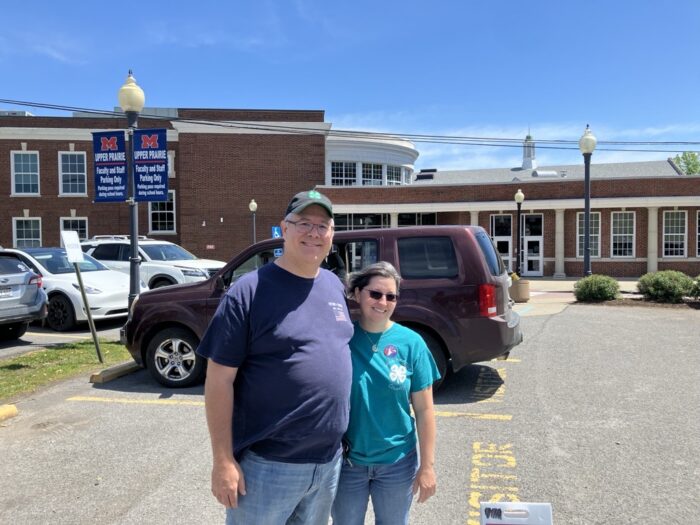
Laird Wright, left and Kimberly Wright stand outside of the Morgantown High School polling location after voting in the Primary Election May 12, 2026.
Photo by Chris Schulz/west Virginia Public Broadcasting
By Chris Schulz at 7:25 p.m.
Closed Republican Primary
Last year the West Virginia Republican party chose to hold a closed primary in 2026, meaning only registered party members will be able to participate.
Republican party Chairman Josh Holstein, R-Boone, told West Virginia Public Broadcasting at the time that the closure was not a shut out, but rather an invitation to join the party.
“The overwhelming majority of West Virginians believe in our values and believe in our platform, and that’s borne out in the results of every election,” Holstein said in 2025. “We just want folks that are willing to, or that believe in our values and believe in our platform, to join us by changing to Republican.”
Kathi Elkins, who was campaigning for Democratic candidate Ace Parsi outside of the Morgantown High School polling location Tuesday, said she hoped the closed primary would inspire more voters to register independent.
“If they have, have not been really happy with the Republican Party, maybe they will drift on that continuum over to be into the Democrat party,” she said. “I don’t see why anybody would register as a Republican. It is mind boggling to me, because those beliefs are not what mine are.”
But it appears Holstein’s wishes may be coming true instead. Since the decision to close the primary was finalized last July, Republican voter registration has increased by nearly 17,000 individuals to more than 519,000 in April 2026, the most recent data available from the Secretary of State.
Republican registrations have been steadily increasing for years as West Virginia, once a Democratic stronghold, has grown increasingly red over the past decade.
Kimberly Wright said it was the Republicans’ perogative to close their own primary.
“I just show up and vote. If I can vote, great, then I vote,” she said. “And if I can’t, then I’ll get there in the general election. You’ve always got your say.”
Laird Wright, Kimberly’s husband, self-identified as a conservative but said previous frustrations with the Republican party led him to register independent.
“This time I didn’t have a chance to vote on that leadership. I understand some of the reasons why they said they were doing it. I still disagree with it,” he said. “I think that if you have people who are trying to impact an election in ways that are illegal, go after them, you know? That’s the reason why we have laws.”
Both Wrights expressed concern over the increasing polarization of the political landscape.
“We’ve got to find a way to talk,” Kimberly said. “We’ve got to find a way to come back together and make some sane decisions, because it can’t be all this side, and it can’t be all that side, because usually what’s in the middle is what works best for all of us.”
By Maria Young at 7:00 p.m.
Voter Turnout
Election officials report heavy voter turnout this morning – which corresponds with an 8% increase in early voting this year over West Virginia’s last non-presidential primary election in 2022.
Deputy Secretary of State Mike Queen repots there are 2,717 candidates on ballots across the state. Tonight, as results begin trickling in from all 55 counties, there’s a new system in place to report those results as quickly as possible.
“We have the election night reporting system, which is new. We’re one of a few states that do have that, so that the county clerks update their their findings or their results as they go throughout the evening,” Queen said. “We can start seeing some of the results as early as 830 or nine o’clock, and then we hope that when the voters go to sleep tonight, they’re going to know which which candidates won, which candidates lost, and they’re also going to know some of those races where a winner or loser was in a race is too close to call.”
Queen said results that are reported this evening are considered preliminary, and won’t be certified under canvassing is done beginning on May 18.
“The county commission serves as a board of canvassers for their county. And the board of canvassers then brings people from both major parties, Democrats and Republicans, together, and they canvass the following week after the election,” Queen said. “The county clerk calls the canvassing team together, they randomly select precincts that they want to hand count, which is part of the canvassing process, and it also gives them a chance during the canvassing to consider all of the provisional ballots.”
Provisional ballots might include ballots from a voter who has gotten married and changed their last name since they registered to vote or someone who has moved to a new precinct. Canvassers will also consider absentee ballots that may be postmarked, but not in today.
By Maria Young at 6:00 p.m.
Voter Motivation
Early voter turnout was up statewide for this primary election – and election officials are optimistic that could hold through this Election Day as well. We spoke with voters in several Charleston precincts about what brought them to the polls.
Carmen Mayhew, now in her early 60’s, has been exercising her right to vote for almost every election since she was 18, because she wants her voice to be heard. This year – the cost of living is at the front of her mind.
“I want somebody to do something about the price of utilities, groceries, gas. I don’t know – this is a local level. I’m sure if something can be done – they’re campaigning that they can, so, we’ll see,” Mayhew said.
Samantha Stone said negative campaign ads made her more aware of what’s going on – and more determined to vote.
“I think it’s very important to vote and I have concerns about the way our country’s being run right now. The way things are being done, the way people are being hurt,” Stone said.
Steven King said it was either show up to vote in the primary or let someone else decide who’s on the ballot in November. He’s looking for overall improvements in the way things are being done.
“Local issues, who’s got a better plan a better vision, a better future not just some single issue. Statewide, again, some sort of vision, some sort of plan, here’s what we’re doing wrong, here’s what we’re doing better,” King said.
Statewide, there are 1,684 voting precincts being manned by more than 8,000 poll workers in all 55 counties. Polls are open until 7:30 p.m.
By Chris Schulz at 5:25 p.m.
School Levies
According to the West Virginia Center on Budget and Policy (WVCBP), West Virginia’s constitution sets the maximum property tax rates for local governments and school districts. However, voters can temporarily exceed these maximum rates through an excess levy, an additional property tax used to provide supplemental funding for community services including libraries, ambulance services, and public schools.
Monongalia County is one of 42 counties in the state that currently has a school excess levy in place, and one of six districts — Gilmer, Morgan, Tyler, Wetzel, and Wirt are the other five — where voters are being asked to renew the levy during the Primary Election.
According to analysis by the WVCBP, ten counties in total have excess or school bond levies on their ballots Tuesday. Hardy and Summers counties are voting on new school excess levies, while Berkeley and Braxton counties are voting on new bond levies, which are specifically for capital improvements and equipment.
Morgantown voters had the excess school levy top of mind when they exited the polls Tuesday.
Holly McMullen said the levy was a primary motivator for her to get out to the polls.
“Just to give more funding to the public school system, we can always use that,” she said.
Kimberly Wright said it was important to support schools and civic programs like 4H.
“Even if you don’t have kids, you might someday. It’s important to support the youth because they are our future,” she said.
Laird Wright, Kimberly’s husband, said the levy system highlighted greater problems with how the state funds education that have long needed attention.
“The can has been kicked down the road for years, and I think they need to address it,” he said. “I think a levy in counties where you have a disproportionate amount of senior citizens, of course they’re not going to be voting to be taxed additionally, especially if they’re on the fixed income.”
By Maria Young at 4:30 p.m.
The Importance Of Voting
Samantha Elswick voted on Charleston’s West Side Tuesday, with her 7-year-old daughter by her side. Elswick said she wants her daughter to know how important it is to vote.
“For me it’s just to – I get emotional about it because, as a woman, we didn’t always have the right to vote. So, I want to set a good example for my daughter. I want her to know – we were just talking about it, actually – how important it is especially as a woman, to come out and whoever you feel the candidates are who are going to help our community, our environment, our country as leaders, to show true representation as leadership.
Elswick said negative ads did not influence her choices in Tuesday’s primary because she does her own, extensive research on the candidates and learns about their views on multiple issues as well as their leadership abilities.
By Chris Schulz at 4:30 p.m.
Supreme Court Race
West Virginians going to the polls today are primarily selecting their party’s candidates for the general election in November or choosing party leadership.
But two seats on the state’s Supreme Court of Appeals will be decided Tuesday. The departure of Justice Beth Walker and the death of Justice Tim Armstead in 2025 necessitated Gov. Patrick Morrisey appoint Tom Ewing and Gerald Titus, respectively, to complete the unexpired terms. Ewing is running to complete a term that expires in 2028, while Titus is running to complete a term that expires in 2032.
Per the Supreme Court’s website, the court is comprised of five justices who are elected to 12-year terms in nonpartisan statewide elections. If a justice leaves office before the end of a term the governor appoints a replacement. Some appointees may remain in office until the unexpired term ends while some must run for election to complete the full term, depending on how much time is left on the term at the time of appointment.
Ewing is opposed by Del. Bill Flanigan, R-Ohio. Four other candidates are vying for Titus’ seat:
Judge Laura Faircloth
Judge Todd Kirby
Senior Judge H.L. Kirkpatrick
attorney Martin Sheehan
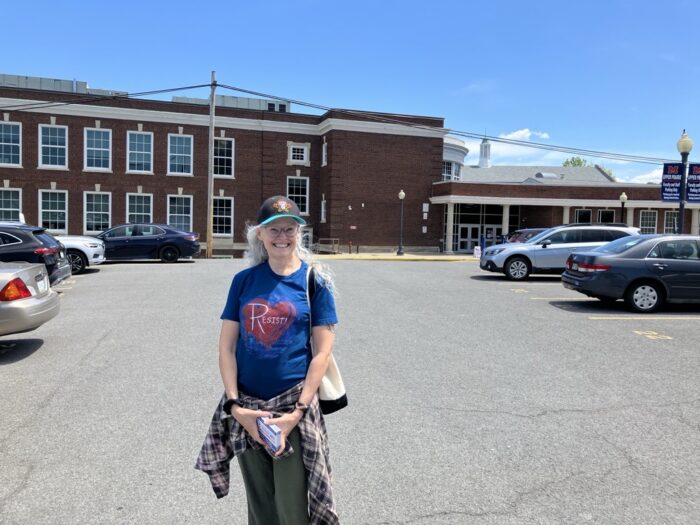
Morgantown voter Angela Kauffman was outside of the Morgantown High School polls Tuesday handing out flyers about the candidates endorsed by Education West Virginia: Kirkpatrick and Flanigan. She said her own confusion about how to find more information on the court race led her to electioneering.
“I had trouble finding out things about the candidates, and so I reached out to some friends who are more politically involved than I am that I know have similar goals that I do,” Kauffman said. “I was asking, ‘Oh, who should I vote for?’ And she let me know, and then she’s like, ‘Oh, by the way, we need volunteers. Can you help other voters who might be confused in the same way and want to know a little bit more about the candidates?’”
Kauffman said recent decisions made by the Supreme Court of the United States have raised her concerns about the power of the judiciary.
“Just bringing that down to the state level, I want to know as much as I can to go forward in making decisions,” she said. “I don’t know how protective we can be at the state level. But it would be nice to we can shape up West Virginia and then go further later.”
Angela Kauffman stands outside of the Morgantown High School polling location during the Primary Election May 12, 2026. In her hand she holds fliers informing voters about candidates endorsed by Education West Virginia. She said her own uncertainty about how to vote in the Supreme Court elections led her to reach out to better informed friends that asked her to volunteer to help other voters seeking more information. Photo Credit: Chris Schulz/West Virginia Public Broadcasting
By Eric Douglas at 3:30 p.m.
Democrats
There are contested Democratic races up and down the ballot this year.
Every Democratic federal primary is competitive: five candidates are running for the U.S. Senate seat currently held by Shelley Moore Capito, two are running in Congressional District 1 (currently represented by Carol Miller), and three are running in Congressional District 2 (currently represented by Riley Moore).
There are also contested Democratic races at the local level, including contests for county commission and city council seats.
On the legislative side, Democrats have candidates in 89 of the 100 House districts and 17 of the 19 State Senate districts, as shown in the maps below. Democratic primaries are competitive in 19 House districts and four State Senate districts.
Independent and unaffiliated voters can vote today in the primary, and they are able to request a Democratic ballot at the polls.
What We’re Watching
This year’s primary election sets the stage for the general election in November, as both major parties pick their candidates from among 2,717 state, county, and municipal candidates, according to West Virginia Secretary of State Kris Warner.
County clerks reported that a total of 67,356 West Virginia voters cast ballots during the early voting period from April 29, through May 9. That’s more than 8% higher than the early voter turnout in the state’s primary election in 2022 that saw 62,283 early voters.
Warner said that county clerks throughout the state reported a substantial increase in voter interest over the last two days of early voting.
Both parties have seats where multiple candidates are vying for the same position. On the Republican side, there are races with multiple candidates and opposing groups within the party. Gov. Patrick Morrisey has taken the unusual step of endorsing candidates for seats in the legislature. And political action committees, many from out of state, have been contributing heavily to certain races or sponsoring negative ads about certain candidates as well.
For up-to-date information on election results, visit the West Virginia Secretary of State office’s website, and stay tuned to this live blog from West Virginia Public Broadcasting.
For a full list of candidates running for election in West Virginia, visit the secretary of state office’s candidate search webpage.
Follow the WVPB Newsroom on Instagram @wvpublicnews.
Follow along with the WVPB Newsroom on May 12 for news and updates from around the state.
For up-to-date information on election results, visit the West Virginia Secretary of State office’s website, and stay tuned to this live blog from West Virginia Public Broadcasting. For a full list of candidates running for election in West Virginia, visit the secretary of state office’s candidate search webpage.
Follow the WVPB Newsroom on Instagram @wvpublicnews.
What’s on the ballot?
The AP will provide vote results and declare winners in contested primaries for the U.S. Senate, the U.S. House, the state Senate and House and mayor of Charleston, as well as general elections for the state Supreme Court and the state Court of Appeals. There are also three state Senate special elections.
Who gets to vote?
West Virginia voters registered with a political party may vote only in their own party’s primary. In other words, Democrats can’t vote in the Republican primary or vice versa. Independent or unaffiliated voters may vote in the Democratic or Mountain Party primaries but not the Republican primary. Voter ID is required.
How many voters are there?
As of April 23, West Virginia had about 1.2 million registered voters, including about 520,000 Republicans, 327,000 Democrats and 302,000 voters unaffiliated with any party.
How many people actually vote?
In 2024, the GOP primaries for president, governor and U.S. Senate each had about 225,000 total voters, which was about 19% of registered voters at the time. Turnout for the Democratic primaries ranged from about 90,000 for governor to about 102,000 for U.S. Senate.
How much of the vote is cast early or by absentee ballot?
About 30% of the vote in the 2024 primaries was cast before Election Day.
When are early and absentee votes released?
Roughly 60% of West Virginia’s 55 counties tend to report all or nearly all of their early and absentee vote results in the first vote report of the night.
Add WVPB as a preferred source on Google to see more from our team
Schuyler Mitchell, assistant news director at nonprofit newsroom Mother Jones, found that at least $1 million in opioid settlement funds have been used to purchase ALPR surveillance systems across the country.
Absentee voting is a major topic in the news with the 2026 general election just over the horizon, but it wasn’t much of an issue in West Virginia’s May primary.
As one of the hardest hit states in the country's opioid crisis, communities across West Virginia have started spending their portion of the roughly $1 billion in settlements from pharmaceutical companies and distributors. Schuyler Mitchell, assistant news director at nonprofit newsroom Mother Jones, reported last month on the use of the funds to purchase automated license plate readers, or ALPRs, from companies like Flock. She spoke to Chris Schulz about her findings.