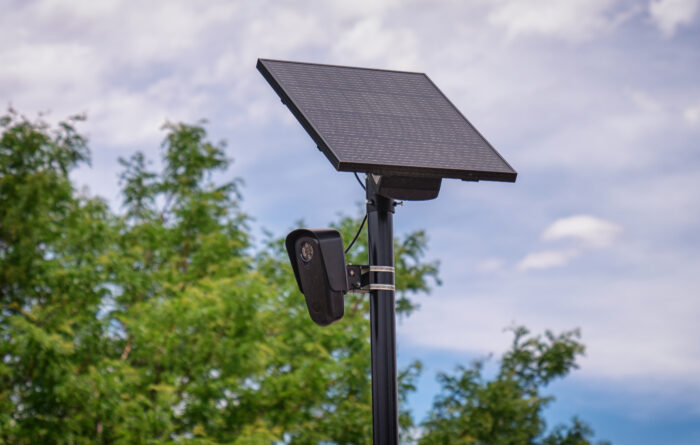
Flock Safety, maker of automated license plate reader (ALPR) systems, has until Monday, Oct. 19 to confirm that representatives of the company will appear at a planned interim legislative committee meeting Nov. 9.
This comes after members of the West Virginia House of Delegates exchanged multiple public letters with Flock over the past three months seeking answers to 19 questions and data requests. Flock met an Oct. 9 deadline to answer delegates’ questions set out in a letter dated Oct. 5
“I think it’s positive that Flock at least categorized their responses with the specific questions that we provided them,” Del. Tristan Leavitt, R-Kanawha, said.
Leavitt has worked with Del. Ryan Browning, R–Wayne, and Del. Patrick Lucas, R–Cabell and Del. Chris Phillips, R–Barbour, chair of the House Government Organization committee to get more information from Flock after lawmakers heard from Kevin Kane, director of Government Affairs for Flock Safety at a legislative interim meeting in August.
“There are still several pieces of information that we requested that they did not answer. Their responses were largely kind of a regurgitation of their first letter to us,” Leavitt said. “However, I thought that maybe the most important thing was that they very clearly expressed their willingness to go back on the record to provide answers, and so that’s why we’ve invited them for the Nov. 9 interim meeting.”
In their Oct. 9 letter Dan Haley, chief legal officer for Flock responded to claims that they had requested an “off the record” or “behind closed doors” meeting. He opened the letter by saying that was never the company’s intent nor was any such request ever made.
“To be explicitly clear: we are proud of our record in West Virginia. We are proud of our products, our safeguards, and our ongoing efforts to continuously improve on each of those fronts,” Haley wrote. “We extended offers to meet, in any setting, with members of the legislature to answer questions, provide a demonstration, and discuss in depth how Flock protects customer data in an effort to further dialogue and understanding.”
Flock’s letter goes on to reply to the delegates’ original, Aug. 14 letter point by point.
Leavitt and his collaborators replied to Flock Monday with the request for company officials to appear in committee Nov. 9 and a new list of questions. Leavitt said the correspondence has reached its usefulness.
“Having this opportunity to go through it with them again in a public setting with a lot more information now, I think hopefully our other members will be far more informed because of the information we’ve gathered thus far,” he said. “But this will be a chance for us to go to the very detailed questions in the last eight-page letter that we sent back, saying, ‘Okay, here are the things we are going to ask your witnesses. Make sure you send people who are sufficiently knowledgeable that they can answer these questions.’ It will be a very different scenario if they come and say, ‘Well, we don’t have the information for that,’ when we told them ahead of time exactly what we intended to ask.”
Kevin Kane, director of Government Affairs for Flock Safety was candid in his lack of information to properly answer certain questions during his appearance before the Joint Standing Committee on Government Organization, prompting delegates to write directly to the company.
Leavitt said Monday’s response remains a request, but he hasn’t ruled out compelling officials to testify if he continues to find their responses inadequate.
“At that point, that may be when -- if there is certain information that we believe is key to our crafting legislation that they have not been willing to provide -- that we that we may need to consider compulsory process,” he said.
ALPRs and Flock in particular continue to attract considerable public interest as communities in West Virginia begin to adopt them. Lawmakers in both chambers have expressed interest in regulating the technology, but Leavitt said there is not a consensus.
“I do think that as we have all of this and have the opportunity to discuss it more as a body, as a legislature, that will be helpful because what everybody can agree on is we need this kind of information,” he said. “Flock has had a history of going to other government bodies and telling them things that were contradicted by the facts on the record. So I think this has been a very important process for us to get more of these facts to help make sure that our members are more informed.”
Leavitt said having a public discussion with the company is important not only to help lawmakers as they consider regulation but also to keep the public informed.