


The Mystery Of The Flatwoods Monster
Many cryptids are said to lurk in the shadows of Appalachia, including West Virginia’s Flatwoods Monster.
Continue Reading Take Me to More NewsAlert (09/29/2026): Our Parkersburg TV transmitter is still undergoing maintenance and remains temporarily inoperative. We apologize for the inconvenience.
All our programming is available via our TV livestreams on our website and WVPB Passport. Thank you for your patience!




To Educate, Inform, and Inspire by Telling West Virginia's Story

Mountain Readers Week will be held Oct. 5-9, 2026! Celebrate and foster a love of reading in children across West Virginia.

Nominate an exceptional West Virginia K-12 teacher today!

On Demand

On Demand

Stream original productions from WVPB

Watch locally produced documentaries & more.

On Demand

On Demand






West Virginia Morning

Inside Appalachia

West Virginia Week

Mountain Stage

Us & Them

The Legislature Today

The Legislature This Week

Send us your comments and questions.

Stream our board meetings.

Check out the latest WVPB news.

Sign up for our newsletter and get weekly updates.

Meet the WVPB staff.

WV Educational Broadcasting Commission, the WVPB Foundation, and the Friends of WVPB.

Come work with us!

Read our annual report and learn how we educate, inform and inspire with your support.

Sponsor impactful and engaging media and entertainment.

Use your IRA to make a gift to WVPB.

Become a member with your gift of $1,000 or more.

Make WVPB part of your legacy.

Manage your membership account.

Learn how you can Protect and Sustain West Virginia Public Broadcasting.

Broadband labeling has been in development since 2015, and was completed by the Federal Communications Commission (FCC) and the Biden Administration.
The new federal rules take effect April 10, 2024. They say any company, large or small, that offers standalone broadband internet service is required to prominently display consumer friendly labels at the point of sale, including in store and online.
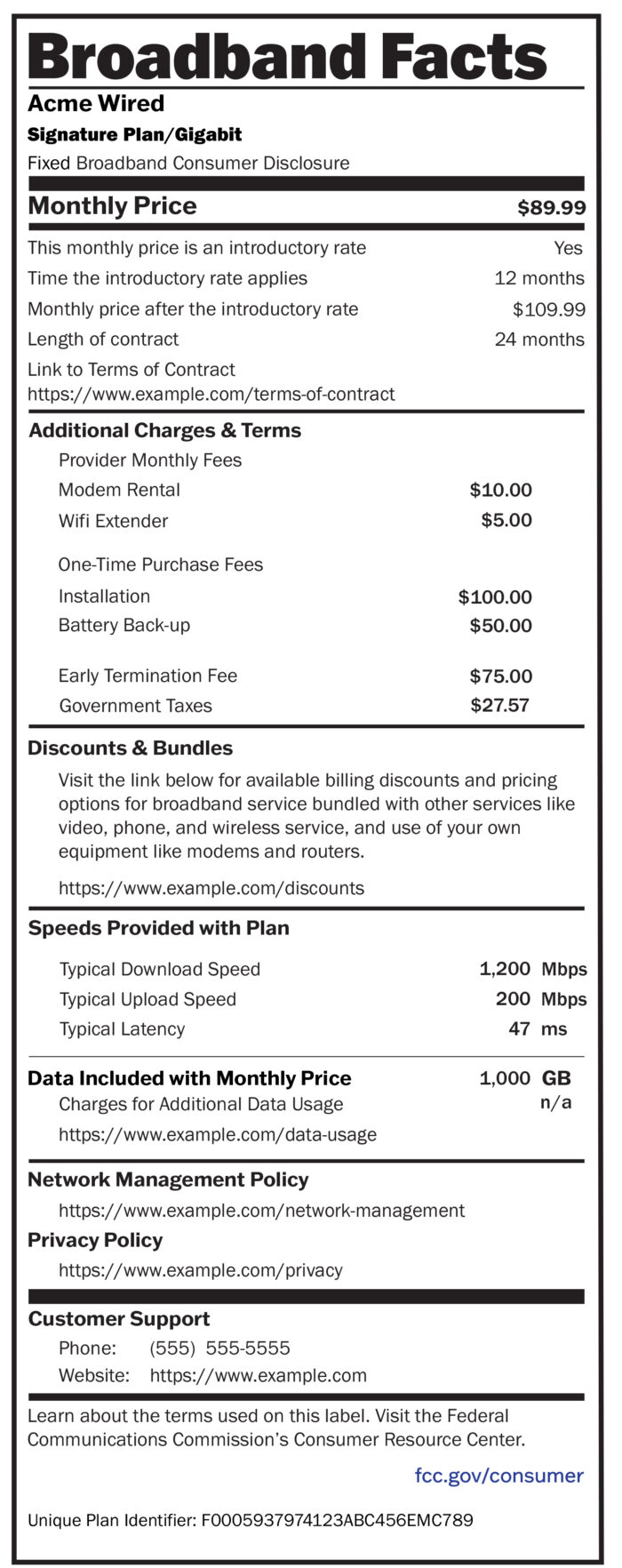
The labeling will resemble the nutrition labels found on food products. The labels must be easy-to-read and include broadband prices, introductory rate details, data allowances and broadband speeds. The labels must also include easy-to-navigate links to learn more about available discounts or service bundles, network management practices and privacy policies.
Separate labels must be displayed for each standalone broadband service offered and it cannot be buried where multiple clicks are reduced to a link, thumbnail or icon that a consumer might miss.
FCC Consumer and Governmental Affairs Bureau Chief Alejandro Roark said it was vital to get internet access service clarified and simplified.
“The FCC borrowed the nutrition label model format from food products because we wanted to make basic information about broadband internet service easily recognizable and easy to understand,” Roark said. “Our rules require that these labels be fully displayed at the point of sale, including on the main purchasing pages that providers may have online.”
Deputy Director of the White House National Economic Council Jon Donenberg said the labels will help consumers comparison shop for internet service, eliminating obscure terms and fine print.
“It will make sure that you have a clear, straightforward explanation of your home internet and mobile plans and services before you sign up for anything,” Donenberg said. “That transparency will also save you money. By making it easier to directly compare plans from one provider to another. Consumers will be able to get the best and most affordable deal on the market or the exact type of service that they need. And companies can compete on offering better terms, not just more confusing ones.”
Roark said the labeling requirements will be extended to the consumer’s monthly bills.
“We’re also making sure that consumers access the standardized, easy to understand information about their internet service plan and doesn’t end when they sign up for service.” Roark said. “In particular, the commission required internet service providers to make the labels accessible on a consumer’s online account. That means that consumers will be able to find this information whenever they pay their bill, compare their current plan to other plans, or engage in any other activity online.”
Regarding potential violations of the broadband labeling laws, the FCC Enforcement Bureau and other bureaus will monitor public reporting consumer complaints to the commission, notices from partner agencies and use other investigative tools to monitor compliance with the law, and refer matters to the Enforcement Bureau as appropriate.
Consumers who feel that the transparency rules are not being met may file complaints with the FCC. The commission will follow up on those complaints to see if there is some larger pattern that may need to be acted on.
To view a glossary that helps consumers better understand the information displayed on the label, click here.
Click here for a sample home broadband label.
Click here for a sample mobile broadband label.
Add WVPB as a preferred source on Google to see more from our team

On this West Virginia Week, nuclear power in West Virginia takes a step back, Child Protective Services (CPS) settles with five children, and we make a visit to a fire tower.
Continue Reading Take Me to More NewsAn autism non-profit says a series of barriers including low Medicaid reimbursement rates have made it all but impossible for the majority of West Virginia children diagnosed with autism to receive the treatment they need.
Continue Reading Take Me to More NewsWest Virginia brought in $16 million more than projected for September, 3% ahead of estimate. For the first three months of the fiscal year, collections are up $62 million with increases in most – but not all -- categories.
Continue Reading Take Me to More NewsFive children, abused at the hands of their adoptive parents and now 8-18 years of age, will share $4.4 million following an agreement between their attorneys and the state of West Virginia.
Continue Reading Take Me to More News