West Virginia is the third most forested state in the country. The fall foliage projection map, a collaboration between the West Virginia Department of Tourism and the Division of Forestry, promotes the best places in West Virginia to see changing fall colors.
Disaster Assistance Approved In First 4 Counties; FEMA Moving In
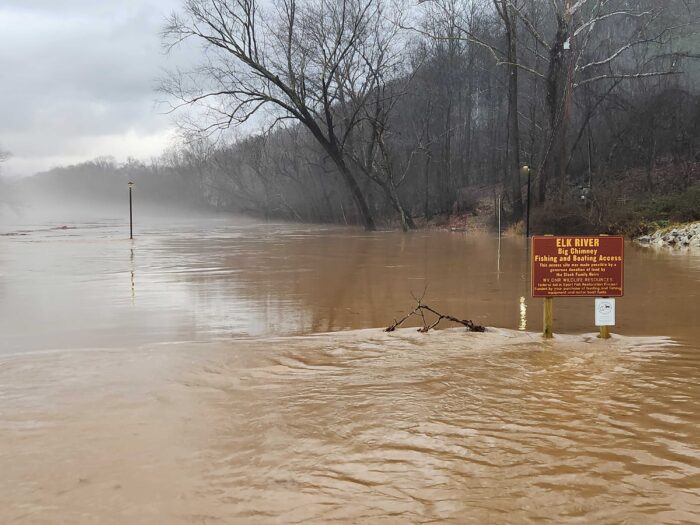
Flash flooding in February hit the southern half of the state hardest, but most seriously in the counties that border Kentucky including Mercer, McDowell, Mingo, and Wyoming counties. Eric Douglas/West Virginia Public Broadcasting
Share this Article
With federal disaster aid approved in Mercer, McDowell, Mingo, and Wyoming counties, the Federal Emergency Management Agency (FEMA) is setting up in the area. Those affected by the February flooding may also be able to access emergency SNAP benefits.
Those residents may also receive help with expenses related to essential items including temporary housing, home repairs, and other needs as a result of the winter flooding.
Flood victims who registered damages through a state survey still need to register directly with FEMA. The state survey was used to help the damage assistance teams apply for the federal help.
Logan and Wayne counties have been declared disaster areas, but the service locations have not been set up yet.
Phone lines are open every day and help is available in most languages. If you use a relay service such as video relay service (VRS) or captioned telephone service, please provide FEMA your number for that service.
4. Speak with someone in person.
Disaster Survivor Assistance (DSA) teams will be on the ground in impacted communities, walking door-to-door to share information and help residents apply for FEMA assistance.
If you have insurance, you should file a claim as soon as possible. FEMA can’t pay for losses that your insurance will cover.
When you apply, you will be asked to provide:
A description of the damage
Your contact information, including your current phone number and your 911 address where you can currently be reached
Your 911 address at the time of disaster
Your Social Security number
Your contact information
If you have insurance, your policy number, agent or company
Your annual household income
Your bank account information, if you would like to receive direct deposit
If you have already applied for FEMA assistance and have questions about the status of your application or about appealing a FEMA determination letter you have received, visit a DRC near you for one-on-one assistance or call the FEMA helpline at 1-800-621-3362. FEMA staff are ready to answer your questions.
Mercer County Disaster Recovery Center Lifeline Princeton Church of God 250 Oakvale Road Princeton, WV 24740 Hours of operation: Monday to Friday: 9 a.m. – 5 p.m. Saturday: 10 a.m. – 2 p.m. Closed Sundays Closed March 15, March 22, April 19
Mingo County Disaster Recovery Center Williamson Campus 1601 Armory Drive Williamson, WV 25661 Hours of operation: Monday through Saturday, 8 a.m. to 6 p.m. Closed on Sundays
McDowell County Disaster Recovery Center Bradshaw Town Hall 10002 Marshall Hwy Bradshaw, WV 24817 Hours of operation: Monday to Saturday: 8 a.m. to 6 p.m. Closed Sundays
Wyoming County Disaster Recovery Center Wyoming Court House 24 Main Ave Pineville, WV 24874 Hours of operation: Monday through Friday: 8 a.m. to 6 p.m. Saturday: 9 a.m. to 3 p.m. Closed on Sundays
How To Access SNAP Benefits
Nearly 3,000 households in those four counties may also be eligible for Disaster Supplement Nutrition Assistance benefits. D-SNAP benefits can be used to purchase food, but cannot be used to buy alcoholic beverages, tobacco, or non-food items.
Eligibility will be based on the household’s net income, which is determined by adding available income, cash on hand, and accessible bank accounts, then subtracting unreimbursed disaster-related expenses, like food loss or damage to property. Assets such as homes and automobiles are not included in the net income eligibility determination.
Residents of the four counties may apply for D-SNAP benefits from March 17, 2025, through March 21, 2025.
Applicants are strongly encouraged to bring the following items:
Photo proof of identity for the head of household, such as a driver’s license or other picture ID;
Documentation of residence or employment in the affected county at the time of disaster;
Verification of all income received since February 5, 2025, and ongoing
Verification of assets such as checking and savings accounts; and
Verification of all disaster-related expenses.
Most benefits will be available within one day of the application. Benefits must be used within 90 days.
Households in the four approved counties receiving ongoing SNAP benefits may be eligible for a one-time disaster supplement to help with recovery. These extra benefits will bring their monthly SNAP amount up to the maximum allowed for their household size. To qualify, households must either request replacement benefits since the disaster or submit a simple form confirming disaster-related expenses. However, households already receiving the maximum SNAP benefit are not eligible for additional funds.
SNAP benefits are 100% federally funded by the U.S. Department of Agriculture (USDA) and offer nutrition assistance to eligible low-income individuals and households.
D-SNAP Benefit Locations
Add WVPB as a preferred source on Google to see more from our team
Meta, parent company of social media platforms Facebook and Instagram, has agreed to introduce restrictions for younger users including time limits and content controls.
Three organizations have submitted letters supporting a PSC staff report submitted Aug. 19 that recommends the application for the MARL transmission line be delayed or dismissed.
Singer, actress and icon Dolly Parton visited West Virginia in 2022 to celebrate the state’s full participation in her Imagination Library, an early childhood literacy program she started in honor of her father in 1995. Dolly Parton died Tuesday after a brief illness. We listen back to an interview she did with then WVPB Executive Producer Suzanne Higgins.