


The Old Louisville Demon Leaper’s Mischief In One Of America’s Largest Victorian Neighborhoods
In the late 1800s, tales of a creature that bounds between rooftops emerged in Old Louisville — The Demon Leaper.
Continue Reading Take Me to More NewsAlert (09/29/2026): Our Parkersburg TV transmitter is still undergoing maintenance and remains temporarily inoperative. We apologize for the inconvenience.
All our programming is available via our TV livestreams on our website and WVPB Passport. Thank you for your patience!




To Educate, Inform, and Inspire by Telling West Virginia's Story

Mountain Readers 2026 has concluded! Please fill out our volunteer post-survey.

Nominate an exceptional West Virginia K-12 teacher today!

On Demand

On Demand

Stream original productions from WVPB

Watch locally produced documentaries & more.

On Demand

On Demand






West Virginia Morning

Inside Appalachia

West Virginia Week

Mountain Stage

Us & Them

The Legislature Today

The Legislature This Week

Send us your comments and questions.

Stream our board meetings.

Check out the latest WVPB news.

Sign up for our newsletter and get weekly updates.

Meet the WVPB staff.

WV Educational Broadcasting Commission, the WVPB Foundation, and the Friends of WVPB.

Come work with us!

Read our annual report and learn how we educate, inform and inspire with your support.

Sponsor impactful and engaging media and entertainment.

Use your IRA to make a gift to WVPB.

Become a member with your gift of $1,000 or more.

Make WVPB part of your legacy.

Manage your membership account.

Learn how you can Protect and Sustain West Virginia Public Broadcasting.
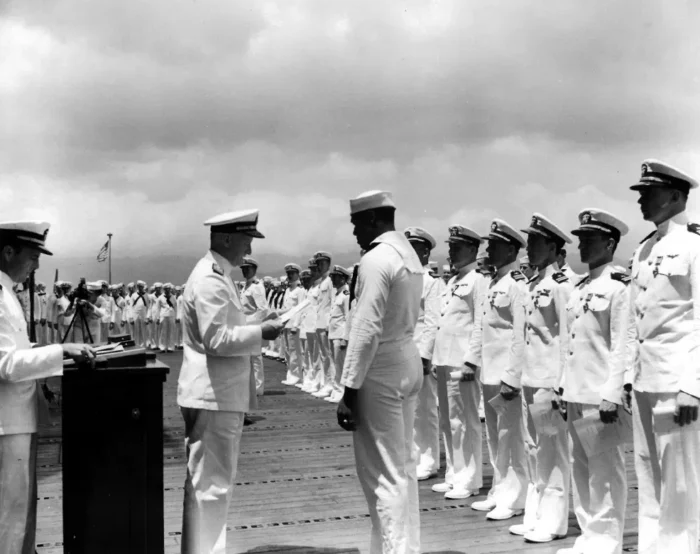
Many West Virginians may not remember the name Doris “Dorie” Miller, but he served on the USS West Virginia when it was attacked at Pearl Harbor.
Miller was a cook and had never been trained to fight on the warship. But on the morning of Dec. 7, 1941, he raced to the deck, manned a machine gun and engaged the enemy, shooting down at least one enemy airplane. He also helped evacuate fellow sailors from the ship before being ordered to abandon ship himself.
Miller was later awarded the Navy Cross, the first Black man to receive the honor.
In 2020, the U.S. Navy commissioned a new aircraft carrier, CVN-81, and chose to name it after Miller, but stories have surfaced recently of discussions about renaming it after President Donald Trump.
News Director Eric Douglas spoke with retired Army Lieutenant Colonel Scott Womack, the commander of American Legion Post 100 in Monroe, West Virginia, to discuss the group’s recent resolution that the Navy should retain Miller’s name on the ship.
Because of construction delays, the Gerald Ford-class aircraft carrier isn’t expected to enter service until 2034.
This interview has been lightly edited for clarity.
Douglas: Obviously, the connection here is that Miller served on the USS West Virginia valiantly. But why did you decide to take this up?
Womack: For two reasons. One is myself personally, but also the Post collectively, believe it’s simply time to honor enlisted service members at the same level as we honor admirals, presidents. When the round of army base renaming happened, I dearly hoped they would rename Fort Bragg, Fort Benavidez for Roy Benavidez, who’s an Army Medal of Honor winner. It seems to me historically enlisted soldiers have just been sort of relegated to, an underclass is the wrong word, but a different category and they don’t receive the same visibility. Yet, as enlisted soldiers and sailors, Marines, Coast Guard and Air Force and now Space Force who do the bulk of the work and suffer the bulk of the price, quite frankly.
And the second one, as a Black sailor serving at a time of official segregation and yet willing to go up top and engage the enemy directly without training is simply remarkable. So we realize that naming a ship for an enlisted sailor is unprecedented, but so is naming a ship for a sitting president.
As long as we’re going to do something unprecedented, let’s honor the enlisted sailor, as was the original plan in January 2020. Why change it?
Douglas: I certainly don’t know the names of all the current aircraft carriers. I believe there’s 11, we know the Washington, the Lincoln, I think the Eisenhower. They’re all former presidents, but it’s interesting that the Navy six years ago chose to name it after Doris Miller.
Womack: I think maybe someone at the Navy at the time, I haven’t researched the process they went through or what might have prompted it, but there’s surely recognition, at least then, of the value of enlisted service members, enlisted sailors, and that it’s their turn perhaps.
Carriers weren’t always named for presidents. The recent ones are, but the World War II carriers are Lexington, Yorktown. They were named for battles. The Enterprise came along. So it’s not like it’s never been done. It’s not always been presidents. I think the nuclear Navy, it probably has always been presidents, but I see no shame in making the change because it’s just high time that enlisted soldiers and sailors, airmen, Coast Guard, and Space Force and Air Force, got their due.
Douglas: You’ve issued a resolution simply saying keep it named after Doris Miller.
Womack: And then the second request is that the state level Department of West Virginia of the American Legion consider adopting ours as a state resolution and forwarding it to the national headquarters. and asking them to consider it as a national resolution. If that whole thing happens, that really adds a good bit of weight. The American Legion is the largest veteran’s organization in the country. And I think that would get people’s attention, probably more so than Post 100. But you got to start somewhere.
Douglas: Have we missed anything you would like to discuss?
Womack: The connection to West Virginia is the USS West Virginia. And I think I mentioned this in our press release that the ship was refloated and actually led the naval squadron into Tokyo Bay to end the war, 81 years ago. And I assume the Navy made that choice because it had been at Pearl Harbor. So even though the signing ceremony was on the Missouri, the West Virginia was at Pearl Harbor, and to have it lead in was probably making a statement that, “Yeah, we’re back.”
I kind of see that’s like a model for West Virginia. The state gets beat down a lot, environmentally, economically, and yet it keeps coming back. The people here are resilient. They keep coming back, keep refloating and keep fighting every day. So it’s a good analogy, I think.
Douglas: You and I probably agree on this, but Dorie Miller should be sort of an adopted son. He was one of ours. He fought on our ship.
Womack: Absolutely. Just as the ship did, he came out of nowhere and stood up and made a statement and made a big difference in so doing.
Add WVPB as a preferred source on Google to see more from our team

In the late 1800s, tales of a creature that bounds between rooftops emerged in Old Louisville — The Demon Leaper.
Continue Reading Take Me to More NewsAround campfires in Dickson County people tell passed-down tales of two local cryptids — one a werewolf and the other the White Bluff Screamer.
Continue Reading Take Me to More NewsSecretary of State Kris Warner has announced that 66,855 ballots have been cast across the state in absentee voting and the first four days of early voting.
Continue Reading Take Me to More NewsSilas House is a prolific writer who is a vital voice in Appalachia. House’s new book is "The Tulip Poplars." It’s a sweeping novel that chronicles the lives of four people as they navigate friendship and forbidden love in 20th century Kentucky. Inside Appalachia Host Mason Adams recently spoke with House.
Continue Reading Take Me to More News