Alert (09/29/2026): Our Parkersburg TV transmitter is still undergoing maintenance and remains temporarily inoperative. We apologize for the inconvenience.
All our programming is available via our TV livestreams on our website and WVPB Passport. Thank you for your patience!
Through early October, the Blowing Rock Art and History Museum in North Carolina is hosting an exhibit celebrating one of the region’s most notable fiber artists – Barbara Grennell. The exhibit does more than expose people to great art; it asks people, what makes art, art? Folkways Reporter Wendy Welch reports.
Need For More Mining Engineers Brings Dept. Of Energy To WVU
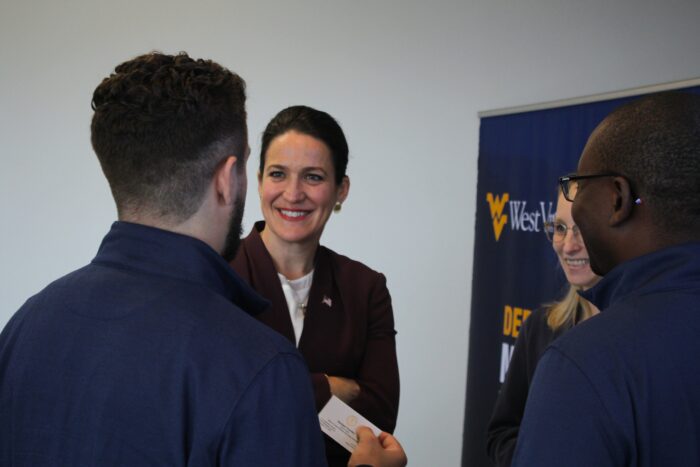
Assistant Secretary of Energy Audrey Robertson from the U.S. Department of Energy's Office of Critical Minerals and Energy Innovation speaks to students and staff during a visit to West Virginia University Sept. 29, 2026.Chris Schulz/West Virginia Public Broadcasting
Listen
Share this Article
Assistant Secretary of Energy Audrey Robertson from the Office of Critical Minerals and Energy Innovation visited West Virginia University Tuesday.
She was on campus to promote the Providing Opportunities for Specialized Education in Critical Technologies (PROSPECT) initiative. PROSPECT aims to double the number of graduates with degrees related to mining, minerals, and associated supply chain technologies within two years.
“Our estimate is that we need about 6,000 mining engineers in the next 10 years in order to maintain our dominance in AI, in order to maintain our national security, our economic security, and our energy security,” Robertson said. “That has to start right here with a lot more students like the ones you see around me today.”
She said the U.S. produces fewer than 200 mining engineers per year, compared to China graduating 3,000 mining engineers each year.
“The universities are competing now for a prize, they will need to deliver doubling of their graduates in 24 months,” Robertson said. “This is an unheard-of challenge at the university level. This is not gradually increase your enrollment. This is drastically change the number of graduates coming out of these great universities, and that’s the challenge.”
Robertson was on campus in part to hear from students about how best to attract future students. A panel of mining engineer students told her that raising awareness was key. They said a robust network of scholarships and industry connections is already in place to ensure most mining engineers accept job offers the fall of their senior year.
“This is a degree pathway and a career with such a bright future. Each of the students you see here today had multiple internship opportunities from their freshman year on. They have multiple job offers when they graduate, and they’re at the very highest end of that income scale with $75,000 to $95,000 starting salary,” Robertson said. “That is an ROI on your education, and WVU is the type of institution with great professors, great TAs, and a great program to prepare them to succeed in this environment going forward.”
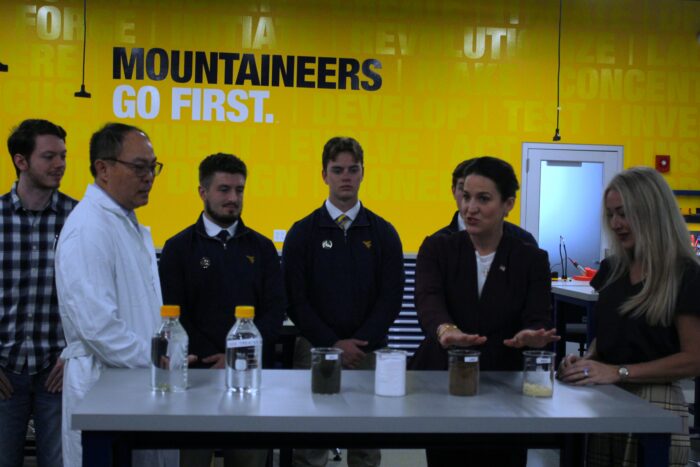
Audrey Robertson, U.S. Assistant Secretary of Energy, gestures at the products of WVU’s rare earth minerals extraction process Sept. 29, 2026. Lian-Shin Lin in the white lab coat is currently the Director of WVU Rare Earth Elements Initiative. Photo Credit: Chris Schulz/West Virginia Public Broadcasting
WVU engineers also showed Robertson their process for extracting rare earth elements from acid mine drainage.
“There are lots of ways to take the resources around us and through innovation, science, and engineering take those resources and turn them back into usable materials,” she said. “That is the fastest way to increase our mineral production in the United States by using what’s already here and repurposing it. You’re going to see an increased focus on that.”
In the future, PROSPECT will also support the implementation of new curricula, financial aid programs, and other incentives that promote continued growth in such fields.
The 2025 Annual Coal Report from the U.S. Energy Information Administration shows the country’s coal industry has experienced a steady decline over the past decade. Total production has fallen from 1.2 million short tons in 2014 to 800,000 short tons of coal in 2024, the most recent year of data available. The 2026 report is scheduled to be published next month.
“I think there’s a really bright future for providing energy, and coal is going to be part of that equation in a way that probably hasn’t happened in a while,” she said. “This Department of Energy has allowed for a number of coal plants around the country to stay open as a way to provide baseline power.”
Since returning to office last year, President Donald Trump has dialed back the federal government’s support for renewables and implemented policies favorable to fossil fuels, including coal.
Students mentioned to Robertson that perception of the mining industry as dirty and dangerous was something most of them had to overcome, and continued to be an obstacle to attracting friends in other engineering disciplines from changing majors.
When asked about worker safety as part of the Trump administration’s planned expansion of mining, Robertson said expansion presented “an exciting opportunity to be not the dull, dirty, and dangerous industry of the past, but really the industry of innovation in the future.”
“With that is going to come the uncompromising safety and environmental regulations,” she said. “Here in the United States, we do it safer than anyone. We are the safest mining community in the world. We produce the cleanest molecules and the cleanest resources on the planet. That is not going to change, and that we’re not going to compromise on.”
Add WVPB as a preferred source on Google to see more from our team
Across the Appalachian Mid-South, local law enforcement is doing more to support U.S. Immigration and Customs Enforcement (ICE) in detaining people. Morgan Watkins with the Kentucky Center for Investigative Reporting analyzed the latest data on ICE arrests in Kentucky, Tennessee and West Virginia. Louisville Public Media's Bill Burton spoke with her about what she learned.
Many farmers in our region raise sheep for meat, but not so much for wool. There’s not a great market for it with textile companies overseas, but researchers at Virginia Tech have teamed up with farmers, to figure out how to use wool to insulate houses, potentially creating a new market.
With West Virginia’s inclusion in the Nuclear Lifecycle Innovation Campuses from the U.S. Department of Energy earlier this month, WVU wants to prepare graduates for demand in a future nuclear industry in the state.
An energy rebate program offered through the U.S. Dept. of Energy provides $88 million to help cut utility bills for low and moderate households in West Virginia.