


Room With A View?
Steel stairs lead to the top of the Red Oak Fire Tower where there's a 14-foot square cabin with panoramic windows and a metal catwalk. There's electricity, but no water.
Continue Reading Take Me to More NewsAlert (09/29/2026): Our Parkersburg TV transmitter is still undergoing maintenance and remains temporarily inoperative. We apologize for the inconvenience.
All our programming is available via our TV livestreams on our website and WVPB Passport. Thank you for your patience!




To Educate, Inform, and Inspire by Telling West Virginia's Story

Mountain Readers Week will be held Oct. 5-9, 2026! Celebrate and foster a love of reading in children across West Virginia.

Nominate an exceptional West Virginia K-12 teacher today!

On Demand

On Demand

Stream original productions from WVPB

Watch locally produced documentaries & more.

On Demand

On Demand






West Virginia Morning

Inside Appalachia

West Virginia Week

Mountain Stage

Us & Them

The Legislature Today

The Legislature This Week

Send us your comments and questions.

Stream our board meetings.

Check out the latest WVPB news.

Sign up for our newsletter and get weekly updates.

Meet the WVPB staff.

WV Educational Broadcasting Commission, the WVPB Foundation, and the Friends of WVPB.

Come work with us!

Read our annual report and learn how we educate, inform and inspire with your support.

Sponsor impactful and engaging media and entertainment.

Use your IRA to make a gift to WVPB.

Become a member with your gift of $1,000 or more.

Make WVPB part of your legacy.

Manage your membership account.

Learn how you can Protect and Sustain West Virginia Public Broadcasting.
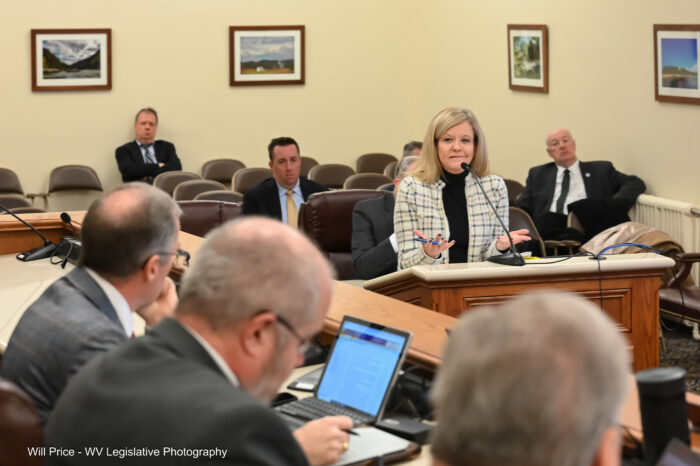
State senators are taking the financial crisis of one school district as a chance to revisit broader funding issues in West Virginia schools.
The Senate Education Committee spent over an hour Tuesday discussing House Bill 4574 to provide emergency funding to Hancock County Schools, but adjourned without taking action.
This is in contrast to the House of Delegates, where rules were suspended last week to quickly pass two bills after the state Board of Education announced the district was at risk of running out of funds by March. Some senators have already expressed frustration that their chamber has not matched the House’s sense of urgency on the matter.
Sen. Jay Taylor, R-Taylor, was one of several lawmakers who expressed concern Tuesday that emergency funds would paper over larger system issues with school funding and erode public trust. Taylor expressed confusion to state Superintendent Michele Blatt as to why the West Virginia Department of Education reported that a large portion of Hancock County Schools’ overspending was from being overstaffed, while the state as a whole continued to report chronic understaffing of teachers.
“The difference is, when you hear about that – it’s been a 1,700 number or 1,500 number (of vacancies) – those are people in positions that are not fully certified to be in those positions,” Blatt said. “The ‘vacancy’ word gets used a lot. They’re not true vacancies in that there’s not people there, but it’s a teacher that may be teaching algebra that does not have the certification to teach algebra.”
Taylor remained unconvinced.
“We come to them with stuff like this, ‘Hey, we need more money.’ They’re not going to trust us, and this is exactly why they don’t trust us,” he said. “This smoke and mirrors, cloak and dagger. ‘Oh, we got too much here, not enough there. Oh, this isn’t certified.’ Well, this is this, is this and this is that. That doesn’t make sense to the average West Virginian. And to be honest, it doesn’t make sense to me. It’s unacceptable.”
HB 4574 allows the West Virginia Board of Education to loan money to school districts with distressed finances under specific circumstances. Education Vice Chair Sen. Charles Clements, R-Wetzel, asked how the districts were expected to pay those loans back.
Blatt said much of the money – especially in the case of Hancock County Schools – will come from reductions in force, more commonly known as RIFs.
“It’s going to be very tight,” she said. “We do know that, moving forward in Hancock, one of the senators mentioned the fact that they also added on funding for a turf and athletic facility just really dug their hole even deeper.”
Senators are expected to continue their discussion Thursday morning.
Add WVPB as a preferred source on Google to see more from our team

A proposed amendment to the West Virginia Constitution is on the ballot Nov. 3 to prevent noncitizens from voting.
Continue Reading Take Me to More NewsA U.S. Energy official visited the West Virginia University campus Tuesday, to promote an effort to increase the number of graduates with expertise in mining, minerals and associated supply chain technologies.
Continue Reading Take Me to More NewsWith West Virginia’s inclusion in the Nuclear Lifecycle Innovation Campuses from the U.S. Department of Energy earlier this month, WVU wants to prepare graduates for demand in a future nuclear industry in the state.
Continue Reading Take Me to More NewsIn this first part of our conversation with assistant professor and director of the West Virginia State University Cybersecurity Innovation Center, Ali Al-Sinayyid, we learn a little about the history of AI and its evolution.
Continue Reading Take Me to More News