Aluminum Plates For Deep Space Win W.Va. 'Coolest' Contest
Aluminum plates that helped keep astronauts on the Artemis II rocket safe won the first ever Coolest Thing Made In West Virginia competition.
Continue Reading Take Me to More NewsAlert (09/29/2026): Our Parkersburg TV transmitter is still undergoing maintenance and remains temporarily inoperative. We apologize for the inconvenience.
All our programming is available via our TV livestreams on our website and WVPB Passport. Thank you for your patience!




To Educate, Inform, and Inspire by Telling West Virginia's Story
Mountain Readers Week will be held Oct. 5-9, 2026! Celebrate and foster a love of reading in children across West Virginia.
Nominate an exceptional West Virginia K-12 teacher today!

On Demand

On Demand

Stream original productions from WVPB

Watch locally produced documentaries & more.

On Demand

On Demand






West Virginia Morning

Inside Appalachia

West Virginia Week

Mountain Stage

Us & Them

The Legislature Today

The Legislature This Week

Send us your comments and questions.

Stream our board meetings.

Check out the latest WVPB news.

Sign up for our newsletter and get weekly updates.

Meet the WVPB staff.

WV Educational Broadcasting Commission, the WVPB Foundation, and the Friends of WVPB.

Come work with us!

Read our annual report and learn how we educate, inform and inspire with your support.

Sponsor impactful and engaging media and entertainment.

Use your IRA to make a gift to WVPB.

Become a member with your gift of $1,000 or more.

Make WVPB part of your legacy.

Manage your membership account.

Learn how you can Protect and Sustain West Virginia Public Broadcasting.
When driving up onto the ridge above the Cheat River where Preston High School sits, a turn left takes you to the traditional classrooms of the main school building.
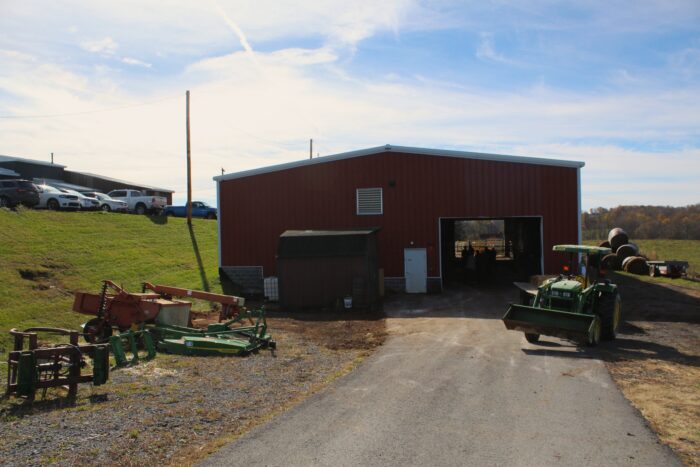
But a turn right takes you into a world of career and technical education, including the school’s mechanic’s shop, a farm, and something no other school in the state has: a slaughterhouse.
“It brings a lot of pride, because we’re the only one that has the full fledged slaughterhouse,” Robert Varner said.
Varner is the processing teacher and Future Farmers of America advisor at Preston High School. He said for close to 40 years the school’s processing class has taught students every step of how to safely turn an animal into meat for the dinner table or market.
“We bring the animal [in] alive and it goes out in packages,” Varner said. “We harvest the animal and everything.”
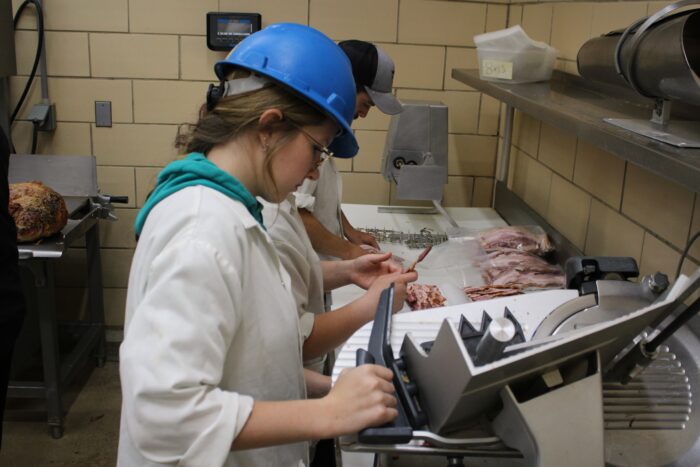
In a classroom where 12 inch knives are wielded as regularly as pens, Varner said safety is key. Students spend a week going over safety procedures before they’re even allowed to wrap meat, let alone touch a blade.
But with careful attention and training, Varner trains students to use vacuum sealers, grinders and even eventually a bandsaw to get through big sides of meat. He said by the end of the year, he’s just an observer.
“But by the time they get out of here, I don’t have to put my coffee cup down,” Varner said. “I hand them the cutting order, so you go get the beef or a hog. They cut it up. I’m sitting there drinking coffee and watching them. They do all the work.”
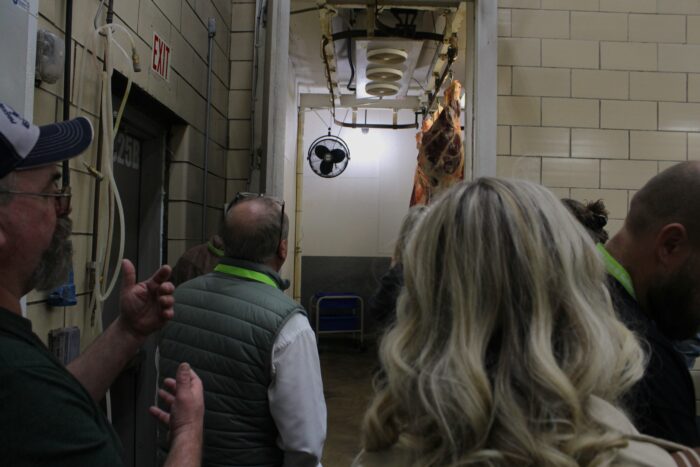
Along with Varner, a state food safety inspector is regularly on site, especially when an animal is being harvested. Varner said sales of the meat students process, as well as fees for processing animals local farmers bring in, not only pays for the program, but the county’s 150 acre farm as well.
James Kimble is the director of Wetzel County Career and Technical Education and Tech Center. He toured Preston’s slaughterhouse late last year as part of a delegation of CTE educators from across the state.
“I wanted to see how they bring the animal in from start to finish,” Kimble said. “Because that’s not a normal process in most high schools. So I wanted to see that.”
Kimble said his school and about 30 to 40 others across the state have processing classes where students learn the art of butchering, but not a slaughterhouse. That means Wetzel’s student-raised hogs have to be taken up to Pennsylvania to be killed, before being brought back for students to process.
According to data from the Future Farmers of America there were 25 meat processing facilities in schools across West Virginia for the 2022-2023 school year, the most recent year data is available.
Kimble said a program like the one in Preston is only possible thanks to a teacher like Varner, a dying breed of agricultural teachers.
“Ag teachers are a different breed. They love what they do, the kids love doing the meat processing,” Kimble said. “It teaches kids a great work ethic, because you know you have to come in after hours, after football practice, after basketball practice, and make sure your hams, your bacons, everything’s cut up, cured, ready to be processed. It’s a dedication by not only the teachers, but also the students as well.”
Lila Riley is a 17-year-old that has taken up the mantle – or more accurately the apron – in Varner’s class. She came in expecting to learn, but said she and her family have been surprised at just how much she has picked up.
“You learn, you do learn a lot,” Riley said. “My family, we kill a lot of deer. We have a farm. It’s just something I’d like to know. It has been very useful, especially with deer season.”
In a busy year, Varner said about a dozen students will take his class. Riley said there should be more students taking the class, but there is a certain stigma around working with an animal carcass that high school students are not immune to.
“Sometimes, when we’re on the kill floor, they’ll say, you stink,” she said. “But it’s all worth it, because in the long run, I know more about killing and processing than they do.”
Riley said she sees the benefit of having butchering skills after she graduates to start a family business or just cut down on cost around deer farming. That’s not her plan for now, but she’s happy for the opportunity.
“I think it’s an awesome opportunity. More kids need to get into it,” Riley said. “I feel like we need to expand our CTE. This is an awesome program, and kids would love it.”
Gov. Patrick Morrisey has flagged workforce education and training as a requirement for the state’s planned economic growth. And with schools across the state consolidating or looking to upgrade outdated facilities, it’s possible West Virginia’s second student-run slaughterhouse could be in your community in the coming years.

Add WVPB as a preferred source on Google to see more from our team

"Mountain Moves” is a new educational board game designed by the West Virginia Department of Tourism and West Virginia Department of Education to engage eighth-grade students in West Virginia history, tourism and career opportunities.
Continue Reading Take Me to More NewsTwo cases about whether the West Virginia Board of Education can mandate vaccines to students entering school without allowing for religious exemptions have been combined by the state Supreme Court of Appeals.
Continue Reading Take Me to More NewsA U.S. Energy official visited the West Virginia University campus Tuesday, to promote an effort to increase the number of graduates with expertise in mining, minerals and associated supply chain technologies.
Continue Reading Take Me to More NewsWith West Virginia’s inclusion in the Nuclear Lifecycle Innovation Campuses from the U.S. Department of Energy earlier this month, WVU wants to prepare graduates for demand in a future nuclear industry in the state.
Continue Reading Take Me to More News