This week, we’re revisiting our episode “What Is Appalachia?” from December 2021. Appalachia connects mountainous parts of the South, the Midwest, the Rust Belt and even the Northeast. That leaves so much room for geographic and cultural variation, as well as many different views on what Appalachia really is.
House Suspends Rules To Address Hancock County Schools Financial Crisis
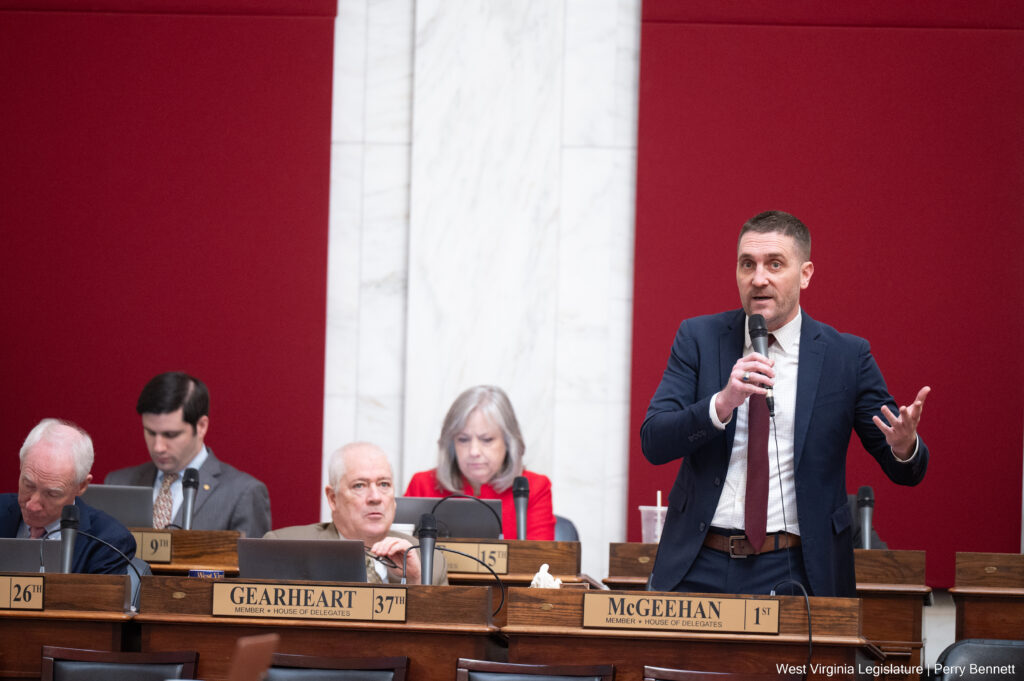
House Majority Leader Del. Pat McGeehan, R-Hancock, explains the need for supplementary appropriations to address the financial insolvency of Hancock County Schools on the floor of the House of Delegates Jan. 19, 2026.Perry Bennett/WV Legislative Photography
Listen
Share this Article
The West Virginia House of Delegates suspended its own rule Monday to provide emergency funds to Hancock County Schools.
The West Virginia Board of Education declared a state of emergency on Friday due to the district’s financial issues.
The West Virginia Constitution states that “No bill shall become a law until it has been fully and distinctly read, on three different days, in each house, unless in case of urgency.” Lawmakers voted to suspend rules because House Majority Leader Pat McGeehan, R-Hancock, said gross mismanagement has led to a situation where current funds available to the district would not carry them through March.
“The state school board and the Department of Education have said they’ve never seen anything like it, where a county superintendent or administration doesn’t make the proper adjustments at the beginning of the year and then just allows the deadlines for being able to kind of make sure things get back on track with a balanced budget, allows that to pass,” McGeehan said. “Now they have no more money, and they’re insolvent, even though there’s obligations, they have to make payroll for the rest of that school year.”
Delegates passed House Bill 4574 to grant the state Board of Education the ability to administer supplemental funds beyond the state school funding formula. The bill creates a loan program titled, “Temporary Shortfall Supplement Fund for County Boards of Education” for financially distressed counties whose reserve funding has fallen below 5% of available funding. The funds carry with them limitations to only be spent to honor personnel obligations and other essential operating expenses and reporting requirements to both the state Board of Education and the Legislative Oversight Commission on Education Accountability.
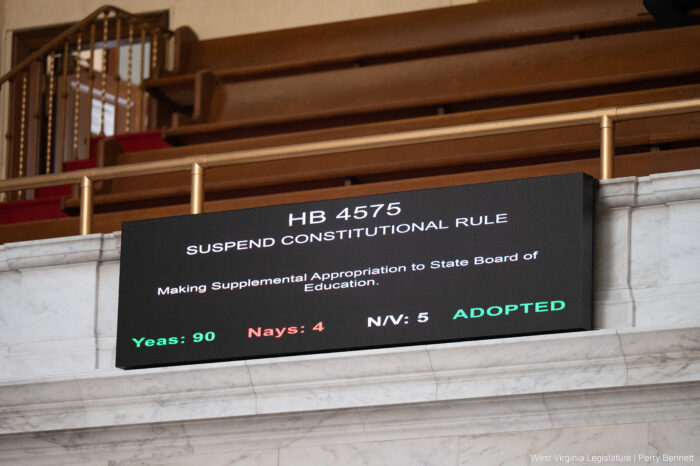
Lawmakers also approved of House Bill 4575, which appropriates an additional $8 million to the state school system to fund the Shortfall Supplement Fund. Both bills passed with overwhelming majorities.
The House of Delegates suspended a rule that requires a bill be read on three separate days to pass two bills to address the financial insolvency of Hancock County Schools Jan. 19, 2026. Photo Credit: Perry Bennett/WV Legislative Photography
The West Virginia Department of Education estimated the Hancock County Schools has overspent its budget by close to $8 million, starting fiscal year 2024 with a $5.5 million fund balance to now having a projected deficit of $2 million. McGeehan said much of the overspending came from the district having more than 140 employees over what the school funding formula budgeted for, as well as large spending on athletic facilities at several schools.
“Then there was also a number of other things that took place, and there may have been potentially some… well, it was gross mismanagement,” he said. “Hopefully it’s not more, something worse than that.”
McGeehan said he was made aware of the situation last month, and he expected the situation is likely to prompt a reevaluation of school finances and legislative oversight.
House Minority Leader Sean Hornbuckle, D-Cabell, urged passage, but urged caution due to the direct effects the situation has on children and local jobs.
“I would also say to piggyback off the gentleman from the first looking at oversight measures and what we can do in auditing,” Hornbuckle said. “But more importantly than that, I would recommend to this body we need to re-evaluate also what we have done and what we will do to make sure we are not putting financial hardships on counties, so that we are not sitting here yet again, having to make emergency action, because if we do not, we will be here.”
Both bills now head to the Senate for its consideration.
An act of vandalism at Appalachian Power’s East Lynn substation in Wayne County has caused nearly 5,000 gallons of what is believed to be a non-PCB fluid to leak from the facility into the nearby creek.
The West Virginia Legislature returns to Charleston and Gov. Patrick Morrisey delivered his State of the State address. Also, flu cases are rising in surrounding states. What does that mean for West Virginia?
On The Legislature This Week, the legislature gavels in and Gov. Patrick Morrisey lays out his vision in his state of the state address. We also hear the minority party’s response to the governor’s address.
The West Virginia Legislature is back in Charleston for the 2026 legislative session. Gov. Patrick Morrisey delivered his second State of the State to the legislature Wednesday night and is seeking a 3% pay raise for state workers and a 10% income tax cut, among other items. Also, in this show, Sen. Mike Woelfel and Del. Sean Hornbuckle offer the minority response.