Alert (09/10/2026): Our Parkersburg TV transmitter is undergoing maintenance for a few days and will not be operational. We apologize for any inconvenience.
All our programming is available via our TV livestreams on our website and WVPB Passport. Thank you for your patience!
This week, in author Willie Carver, Jr.’s new book, he reconsiders a negative childhood experience with a neighborhood girl who might have just been looking for a friend. Also, a southwestern Virginia community rang the alarm after more and more of its children were diagnosed with cancer. A local journalist is trying to unravel the cause. And, the city of Asheville has a new crusading reporter. He’s a puppet.
Cemeteries Project Revives The Stories Of W.Va. Veterans
The West Virginia National Cemeteries Project pairs high school students with graduate students to research the lives of veterans interred at the state's two National Cemeteries, including the Grafton National Cemetery pictured here.Chris Schulz/West Virginia Public Broadcasting
Kyle Warmack, West Virginia Humanities Council program officer and the project’s facilitator, said the project’s goal was to foster deeper engagement with the stories and sacrifice of local veterans, but also to promote important research and writing skills.
“At the Humanities Council, I have the privilege of working with a lot of folks in academia at the college level, and when you talk to them, there can sometimes be frustration with the students that they have coming in, and the level of experience they have with research and writing,” he said.
For the cemeteries project, Warmack helped pair history graduate students from West Virginia University with high school students from Grafton High School to delve into the lives of veterans buried in the local cemeteries. Grafton was a logical place for Warmack to start the project.
“Look at Grafton and the long history that they have with the cemetery, with the Memorial Day parade they have here,” he said. “Parades are wonderful, these are wonderful displays of both community and patriotic sentiment. But when do we get a chance to tell the stories behind the veterans that we’re celebrating? There are thousands of headstones in these cemeteries.”
The Grafton National Cemetery was established in 1867 as a permanent burial site for Union soldiers who had died in hospitals and on battlefields throughout West Virginia. Two years later, the town held its first Memorial Day parade, a tradition that continues to this day. Then, in the 1960s, the West Virginia National Cemetery was established five miles away in Pruntytown as the Grafton cemetery began to fill up.
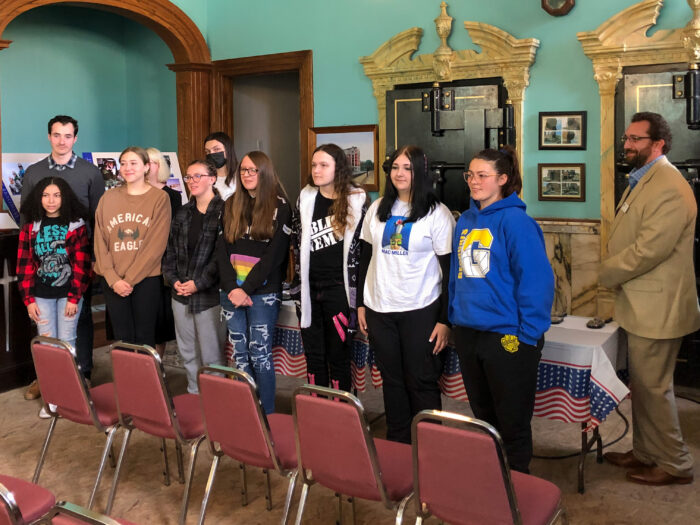
Some of the students from Grafton High School and West Virginia University that participated in the West Virginia National Cemeteries Project pose for a photograph at the Taylor County Historical and Genealogical Society Monday, April 24, 2023. Credit: Chris Schulz/West Virginia Public Broadcasting
For high school students like Karigan Roudte, who researched the life and World War II service of twins Charles and William Lewellyn of Harrisville, the process was eye-opening.
“It’s an amazing experience. I honestly have never really thought about war as much as I have,” she said. “It’s brought so much insight to me to see how these twin brothers, they grew up together and they died together, how they intersect. It’s honestly a real changing thing, how I thought about war and life, and it’s brought such a new world and opened so many different doors to me. I think it’s a really great thing that they brought us to be able to experience.”
Becky Bartlett is a teacher and librarian at Grafton High School, and along with her colleague Richard Zukowski, she supervises the students’ research. Bartlett said the project is an engaging way for her students to learn research skills that go well beyond the computer.
“Probably one of the most important things for the kids of the 21st century to learn is that not everything is online. Since I have been the librarian, I have literally had students say to me, ‘It’s all online,’” she said. “They don’t understand, because they’ve grown up in a life that they can easily get online and search, that sometimes you have to go find a book. Sometimes you have to go to the courthouse and pull records. Sometimes you have to actually contact people to get interviews that were recorded, things like that, that aren’t online.”
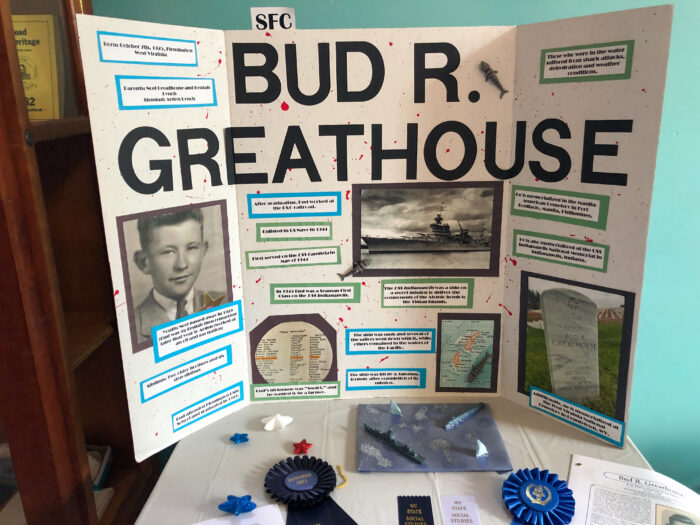
Students had the opportunity to learn about major military events like the sinking of the USS Indianapolis in World War II, to the more human aspects of service, like Pauline Tetrick of Bridgeport who joined the Women’s Army Corps at the age of 36, at the end of the Korean War.
Beyond hard skills, one aspect of the project that Bartlett likes is that she can see it fostering a deeper interest in history, one that she hopes will last her students a lifetime.
“We have learned a lot just about the history of these wars that these veterans served in. I did not know the story behind the USS Indianapolis until we did this project,” she said. “There’s that rabbit hole, you learn something, and then you see the connection to it in so many places. And I think they’ll probably be learning stuff for the rest of their lives.”
One of the displays created by students presents information about veteran Bud Greathouse, who was killed in action serving on the USS Indianapolis. Credit: Chris Schulz/West Virginia Public Broadcasting
That level of engagement is certainly evident when speaking with Emily Bublitz who is a graduate student of history at West Virginia University.
“We do a lot of the back-end research,” she said. “In the initial stages, we go in and we have this huge master list of everyone who has been buried at the National Cemetery, then we go through and research the vets to try and get one that we find that has enough materials on them to know that we can write a biography based off of them, because some people, there’s nothing. Maybe, there’s like just a draft card, but there’s nothing else.”
For Bublitz, the most rewarding aspect of the project is precisely why it was established: making a human connection to the name on the gravestone.
“The more I learn about these veterans like that, the more I care about them and their stories, and I want to do them justice,” she said. “That becomes very central to how I go about doing my work with this. I see it as giving them back their personhood, because they’re more than just veterans. That’s such a core part of who they were, but they’re also more than that. I want them to be remembered as fully fleshed out people who had families and interests and hobbies.”
The West Virginia Humanities Council hopes to expand the project to more schools in the coming years.
Add WVPB as a preferred source on Google to see more from our team
This week, in author Willie Carver, Jr.’s new book, he reconsiders a negative childhood experience with a neighborhood girl who might have just been looking for a friend. Also, a southwestern Virginia community rang the alarm after more and more of its children were diagnosed with cancer. A local journalist is trying to unravel the cause. And, the city of Asheville has a new crusading reporter. He’s a puppet.
Lydia Hamessley is a professor of music at Hamilton College in New York and the author of "Unlikely Angel, The Songs of Dolly Parton." She spent nearly a decade researching Dolly's music catalog. Inside Appalachia Associate Producer Abby Neff talked with Hamessley.
Dolly meant a lot to educator, author and poet Willie Edward Taylor Carver, Jr. from east Kentucky. Inside Appalachia Producer Bill Lynch spoke with Carver about the loss of Dolly Parton.