The economy is everything we buy or sell and the services we use. It can be a pretty broad category and most of us struggle to understand what it all means.
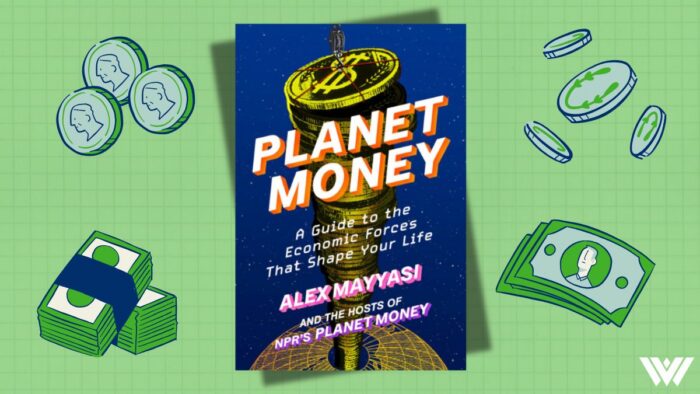
The show Planet Money from NPR dives into those topics and attempts to make sense of it all. And now, the show has published a book called Planet Money: A Guide to the Economic Forces That Shape Your Life, written by Alex Mayyasi.
WVPB News Director Eric Douglas spoke with Mayyasi and one of the show hosts Sarah Gonzalez to break it down and learn more about what readers and listeners can gain.
Tune in to Planet Money on WVPB Tuesday nights at 9 p.m.
This interview has been lightly edited for clarity.
Douglas: Give me the 30 second version. What is the economy? Why should I care about it?
Mayyasi: I mean, first I have to give my favorite joke is that economists say economics is what economists do, because there is this way that it’s a little bit nebulous, and that’s what we’re referring to. But I think one answer is that the economy is humanity’s greatest invention. The economy is all of us pursuing our interests and values, training with each other, interacting with each other, working together. Sometimes when we don’t even know it and we just find it absolutely fascinating to try to better understand and learn how it works and share that with other people.
Gonzalez: So in the book, we say just a short 100 years ago, if you were to ask anyone “How is the economy doing?” people wouldn’t know what you even meant by that. And so, in the book, we get into what created the concept of the economy in the first place. So, we really start at the beginning.
Douglas: One of the researchers is going back 4,000 years in the early part of the book. And I’m like, wow, all right, we’re starting baseline here.
Gonzalez: I think you’re talking about “The History of Light.” Yeah, I love “The History of Light” chapter. So, for the listeners, we basically get into like, how many hours you used to have to work to afford to light up a room in your home for one hour. And we do this as a way to explain what we would now call the cost of living and why some things like light or clothes or food have gotten cheaper and cheaper over time, and will get cheaper and cheaper for ever and ever and ever, while other things like childcare are going to keep getting more and more and more expensive.
Douglas: What is the general public getting wrong about the economy?
Mayyasi: Big question. I mean all of us are getting things wrong all the time, and that’s what economists recognize, that they’ve advanced the frontier of understanding a lot, but there are a lot of things they want to understand better.
I will say one thing that I think economic research has really shown is a misconception, so much so that they’ve given a name to it, is something called the lump of labor fallacy, and so that idea is really relevant.
Now, I think as people are thinking about AI (artificial intelligence) and automation, people are thinking will AI take my job? And, you know, I think that is something that’s totally reasonable to be concerned about. But there is this kind of misconception that AI might start doing everyone’s jobs and then, what will I do? There’ll be no jobs left for us. They’ll just have this underclass of permanently unemployed people.
We could see over time that there’s not this fixed amount of work, and if we automate some of it, there’ll be less work overall. Humans always come up with new ideas. We have new wants and needs and desires that people try to address and solve. You can look back not that long ago, something like 70% of the American workforce worked on farms. And then, of course, we had all sorts of automating technology used on farms. The number of people who work on farms today, the percentage is quite low, but it’s not like those people had nothing to do.
People moved to the cities and started working in factories. And today, like a lot of the most common jobs in the country, there are all sorts of jobs people do that just didn’t even exist 50 or 100 years ago. So that’s the lump of labor fallacy, there’s not just a set amount of work, and if we automate some of it, all those people will be unemployed. There’s always more work that can be created as we come up with new ideas, new companies, new innovations.
Douglas: Later in the book, you refer to the cost of goods and services and the rising cost of childcare. Specifically, that’s something we’re struggling with in West Virginia and the idea of subsidizing childcare, we hear it every legislative session that people need more childcare, and if we had more childcare, we could actually get more people into the workforce. So, explain why childcare keeps getting more and more expensive.
Gonzalez: So, I did an episode on the daycare market. We called it “Baby’s first market failure,” because it was basically like, you have people that are like, “here I am, I have money, I want to pay for childcare. Take my money. Somebody. Please take my money.”
And yet still, people are like, “oh, sorry, hold on. There’s a waitlist for that.”
Lines are a sign that something is wrong in that market. Something is broken. If you have money and you’re willing to pay for something, you should be able to get that thing right? But then also, why is it even so expensive? And one of the answers, and obviously there’s a lot of answers, but one of the answers is just that, while technological advancements can make it so that you need less labor for things to make clothes or to make a bag of chips or whatever, it’s still going to take one adult to care for four kids, right? I think in most places it’s like a one to four ratio for infants. And so, you can’t really innovate your way out of that. And the same thing is true for going to go see a play. You’re always going to need however many people to perform this play.
Mayyasi: You need four people for a quartet. There’s no getting around it.
Douglas: At the end of that section in the book, you refer to taxation. Our taxes are how we pay for those services and they’re just inevitable, that they will keep increasing.
Mayyasi: We were just talking about how it’s possible, over time, to make it always cheaper and faster to produce a TV, but you can’t make daycare cheaper and faster. The cost of labor actually tends to go up as your economy grows. This is kind of the price of success that things like childcare, haircuts, the arts, that are just labor intensive, they get more expensive over time. It’s kind of the price of success of living in a growing economy.
That sounds like a huge bummer, but it is also the case that if the entire economy is growing, the entire society is wealthier, and that means there is money, a successful economy makes enough new wealth, generates enough new wealth, that you can use a portion of that to subsidize things like childcare and daycare, that the cost of them, like you can’t innovate them to be cheaper, that they do get more expensive, and that are just, like, really essential to our lives.
Douglas: Any last comment?
Gonzalez: For me, an important point to make is that if you are not naturally interested in the economy, I think that is kind of where we meet people with this book. So, it’s not necessarily what isn’t working about the economy. We try to answer the hugest questions of the economy right now, but we also do things like getting into the root of what is a bank? It’s a confidence trick. It only works if we all believe in it, right?
So, it’s that kind of thing. And economics is like, it’s the daycare market, right? It’s your love life, it’s the grocery store. I mean, it’s all around you. It’s everything.