


Pro Bike Races Return To Charleston
The 2026 USA Cycling Professional Road National Championships will take place June 16-21 on the roads of downtown Charleston.
Continue Reading Take Me to More News


The winning stories from the 2026 WVPB PBS KIDS Writers Contest are now available to read!

Nominate an exceptional West Virginia teacher today!

On Demand

On Demand

Watch locally produced documentaries & more.

On Demand

On Demand



West Virginia Morning
Inside Appalachia
West Virginia Week
Mountain Stage
Us & Them
The Legislature Today
The Legislature This Week

Send us your comments and questions.

Stream our board meetings.

Check out the latest WVPB news.

Sign up for our newsletter and get weekly updates.

Meet the WVPB staff.

WV Educational Broadcasting Commission, the WVPB Foundation, and the Friends of WVPB.

Come work with us!

Read our annual report and learn how we educate, inform and inspire with your support.

Sponsor impactful and engaging media and entertainment.

Use your IRA to make a gift to WVPB.

Become a member with your gift of $1,000 or more.

Make WVPB part of your legacy.

Manage your membership account.

Learn how you can Protect and Sustain West Virginia Public Broadcasting.

Tallow is rendered animal fat and has been used primarily in traditional food preparation — as an ingredient and as a cooking oil. In addition, tallow can be used in making soap, candles, healing salves, skin moisturizers and perfumes, as well as lubricants for wood, leather and metal working.
Tallow is produced by a stovetop technique known as rendering, which is the melting and clarifying of hard fat from around the kidneys and loins of mostly cattle and sheep. But tallow can be rendered from the fats of other ruminants, including both domestic and wild species such as deer and goats.
Rendering purifies the fat and rids it of “cracklings,” the bits of protein that can spoil the tallow if left unrefrigerated.
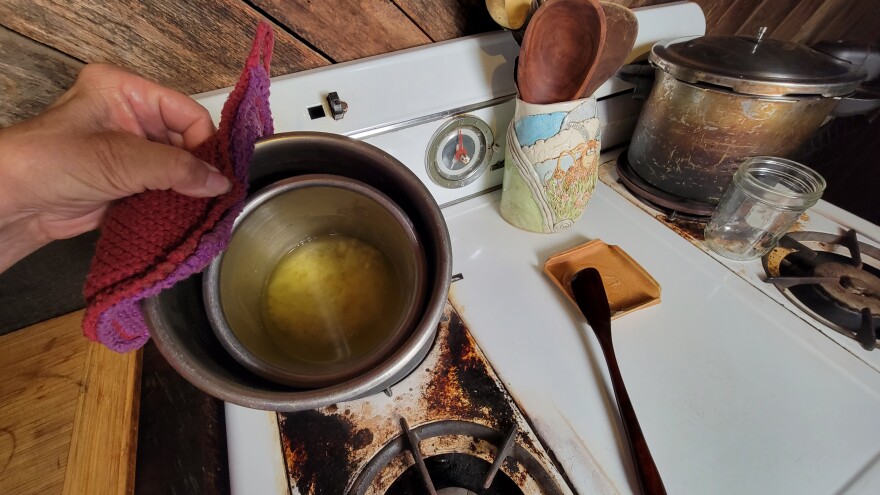
Tallow, when rendered clean, can last up to a year at room temperature if stored in a dark place, and for many years when stored in the freezer.
The process begins by taking the hard fat and slowly cooking it in water until the fat chunks have turned cloudy and a yellow liquid, the tallow, rises to the top.
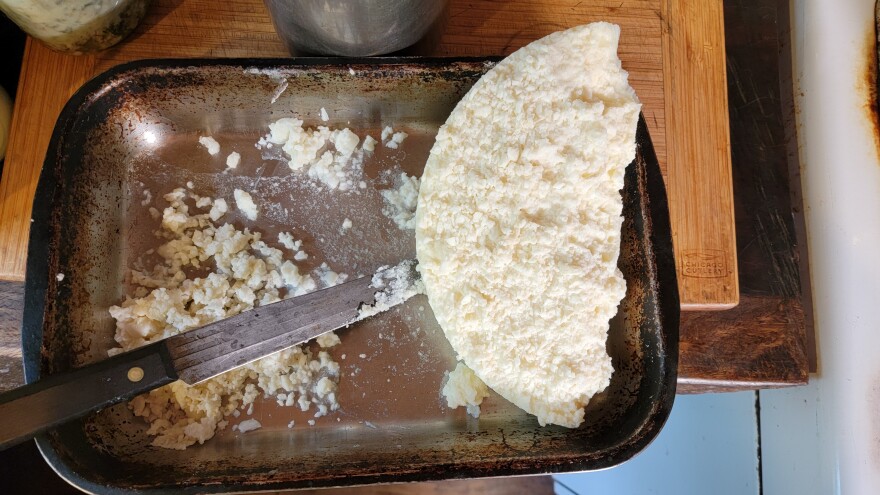
Next, it’s cooled in a refrigerator until a solid whitish substance forms at the top of the pot.
The solid is removed from the pot and any traces of protein bits still attached can be shaved off with a kitchen knife. Then, the entire process is repeated until the water is clear and the tallow is clean of any bits of protein.
The tallow is then strained into a jar and topped with a secure lid. When cooled, the tallow is ready for use.
There have always been several positive reasons to use tallow. Because of its high smoke point of 480 degrees, tallow was often used for deep frying, until the rise of vegetable oil.
While tallow contains saturated fat, it also contains monounsaturated fats, which are considered good for the heart. Beef tallow contains conjugated linoleic acid, which is a natural anti-inflammatory.
It’s also very good for the skin, either applied topically or consumed as an ingredient in any of a multitude of recipes. That’s because it’s high in omega 3’s and is packed with vitamins A, D, K, E and B12.
Add WVPB as a preferred source on Google to see more from our team

The 2026 USA Cycling Professional Road National Championships will take place June 16-21 on the roads of downtown Charleston.
Continue Reading Take Me to More NewsOn this West Virginia Week, the unhoused population in the state declines, child well-being remains the same, and just how many abandoned gas wells are there?
Continue Reading Take Me to More NewsThis week, we’re revisiting a show featuring storytellers out loud in front of audiences. Folks like five-time champion of the West Virginia Liars’ Contest, Bil Lepp. Also, musicians Anna & Elizabeth, whose storytelling used something known as a crankie. And, we’ll head to the International Storytelling Center in Jonesborough, Tennessee.
Continue Reading Take Me to More NewsThis week’s Inside Appalachia features storytellers from around the region, including author, television host and five-time West Virginia Liars Contest winner Bil Lepp. Here he is back in 2019, telling a story during a Mountain Stage performance at the West Virginia Culture Center.
Continue Reading Take Me to More News