Alert (09/29/2026): Our Parkersburg TV transmitter is still undergoing maintenance and remains temporarily inoperative. We apologize for the inconvenience.
All our programming is available via our TV livestreams on our website and WVPB Passport. Thank you for your patience!
This week, author Silas House returns with a sweeping new novel. Also, some folks say, you have to fake it 'til you make it, even if you're trying to establish a state park. And, the story of the first Mothman sightings as written by a small town journalist in 1966.
There are many folklores and charms when it comes to getting lucky in Appalachia. It’s been said that it’s bad luck to eat lettuce on a hot summer day. People also believe that placing parsley seeds on a fence post and allowing the wind to blow it off to sow it will clear them of any bad luck.
But, the most famous good luck charm in the world has got to be the four-leaf clover. One old mountain lore is that a green salve of four-leaf clovers rubbed over your whole body is said to make you invisible but you cant miss even one wrinkle.
Chuck Kleine
/
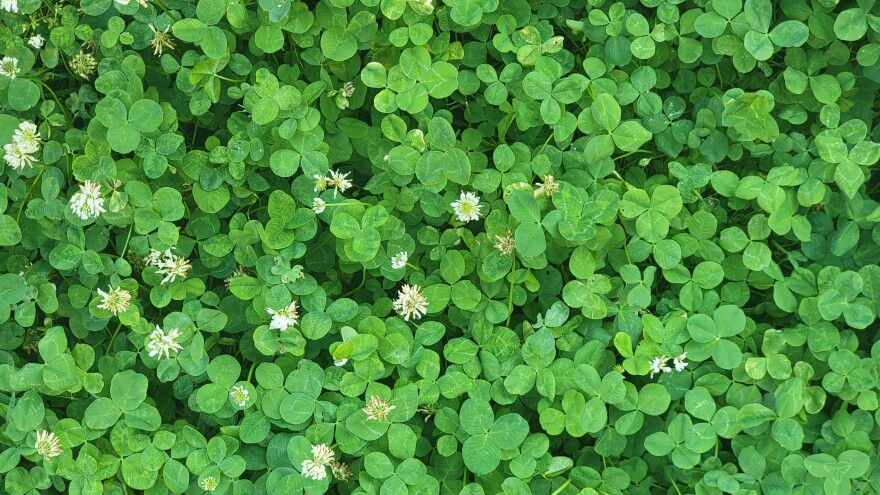
Can you find the four-leaf clover in this picture?
Red clover and white clover are the most common types of the plant we see in West Virginia.
Neither of them are native to the area and are considered one of the earliest plants brought by Europeans. Both red and white clover are edible and are often used like spinach in a salad.
Some folks use the flowers to make a clover jelly or steep them in water to make tea. The leaves of thye red clover can also be dried and used as a vanilla extract substitute.
There are a few native clover in West Virginia. The native Running Buffalo Clover has recently been removed from the endangered species list. Kate’s Mountain Clover is another native species, it is rare to find and stunning when in bloom.
Take some time to glance down at the next clover patch you see and have a closer look. The flowers are just beautiful, and maybe you’ll even find some luck hidden under your feet.
EDIBLE MOUNTAIN – Clovers
Add WVPB as a preferred source on Google to see more from our team
This week, author Silas House returns with a sweeping new novel. Also, some folks say, you have to fake it 'til you make it, even if you're trying to establish a state park. And, the story of the first Mothman sightings as written by a small town journalist in 1966.
The annual West Virginia Book Festival, a free event for book lovers of all ages, will be held on Saturday, Oct. 24, at the at the Charleston Coliseum and Convention Center.
Silas House is a major voice for Appalachia. The Kentucky native has written more than 15 books and served as the state's poet laureate. His latest book is The Tulip Poplars, a sweeping novel about the lives of four people as they navigate friendship and forbidden love throughout the 20th century. Inside Appalachia's Mason Adams spoke with House.