This week, we reflect on Dolly Parton’s passing and her legacy in the region. Also, the Adaptive Climbers Festival at Kentucky’s Red River Gorge feels like home for climbers with disabilities from around the world. And, a new book spotlights Appalachian plants and encourages readers to get in touch with nature.
Home » Stories » Pricketts Fort Forges New Connections By Teaching Old Skills
Published
Pricketts Fort Forges New Connections By Teaching Old Skills
Listen
Share this Article
The blacksmith is one of the most enduring figures from the early days of American history. The art form calls to mind strength, ingenuity and craftsmanship…fire, iron and sweat. But in the age of technology and 3-D printers, what’s to become of this time-tested trade? One West Virginia state park is taking steps to forge new interest in traditional arts.
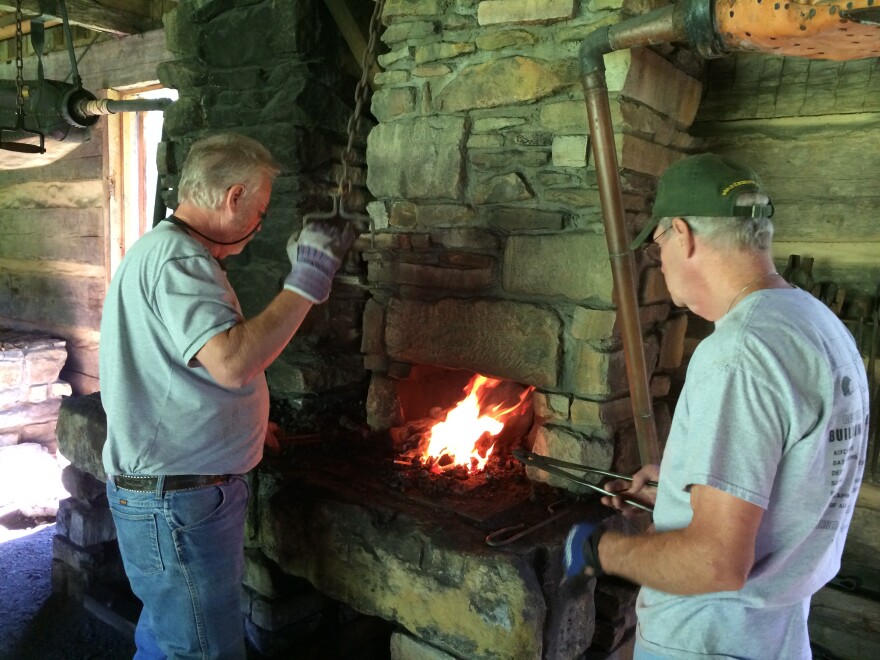
On this cool-for-mid-August day at Pricketts Fort State Park, coals in this blacksmith shop are burning hot and bright, fanned by bursts of air from a gi-normous bellows suspended from the ceiling. Most days this is where you would encounter a park employee demonstrating the art of blacksmithing.
But today, a group of students is getting the chance to try the craft as part of a three-day hands-on workshop.
Credit Sarah Lowther Hensley
/
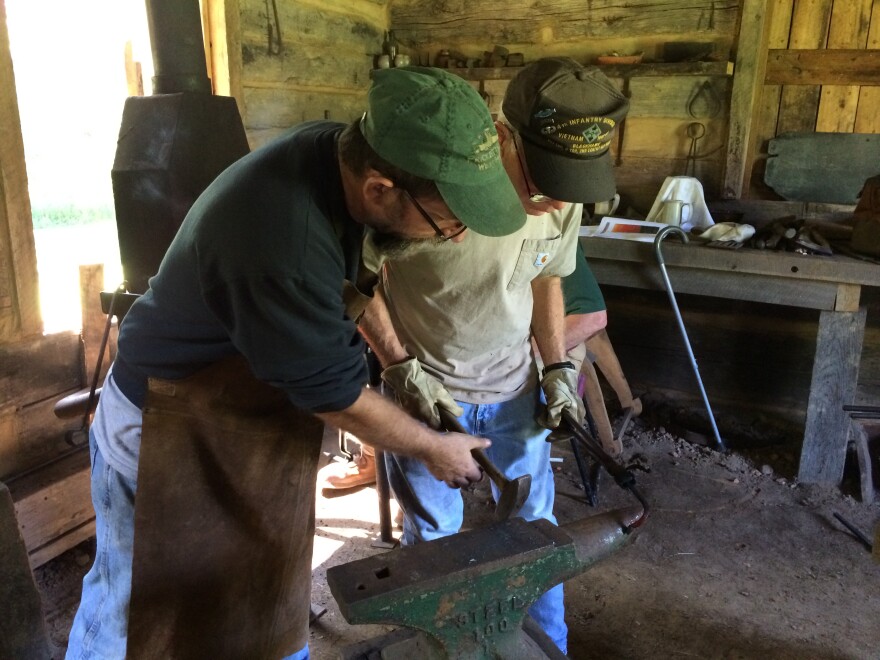
Jim Mays works on applying the techniques he has learned in the Pricketts Fort Blacksmithing Workshop.
“I’m Jim Mays, living in Farmington right now but originally from East Side of Fairmont. This is on my bucket list of what I wanted to do, so a good chance to get it done.”
Mays is a retired steelworker who did construction and ran heavy equipment in the coal mines. He has a small forge at home and is taking the class in hopes of learning a new skill. He watches closely as the instructor demonstrates techniques.
“There are several things I want to try to make,” says Mays. “He’s a good teacher. He’s got some – gotta lot of patience.”
The patient instructor is Greg Bray, Executive Director of Pricketts Fort. Bray first learned the craft at the Augusta Heritage Center at Davis & Elkins College. He’s now earned his living as a blacksmith for more than twenty years, but he can remember that initial learning curve.
“This is the beginning class. They all struggle just a little bit and it gets frustrating for ‘em. It was frustrating for me when I started,” says Bray. “And I tell that story every time I start a class – a new class – and I tell how frustrated I was and how I almost didn’t pursue it and that kind of helps them out a little bit.”
Credit Sarah Lowther Hensley
/
Greg Bray shows Chuck Huff of Fayetteville, Georgia a technique during the Pricketts Fort Blacksmithing Workshop.
“My name is Chuck Huff. I’m from Fayetteville, Georgia. It is challenging, I mean, it’s a little harder than I thought, but you learn a lot. It’s very interesting – but difficult.”
Use your tongs. Take your time. Don't get in a big hurry, because if you start hurrying and rush around, these things are going to flop around – move around – and you're not going to get anything accomplished. – Greg Bray to students in the Pricketts Fort Blacksmithing Workshop
“My name is Ed Harris. I’m from Rivesville West Virginia and I’m taking the class – several reasons. A new hobby. To make something. My wife is into crafts and she likes the 17th and 18th century decorations and so I said well I’ll see if can make ‘em.”
His favorite part of the class so far?
“The challenge of learning something new with my hands and seeing the art – the art form.”
Generating enthusiasm for the art form and for the past is one of the goals of the workshop. But Bray says there is another reason – and that is to make sure this type of opportunity is available in the future.
“If you don’t pass this on – if you don’t find people that care about it and want to try it and want to do it, then it’s going to be lost,” says Bray. “And we’re seeing that in our staffing today because there’s not a lot of new people coming up – we’re all getting older out here at the fort and we’re not seeing new people coming up.”
Credit Sarah Lowther Hensley
/
Jim Hays and Ed Harris team up to practice what they’ve learned at the Pricketts Fort Blacksmithing Workshop.
Bray is encouraged by the response to the workshops. He offers them two or three times a year. One gentleman who has taken the blacksmithing workshop twice stopped by today to visit the fort. Bob Minney recruited his army buddy, Chuck Huff, to come up for the class. Minney regrets not learning these skills from his grandfather and father, but says he’s very glad that Pricketts Fort is taking up the slack and teaching all sorts of traditional arts and trades skills to the current generation.
“I recommend – learn to do things with your hands – get back to not just buying and throwing away – but repair and make things,” says Minney. “And it’s satisfying – it’s good for the soul. That’s all!”
“The whole thing’s a process and – if I keep you on the same thing over and over again you’re going to get aggravated,” Bray tells the students. “So I try to mix it up – but it’s a process so – give it a shot.”
Add WVPB as a preferred source on Google to see more from our team
This week, we reflect on Dolly Parton’s passing and her legacy in the region. Also, the Adaptive Climbers Festival at Kentucky’s Red River Gorge feels like home for climbers with disabilities from around the world. And, a new book spotlights Appalachian plants and encourages readers to get in touch with nature.
In the wake of Dolly Parton's death on Tuesday, her Imagination Library of West Virginia has had an outpouring of comments and calls about the late singer's impact.