Alert (March 11, 2026): Our TV translator in Flatwoods is experiencing technical issues. Our engineers are troubleshooting the problem. Thank you for your patience.
On this week's premiere broadcast of Mountain Stage, host Kathy Mattea welcomes The Steel Wheels, Sam Weber, Peter Holsapple, Lily Talmers, and Rylee Bapst Band to the Memorial Auditorium in Athens, OH.
Home » WVPB Podcasts » ‘It Was a Terrible Loss’: School Closures and Their Effect on Communities Inside Appalachia
Published
‘It Was a Terrible Loss’: School Closures and Their Effect on Communities Inside Appalachia
Listen
Share this Article
This week on Inside Appalachia, basketball was a big deal for the small town of Northfork, in McDowell County, West Virginia. The high school team won the state championship eight years in a row.
“Little old ladies who wouldn’t know a football from a basketball became big fans because it brought positive notoriety and attention to the community,” Northfork alumni Gary Dove recalled.
Yet, despite its success on the basketball court, Northfork was one of thousands of schools that have closed across the country in recent decades. Declining population in rural Appalachia has made this especially common as school boards attempt to consolidate resources. But when a school is closed, it’s more than a building that disappears. In this episode, we’ll explore how school closures affect community pride, and participation in extracurricular activities, like sports.
During the past 50 years, many people in coal country have watched as their towns faded to mere shadows of what they used to be. As mines shut down and jobs left, hundreds of coal towns have wasted away.
Schools often served as a kind of anchor for small towns. When those schools close, it can often mean the beginning of a town’s decline.
West Virginia Public Broadcasting video producer John Hale stepped into the radio reporter role to tell the personal story of Northfork High School, in McDowell County, West Virginia. During the production of his piece, Mark O’Dell Page, Hale’s uncle Joe, passed away after a sudden illness. That story is dedicated to his memory.
Loading…
Preston County Sports Museum
Credit Jesse Wright / WVPB
/
WVPB
Anna Nassif inside the “hall of fame” in the Preston County Sports Museum. The hall includes manikins with sports uniforms and banners for all 10 of the original high schools.
Another story of school closure takes us to Preston County, West Virginia. It’s in the northern corner of the state, bordering Maryland and Pennsylvania. There’s only one, central high school. But there was a time when there were 10, and the rivalry and team spirit among the schools was strong.
Former students from the original 10 schools created the Preston County Sports Museum to help memorialize the sports league of years past. It’s the only one of its kind in the state.
The Effects of School Consolidation
Education policymakers in favor of school consolidation say students will find more enriched classes, and activities — like after-school options — by combining students into a centralized school building and by combining resources.
However, those opposed to school consolidation point to the negative impacts to communities.
Credit John Hale / WVPB
/
WVPB
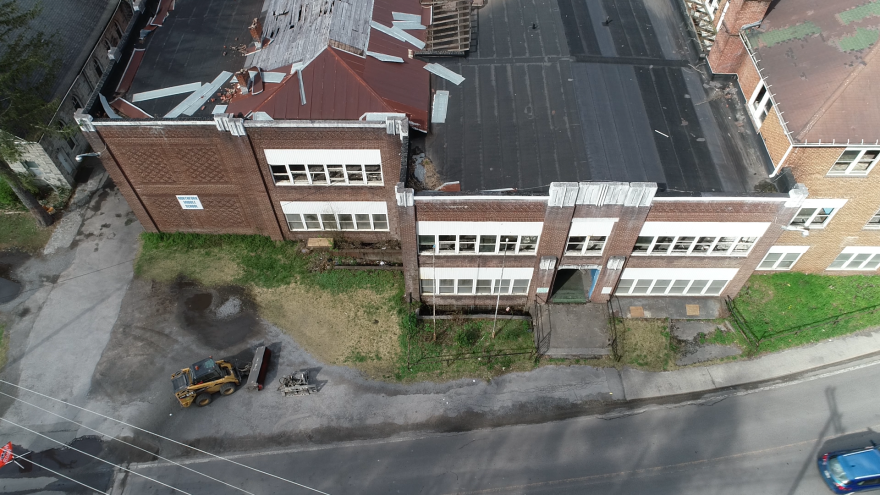
Northfork High School, now slated to be torn down.
One researcher at the University of Dayton said “The school district is the glue that holds the community together.”
The National Education Policy Center at the University of Colorado in Boulder published another report that says, “larger school and district sizes are associated with reduced rates of student participation, more dangerous school environments, lower graduation rates, and larger achievement gaps along lines of poverty, race and gender.”
If you have thoughts on how school consolidation has impacted your local community- we’d love to hear from you. Our email is: insideappalachia@wvpublic.org, our twitter handle is @Inappalachia, or send a letter to 600 Capitol Street. Charleston WV, 25301.
Roxy Todd is our producer. Eric Douglas is our associate producer. Our executive producer is Jesse Wright. He edited our show this week. Our audio mixer is Patrick Stephens. You can find us online on Twitter @InAppalachia.
Add WVPB as a preferred source on Google to see more from our team
An Us & Them episode honored by the Virginias Associated Press Broadcasters for Best Podcast examines the hidden side of homeownership in Appalachia. While West Virginia has the nation’s highest homeownership rate, aging housing stock and low incomes leave many residents living in deteriorating conditions. Reporting from western Virginia, this episode explores what happens when owning a home doesn’t mean building wealth.
By some measures, West Virginia has the nation’s highest homeownership rate. However much of that housing is old and needs repair. Our latest episode of Us & Them is a recent award winner from the Virginia AP Broadcasters. Trey Kay uncovers an aspect of the housing crisis we don't often hear about – structures without electricity or running water that people call home.
Fluorspar is a little-known mineral used to make everything from steel, aluminum and gasoline to uranium fuel and batteries. For the Appalachia Mid-South Newsroom, WKMS’ Lily Burris reports the largest known deposit of the critical mineral in the U.S. is in western Kentucky – and its applications in artificial intelligence (AI) could reawaken the region’s mining industry.
The economy is everything we buy or sell and services we use. It can be a broad category and most of us struggle to understand what it all means. The show "Planet Money" from NPR dives into those topics and attempts to make sense of it. And now, the show has published a book called Planet Money: A Guide to the Economic Forces That Shape Your Life. We speak with the author and one of the program's hosts.