This week's broadcast of Mountain Stage is a special episode featuring songs that represent the four seasons of the year. You'll hear live performances by Doc Watson, Bruce Hornsby, Susan Werner, Molly Tuttle, Taj Mahal, Norah Jones and many more.
How Black Musicians And Luthiers Are Reclaiming The Banjo
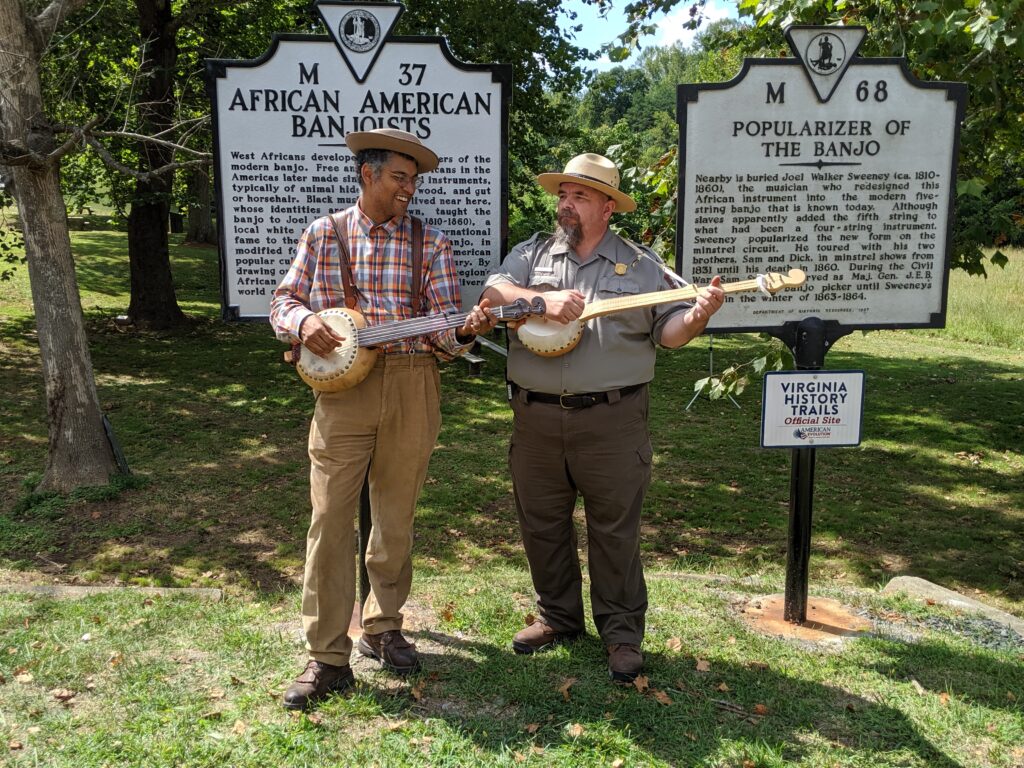
Folkways Reporter David Wooldridge with musician Dom Flemons at the September 7, 2019 dedication of the marker for Unknown African American Banjoists in Appomattox, Virginia. Photo courtesy David Wooldridge.David Wooldridge/West Virginia Public Broadcasting
Listen
Share this Article
The banjo, an instrument closely associated with mountain music, originated in Africa and came to America with enslaved Africans. In the 1830s and 1840s, it was taken up by white musicians and became a staple of minstrelsy, a form of racist entertainment in which white performers—often in blackface—depicted stereotypes of Black Americans. Eventually the banjo crossed fully over into white public culture and was separated from its African roots and identity. Now, there’s an emerging movement of Black musicians who are reclaiming the banjo and taking the instrument—and its sound—in new directions.
One of the most well-known of those musicians is Dom Flemons. He’s mostly known for his membership in the Carolina Chocolate Drops, an all African American string band formed in the early 2000s, an era when Americana music was gaining a wider audience.
Many of the band’s songs are drawn from the 19th century, when the banjo was just being introduced into white popular culture and music through minstrelsy. A century later, Flemons and the Carolina Chocolate Drops dug into that difficult history.
“I just saw that there was a need for new African American representation that could present some of the older material, but at the same time not pandering to any sort of backward thinking or anything like that,” Flemons said. “We were always very 21st-century and you know, urban, hip, thinking about, ‘Where does the music go from here?’ instead of trying to be relegated to something in the past.”
A younger generation is picking up the banjo, too.
Byron Thomas, who works for a public school system in Maryland, became interested in the banjo after reading a story in an old Boy Scouts magazine about a formerly enslaved man who made a banjo from a cigar box.
David Wooldridge
/
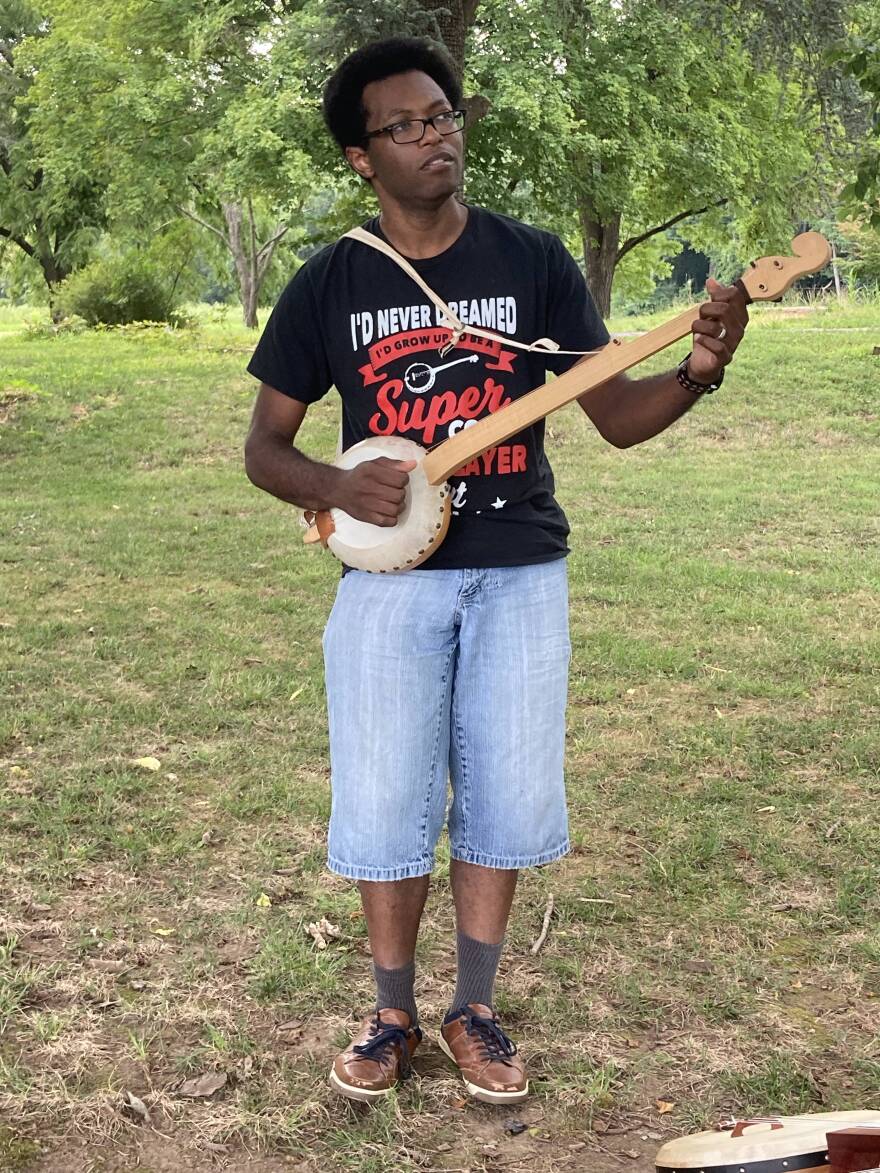
Byron Thomas playing a gourd banjo.
“Just finding that article was the thing that brought me to the banjo just because at that point in my life, I [thought], ‘The banjo is just a white instrument,” Thomas said. “So I did not really have any kind of inclination to play the banjo at that point until I was like, ‘Huh, wait a second. What do you mean that there was a former slave playing a banjo?’ Now I have to figure out what in the world was going on and what has happened. Because now I’m very curious as to why in modern culture—mainstream, at least—we don’t see any Black people really playing banjo in front of us.”
Thomas has since researched banjo history and learned to play old tunes. But he also sees the instrument as a living thing and has a growing interest in learning to build banjos from a Black luthier.
Dena Jennings is a medical doctor, conflict therapist, and gourd banjo builder who grew up in Ohio. Her family has Appalachian roots.
“My mom grew up in a hollow in Kentucky in the Cumberland Gap area,” Jennings said. “And what I didn’t realize when I was growing up, we were heavily involved in the Pentecostal church and all of our friends and family and others were from that region of Cumberland Gap. It was pretty much like the hollow during the Great Migration—and a lot of Black families moved from the South to the North—it was almost like that hollow unscrewed itself like a light bulb and screwed itself in Akron, where jobs were.”
Jennings’ gourd banjos are pieces of art. She grows and selects the gourds on her farm in Orange County, Virginia and uses hides to create the heads. Her banjos have an earthy, bassy and funky sound. She said she was amazed when she first learned that the banjo started as a gourd instrument.
“I used to make an annual trip to Elderly Instruments in Lansing, Michigan—it wasn’t far from Akron. So I’d go up there and look around at the instruments that I either couldn’t play or couldn’t afford, and at least look at them and then get in the car and come back. But one year I went and I saw this amazing banjo. And it was a simple rim banjo with a simple goatskin head and simple nylon strings on it. And when I took it off the wall and plucked around with it… the sound was like honey from a honeycomb. It was just so warm and so rich and I said, ‘I need to know more.’”
Jennings feels she has a role to play in fostering a safe space for people who want to explore the history of the banjo, especially Black people exploring the Black history of the banjo. She hosts an event for banjoists called the Affrolachian On-time Music Gathering.
“You can’t know where you’re going if you don’t know where you’ve been,” said Jennings.
This week's broadcast of Mountain Stage is a special episode featuring songs that represent the four seasons of the year. You'll hear live performances by Doc Watson, Bruce Hornsby, Susan Werner, Molly Tuttle, Taj Mahal, Norah Jones and many more.
Across the nation, more than 390,000 children rely on foster care. However, a shortage of licensed foster homes is creating a national crisis. While official foster care cases are carefully tracked, many informal examples of kinship care aren’t part of the data. For this Us & Them episode, we hear the experiences of those who’ve been part of the foster care system.
Stock car racing’s roots run deep in Appalachia. Our twisty roads and dark hollers were home to moonshiners — and moonshine runners, who became known for their driving skills. And they became some of NASCAR’s first stars when it formed in 1948. But NASCAR’s oldest continuous racing team had nothing to do with moonshine.
WVPB's Matt Jackfert speaks with harper, composer and producer Maeve Gilchrist. They discuss her compositions, the Silkroad Ensemble and the group's upcoming performance.