Alert (09/10/2026): Our Parkersburg TV transmitter is undergoing maintenance for a few days and will not be operational. We apologize for any inconvenience.
All our programming is available via our TV livestreams on our website and WVPB Passport. Thank you for your patience!
This October, the Adaptive Climbers Festival will gather in Kentucky’s Red River Gorge for the fifth year. In 2023, Folkways Reporter Emily Chen-Newton covered the event for Inside Appalachia. Since then, the Adaptive Climbers Festival has grown. Organizers say they’re nearly at capacity, with 300 climbers, caregivers and volunteers. Ahead of the festival, the campground has made accessibility improvements. Volunteers with the ACF have also been sprucing up the trails.
House Democrats Say Cannabis Reform Would Bring Economic Gains
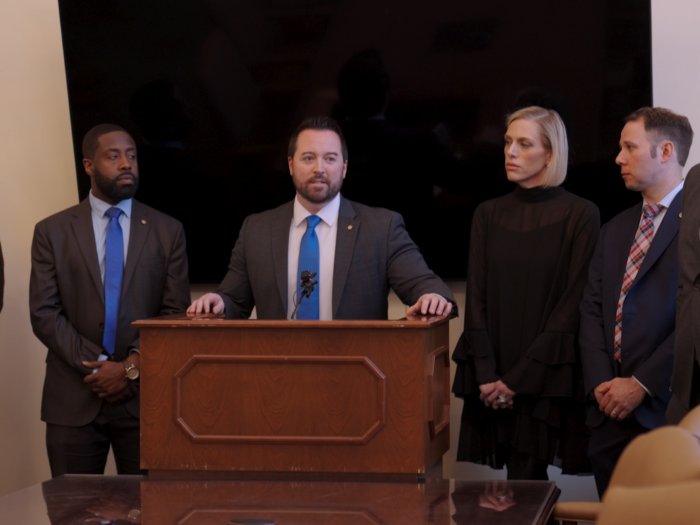
Del. Sean Hornbuckle, D-Cabell; Del. Shawn Fluharty, D-Ohio; Del. Kayla Young, D-Kanawha; and Sen. Joey Garcia, D-Marion gather for a Democratic press conference at the State Capitol Monday.Ethan Rayment/West Virginia Public Broadcasting
Listen
Share this Article
West Virginia’s Democratic lawmakers represent a minority of the West Virginia Legislature, and say stonewalling from some Republicans can make it hard to pass bipartisan legislation. But this year, they hope cannabis policy reform is something both parties can agree on.
Democrats from the West Virginia House of Delegates and West Virginia Senate gathered at the State Capitol Monday afternoon for a joint press conference on this year’s legislative session thus far. Monday was the twentieth day of the 60-day session, marking it one-third of the way complete.
House Democrats brought attention to two policies that would reform the state’s policies surrounding cannabis use: House Joint Resolution 27 and House Bill 2887.
House Joint Resolution 27: A Constitutional Right
Under House Joint Resolution 27, a new measure would appear on West Virginia voters’ ballots during the 2026 general election: whether to modify the West Virginia Constitution to legalize the possession of two ounces of marijuana or fewer per person, and to expunge past marijuana possession convictions in the state.
“The possession of cannabis for purposes of consumption by adults 21 years of age or older shall be lawful in quantities of no more than two ounces, or four individual plants per person,” the constitutional amendment would read. “The legislature may enact laws relating to lawful sales and manufacturing of cannabis in this state. Any prior conviction for possession of two ounces or less of cannabis is subject to dismissal or expungement by petition to the circuit court in the county where the conviction occurred.”
The bill’s lead sponsor is House Minority Leader Del. Sean Hornbuckle, D-Cabell. It is cosponsored by four other Democratic delegates: Del. Hollis Lewis, D-Kanawha; Del. Mike Pushkin, D-Kanawha; Del. Evan Hansen, D-Monongalia; and Del. Rick Garcia, D-Marion.
During Monday’s press conference, Lewis advocated for the passage of the bill. He said that it aligns with Gov. Patrick Morrisey’s “backyard brawl” economic development plan, which aims to make West Virginia more enticing to new residents and businesses than neighboring states.
Lewis said that Morrisey has talked about “not starting programs” funded by the state “unless we have new revenue,” and pointed to marijuana legalization as a possible solution.
“When we look at being competitive in that backyard brawl, we have states like Virginia, Maryland, D.C. and Ohio all have recreational use cannabis, and I think Pennsylvania has a bill coming out to legalize recreational cannabis,” he said. “The longer we wait to do this, the less competitive we are, the more money we lose.”
The bill was referred to the House Judiciary Committee on Feb. 25 and is waiting on committee review.
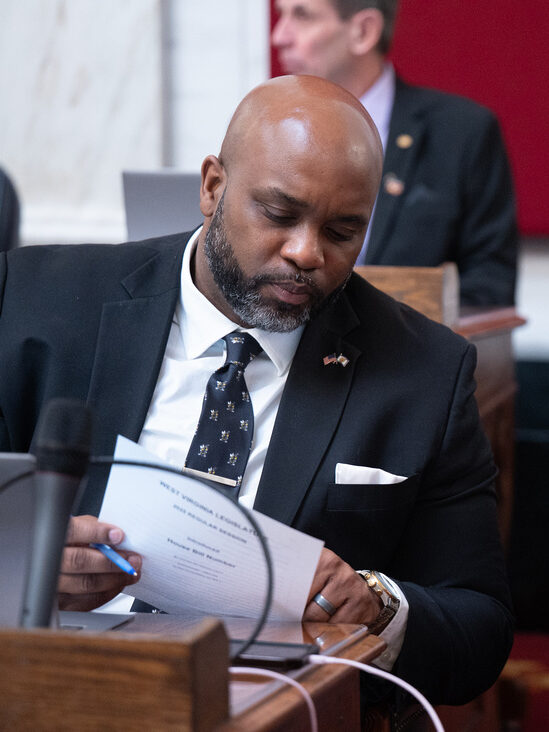
Del. Hollis Lewis, D-Kanawha, reviews a bill on the House floor on Feb. 26.
Photo Credit: Perry Bennett/WV Legislative Photo
Del. Evan Hansen, D-Monongalia, speaks at a Feb. 24 committee meeting.
Photo Credit: Perry Bennett/WV Legislative Photo
House Bill 2887: Letting Counties Decide
House Bill 2887 would allow county commissions in West Virginia to determine “whether the manufacture and sale [of cannabis] to persons 21 years of age or older is allowed in the county,” the bill reads — placing the decision in the hands of local governments.
Hansen is lead sponsor on the bill, but it is cosponsored by every Democratic member of the House.
The bill also sets standards for cannabis sale regulation, as well as taxes on cannabis sale and distribution. Under the bill, county governments would be entitled to retain 50 percent of the local sales tax for marijuana sales within their jurisdiction.
Other funds generated from the marijuana industry would go toward areas like the Public Employees Insurance Agency Stability Fund, which helps stabilize finances for West Virginia’s state employee insurance program.
At a separate press conference held by House Democrats on Feb. 24, Hansen described the bill as a statewide opportunity for “increasing revenue.”
“There’s some level of local control, but what’s important about that is that that would create a new revenue stream that could be in the tens to hundreds of millions of dollars,” he said.
“It would be a great revenue to generate in West Virginia, and go nicely with our tourism market here,” Lewis said regarding House Bill 2887 during Monday’s press conference.
The bill was referred to the House Judiciary Committee on Feb. 24, and still awaits committee review.
Add WVPB as a preferred source on Google to see more from our team
The total number of employed state residents increased by 400 - rising to 741,000 - while the number of unemployed state residents decreased by 700 to 31,300.
Two federally important facilities located in West Virginia require a strict limit on radio frequency interference. But for decades – increasingly as communication systems have become more advanced – those limits have made it difficult for emergency crews and first responders in Pendleton and Pocahontas counties to do their jobs as safely and effectively as possible. Now the results of a lengthy federal study show exactly how precarious the situation is. We caught up with Pendleton County Emergency Management’s Rick Gillespie to find out what the study shows and what happens next.
In recent years, physicians across the country have monitored surges of a condition known as Alpha-Gal Syndrome, which can cause allergic reactions to red meat. Hannah Saad with Appalachia + Mid-South Newsroom member station WKMS reports that, now, farmers, restaurateurs and the afflicted are flocking to a new source of protein.