Alert (09/10/2026): Our Parkersburg TV transmitter is undergoing maintenance for a few days and will not be operational. We apologize for any inconvenience.
All our programming is available via our TV livestreams on our website and WVPB Passport. Thank you for your patience!
This week, one thing about Appalachians: we can get competitive. We’re proud of our local food. Love a good hunt. And enjoy competition with friends. We learn the rules and celebrate our victories. You'll hear these stories and more this week, Inside Appalachia.
Home » WVPB Podcasts » Maybe The Best Classroom Is Right Outside Your Door, Inside Appalachia
Published
Maybe The Best Classroom Is Right Outside Your Door, Inside Appalachia
Listen
Share this Article
With kids cooped up inside their homes and classroom instruction happening remotely, we thought it would be a great time to take another listen to an episode of Inside Appalachia that originally aired in 2019. We explore the power of getting children outside to learn, a topic that’s perhaps even more important now than ever.
Doctors agree that getting kids outdoors is safe during the pandemic as long as we maintain social distancing so we are looking at why learning outdoors is good for all of us, but especially kids.
“I think there’s a difference between opening up a science textbook and learning about water quality when you can go outside and be in your own watershed,” Hannah Spencer said. Spencer is a co-founder of the Mountain Stewardship and Outdoor Leadership school, or Mountain SOL, an outdoor education program based in Morgantown.
Teaching outside might not solve all the underlying issues that make education challenging, but research shows that offering children outdoor learning opportunities improves test scores. For kids struggling with attention disorders, it can be as effective as therapy and medication.
Author and researcher Florence Williams points out that kids in the U.S. today, “spend half as much time outdoors as their parents did. Instead, they spend up to seven hours a day on screens, not including time in school.”
A review of 13 scientific studies published this year in BMJ Open, a peer-review medical journal, found that “there is evidence that higher levels of screentime is associated with a variety of health harms” for children and young people. It concluded that evidence suggests kids with high levels of screen time are overweight, have an unhealthy diet and have a poor quality of life. High levels of screentime are also associated with “irritability, low mood and cognitive and socioemotional development, leading to poor educational performance.”
The American Academy of Pediatrics recommends that parents should place consistent limits on their children’s screen time (television, phones, computers, all devices).
One possible bright spot in all this is that here in Appalachia, we have an abundance of nature. It can provide a ready-made opportunity to teach kids about the ways industry and pollution can affect the environment. And it can nurture their curiosity. All we have to do is walk outside.
Credit Jesse Wright / WVPB
/
WVPB
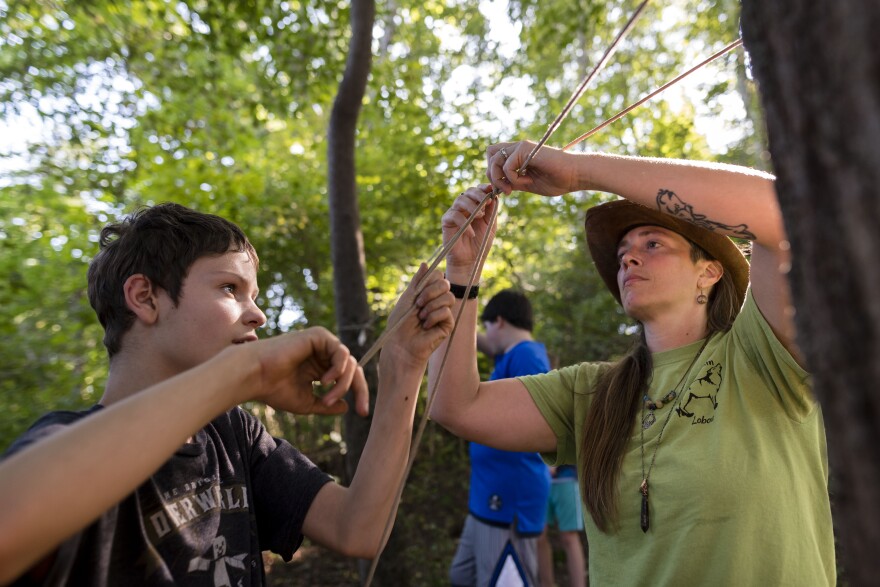
Jen-Osha Buysse, co-founder and director of the Mountain SOL program, helps Aidan McGinnis attach a tarp to a tree during a class Sept. 13, 2019, in Morgantown, W.Va.
A Place Outdoors For Children With Parents Who Struggle With Addiction
If you’ve ever been to church camp, band camp or just about any kind of summer camp, you know that kids often form strong bonds in those settings. They make connections based on shared experiences outside of their own homes. It’s almost like a temporary reset button on their lives.
For children with troubled home lives, these experiences can be even more powerful and life changing. A group in Ohio has turned into this idea that kids find coping mechanisms more readily in natural environments. Last summer, National Public Radio reporter Kavitha Cardoza visited a program set outdoors in Dayton, Ohio, that hosts children whose parents struggle with addiction.
This story includes details about neglect and abuse that may be unsettling for some listeners.
Outdoor Learning Can Happen In Cities, Too
Many stories in this episode take place in communities that border national forests, with access to an abundance of trees and other wild plants and animals. But you don’t need pristine and remote landscapes to reap the benefits of going outside. Sure, scientists have identified that soils and trees emit chemicals known to improve immune function and even help prevent cancer — but sometimes just walking through your own community can inspire learning and engagement. WFPL’s Liz Schlemmer reports from the parking lot at Louisville Male High School, where science teachers and students are tackling tough subjects like climate change.
Outdoor Academy At Boy Scout Jamboree
If you were in southern West Virginia last summer, you may have encountered Boy Scouts who were visiting from across the globe. Turns out tens of thousands of young scouts from more than 150 countries came to rural southern West Virginia that summer. Glynis Board reports it’s the first time the event has come to the U.S. since 1967. She interviewed scouts from South America and all over the world.
Glynis Board went back down to the scouts’ high-adventure property this fall to visit organizers, teachers and students participating in a pilot program with West Virginia University to tackle an ambitious goal — getting all sixth-graders in West Virginia learning outside.
Our energy and environment reporter, Brittany Patterson, guest hosts this episode. She closes the show with these thoughts:
“Sometimes my job reporting on the environment is really tough. Reporting about all the things in our environment that are making us sick, or could be making us sick, and what’s at stake can be, well, very overwhelming.”
“But then, I also get to visit foresters who know trees like they’re family, hike through rare bogs, finding plants that have been here since the ice age, and breathe in mist from raging mountain waterfalls. My job is awesome because of these super-beautiful, life-giving moments.
“And watching kids have those moments, experiencing the outdoors is like honey for my soul. So remember — having a bad day? Go outside. Find yourself hyper-distracted? Try going outside. Your kid is having a hard time focusing? Send him to breathe outside for a couple minutes. It’s worth a try. Trust me.”
Loading…
We had help producing Inside Appalachia this week from NPR’s All Things Considered and WFPL in Louisville.
Our theme music is by Matt Jackfert. Other music this week was provided by Dinosaur Burps.
Roxy Todd is our producer. Eric Douglas is our associate producer. Our executive producer is Glynis Board. She also edited our show this week. Our audio mixer is Patrick Stephens.
You can find us on Twitter @InAppalachia. You can also send us an email to Inside Appalachia@wvpublic dot org.
Add WVPB as a preferred source on Google to see more from our team
This week, one thing about Appalachians: we can get competitive. We’re proud of our local food. Love a good hunt. And enjoy competition with friends. We learn the rules and celebrate our victories. You'll hear these stories and more this week, Inside Appalachia.
In southern Ohio, there’s a musical tradition that goes back nearly 1,000 years and 4,000 miles. For Inside Appalachia, Folkways Reporter Capri Cafaro has this story.
News Director Eric Douglas sat down in a classroom studio with Marshall's Chuck Bailey, the student news director Emma Johnson, and the Director of the Marshall School of Journalism and Mass Communications Rob Quicke, to learn more.