


New Bishop Has Existing Connections To W.Va.
Evelio Menjivar-Ayala will serve as the tenth Bishop of the Diocese of Wheeling-Charleston — which encompasses all of West Virginia — starting in July.
Continue Reading Take Me to More News


The winners of the 2026 WVPB PBS KIDS Writers Contest have been announced!
Nominate an exceptional West Virginia teacher today!

On Demand

On Demand
Watch locally produced documentaries & more.

On Demand

On Demand

West Virginia Morning
Inside Appalachia
West Virginia Week
Mountain Stage
Us & Them
The Legislature Today
The Legislature This Week

Send us your comments and questions.

Stream our board meetings.

Check out the latest WVPB news.

Sign up for our newsletter and get weekly updates.

Meet the WVPB staff.

WV Educational Broadcasting Commission, the WVPB Foundation, and the Friends of WVPB.

Come work with us!

Sponsor impactful and engaging media and entertainment.

Use your IRA to make a gift to WVPB.

Become a member with your gift of $1,000 or more.

Make WVPB part of your legacy.

Manage your membership account.

Learn how you can Protect and Sustain West Virginia Public Broadcasting.

In this week’s episode of Inside Appalachia, we explore how our cultural traditions change over time and evolve as they get passed from person to person.
How does foklife fit into our already busy, and frankly, quite stressful lives?
“Henry Glassie, another folklorist, says that folklore is the creation of the future out of the past. So in order to know where we’re headed, we have to know about these traditions in the past,” explained West Virginia state folklorist Emily Hilliard.
Can Art Help Revive Small, Appalachian Towns?
Greensboro is a small town in southern Pennsylvania, just across the West Virginia border. In years past, the town has weathered the boom and bust of a pottery industry, river trade and coal. Lately, it’s been more bust than boom. But now, some artists are trying to stimulate the local economy using what they know best: creativity.
“Our goal is to preserve the past, but promote the future. Through using what the past has given us, we can create really beautiful art in our small Appalachian towns, which in my opinion is diminishing,” co-op founder Shane McManus said.
Folkways Corps Reporters
Ten people recently joined what we’re calling the Inside Appalachia Folkways Reporting Corps. Some are journalists, others are folklorists, and a few are storytellers in their own way. They live in North Carolina, Virginia, Kentucky and West Virginia. Everyone came together recently for a training in southern West Virginia.

Journalists do things differently than folklorists, and vice versa. As the two styles got together for training, we discovered that folklorists and journalists also have some common ground.
We also went over the techniques for recording interviews and producing them from the field. We talked a lot about why we all do what we do, and why storytelling matters.
The inaugural class of the Folkways Reporting Corps includes reporters from four different states. In West Virginia, corps members include Lexi Browning, Zack Harold, Chris Williams, Jordan Lovejoy, and Heather Niday.
We also welcome Mason Adams and Jeremy Farley from Virginia; Rachel Greene and Saro-Lynch Thomason from North Carolina; and Nicole Musgrave from Kentucky.

In addition to the Folkways Corps, we’ve also recently hired a new folklife reporter. Caitlin Tan has already produced several stories for Inside Appalachia since she moved from Wyoming to West Virginia last December to work with us. In this episode, we hear why she made the decision to move across the country to work with Inside Appalachia.
Modern Business Re-Imagines Traditional W.Va. Folklore
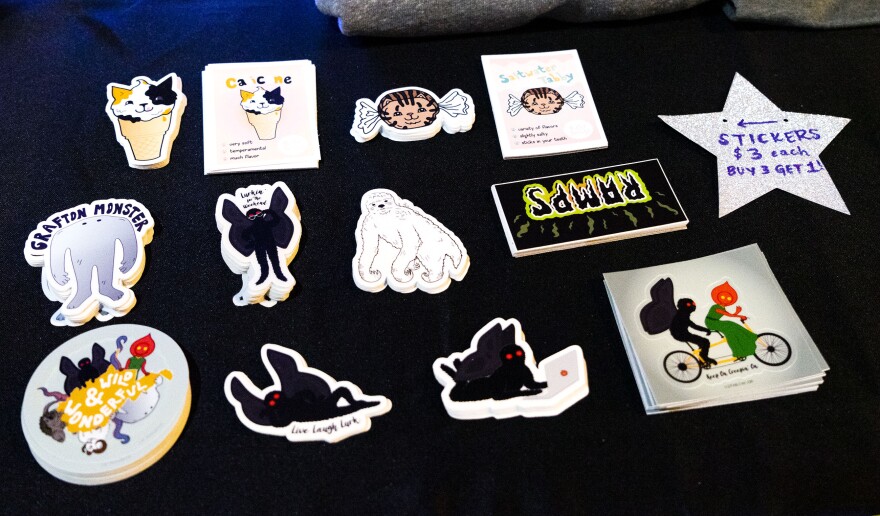
We also visit the home studio of Liz Pavlovic, a graphic artist in Morgantown who has built a successful design business by reinterpreting some beloved local treasures with a modern, cartoonish flare.
One of Pavlovic’s designs features two West Virginian monsters. Below the illustration are the words “not all who lurk are lost.”
“That’s a new poster I’m working on. It’s Mothman and Flatwoods Monster – I have them hanging out a lot. They’re kind of the best friends of the group I guess,” Pavlovic said.
“I love that she draws on these almost inside jokes that we have as West Virginians and turns it into something beautiful,” said Candace Nelson, one of Pavlovic’s fans. “I like that it’s almost as though you have to be in on it. You have to know West Virginia culture to really truly appreciate it.”
Loading…
For more stories of local lore, check out these Inside Appalachia stories:
Music in this episode was provided by Dinosaur Burps, John R Miller, Spencer Elliot, Doris Fields and Ben Townsend.
Roxy Todd is our producer. Eric Douglas is our associate producer. Our executive producer is Jesse Wright. Catherine Moore edited our show this week. Our audio mixer is Patrick Stephens. Zander Aloi helps us with promotions.
Special thanks to The West Virginia Folklife Program, a project of the West Virginia Humanities Council.
Find us on Twitter @InAppalachia On Facebook, and on Instagram. You can also send us an email to InsideAppalachia@wvpublic dot org.

Add WVPB as a preferred source on Google to see more from our team

In an effort to attract more horse racing competitors this year to West Virginia, the state Legislature increased the funding cap to $2 million for certain races – and neighboring states are taking similar action. When Golden Tempo won the Kentucky Derby on Saturday, his owner, trainer and jockey won an estimated $3.1 million winning purse. For the Appalachia + Mid-South Newsroom, Justin Hicks reports much of that growth can be attributed to increased gambling on historical horse racing games.
Continue Reading Take Me to More NewsOn this West Virginia Week, an opioid settlement reaches a milestone, gas prices shock Sen. Shelley Moore-Capito, R-W.Va., and we have more information on the recent chemical spill near Nitro.
Continue Reading Take Me to More NewsThis week, historian Mills Kelly’s love affair with the Appalachian Trail started when he was a boy scout. Also, the region is known for exporting coal, but it’s losing people, too. And, Cuz’s Uptown Barbeque in southwestern Virginia fuses Asian ideas with Appalachian comfort food.
Continue Reading Take Me to More NewsMills Kelly is a lifelong hiker and Appalachian Trail scholar. He shares the trail’s history and more on "The Green Tunnel Podcast." He’s also written several books, including his most recent, called "A Hiker’s History of the Appalachian Trail." Inside Appalachia’s Bill Lynch spoke with Kelly to learn more.
Continue Reading Take Me to More News