This week, we reflect on Dolly Parton’s passing and her legacy in the region. Also, the Adaptive Climbers Festival at Kentucky’s Red River Gorge feels like home for climbers with disabilities from around the world. And, a new book spotlights Appalachian plants and encourages readers to get in touch with nature.
Home » WVPB Podcasts » Inside an Appalachian Coal Legacy: Black Lung
Published
Inside an Appalachian Coal Legacy: Black Lung
Listen
Share this Article
Coal mining has touched so many aspects of life in Appalachia. The coal industry has provided more than just jobs — it’s helped build towns, bridges and it’s even provided money for many Appalachians to go to college. We also have a deep cultural connection to coal and its history.
Still, there’s no denying the coal industry has changed the landscape of our mountains, and infected many miners with a deadly disease known as black lung.
On this episode of Inside Appalachia, we look at this part of coal’s legacy, and the complicated, often broken or mismanaged system that’s meant to help miners and their families.
Just how massive is this problem in Appalachia? Well, the answer is complicated, as a recent NPR investigation discovered.
Nationwide, less than a hundred cases were reported to the government in the past five years. But NPR obtained data from 11 black lung clinics in Virginia, West Virginia, Pennsylvania and Ohio, which reported a total of 962 cases so far this decade. The true number is probably even higher, because some clinics had incomplete records and others declined to provide data.
In West Virginia alone, 186 cases of progressive massive fibrosis, or severe black lung, were diagnosed at federally-funded lung clinics since 2009. The total is likely higher because some clinics reported only one or a few years’ worth of data.
Late last year, NPR’s investigative reporter Howard Berkes looked into the underreported cases of black lung in a two part report. We check in with Berkes to find out what’s happened since the report aired.
Complicated Black Lung is Fatal
In this episode we hear the testimony of one former miner who suffers from advanced stages of Black Lung, Mackie Branham, age 39, of Elkhorn Creek, Ky. He worked hard to feed his family and now, as his life leaves him one breath at a time, he wonders about the cost.
Branham hopes for a lung transplant, which may give him five to 10 more years of life.
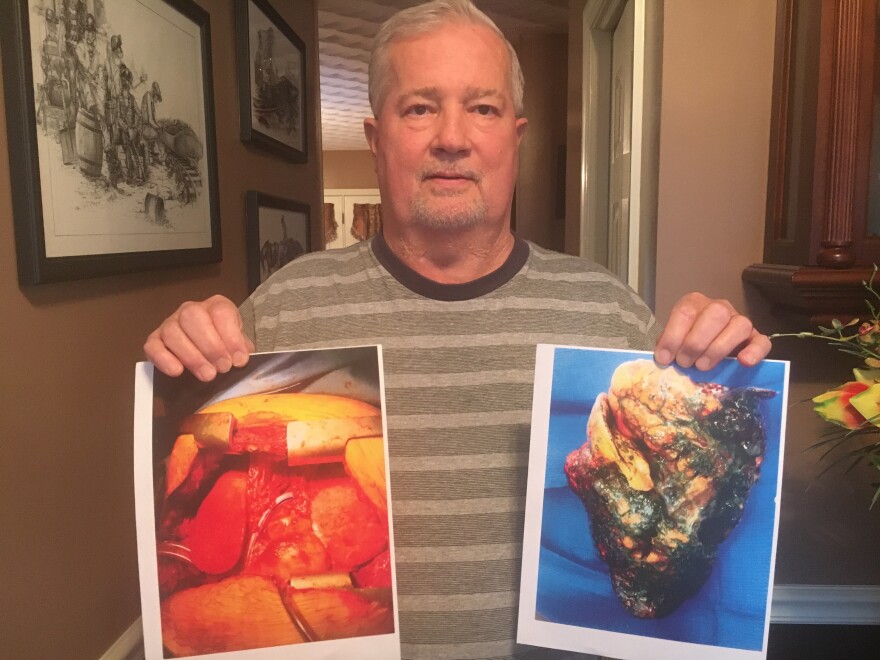
And we’ll check back in with former miner, Robert Bailey, who received a double lung transplant fifteen months ago. We first heard from Robert at a Black Lung Conference at Pipestem in June of 2014. Bailey’s doctor told him he needed a lung transplant, which meant he didn’t have much longer to live.
Credit Jessica Lilly
/
Robert Bailey holds up a picture of his new lungs and a photo of his lungs that were replaced
Could an End to Obamacare Affect Black Lung?
In 2010, when President Obama signed the Affordable Care Act into law, it included special provisions that make it easier for coal miners to get black lung benefits. Republicans introduced an alternative plan to replace Obamacare, but the first attempt failed to get support.
Still, this might not be the end of America’s health care story. In a recent visit to West Virginia, Vice President Mike Pence vowed to keep fighting to repeal the ACA. And as Kara Lofton reported back in January, if the ACA is repealed, gaining black lung benefits could become much more difficult for miners, effectively harming a group of people Trump promised to protect.
Former Kentucky Coal Miner, Gary Bentley
Credit Lance Booth
/
We also hear from former coal miner Gary Bentley. He spent 12 years as an underground coal miner in Kentucky before he left the industry in 2013. Bentley writes a blog called “In the Black,” for the rural news website “The Daily Yonder.” In his column, he shares stories from his career in the mines.
Inside Appalachia is produced by Jessica Lilly and Roxy Todd. Our audio mixer is Patrick Stephens. Glynis Board edited our show this week. Our executive producer is Jesse Wright.
Noise pollution has reached dangerous levels for residents living near the Memphis-Mississippi border. That’s the home of Elon Musk’s X-AI data center campus that runs Grok, the AI chatbot for the social platform X, formerly known as Twitter. For the Appalachia + Mid-South Newsroom, WPLN’s Caroline Eggers reports on what’s becoming an emerging model of data center – and unchecked noise pollution.
This week, we reflect on Dolly Parton’s passing and her legacy in the region. Also, the Adaptive Climbers Festival at Kentucky’s Red River Gorge feels like home for climbers with disabilities from around the world. And, a new book spotlights Appalachian plants and encourages readers to get in touch with nature.
On this West Virginia Morning, we lost the beloved Dolly Parton this week. The Tennessee native was an American music icon, an actress and a philanthropist. She was also, undeniably, Appalachian.