Written by a former slave ship captain, “Amazing Grace” has traveled far beyond its origins. In this encore episode, Us & Them traces how the hymn has become a powerful folk song and civil rights anthem — speaking to pain, forgiveness and the possibility of change.
Two 50-Year-Old Programs Still Fighting the War on Poverty
Listen
Share this Article
It’s been more than 50 years since President Lyndon B. Johnson declared the War on Poverty. During the 1960s, the Appalachian region was facing economic hardships, partly because of mechanization in the coal fields. In 1965, President Johnson signed the Appalachian Regional Development Act of 1965, which created the Appalachian Regional Commission.
We’ll hear from Earl Gohl, the co-chair of the ARC, to talk more about what the ARC has learned about fighting poverty in the last 50 years. Gohl says that while some things have changed, some parts of the region continue to deal with the same issues.
One New Approach to Fighting Poverty- Promoting Appalachian Food
One of the most recent focuses of the ARC is local, healthy foods. Last year, the commission introduced a local foods map, called Bon Appetite Appalachia, that highlights restaurants, wineries and festivals that use local foods throughout Appalachia.
Local Foods Program Gets National Assistance
Wheeling, West Virginia was one of the top picks in a national Local Foods, Local Places Competition. As a result, local organizations are receiving technical assistance from multiple state and federal agencies- including the ARC- to help capitalize on the growing demand for local foods. As Glynis Board reports, meetings with federal agency representatives began on March 26th.
Credit Glynis Board / WVPB
/
WVPB
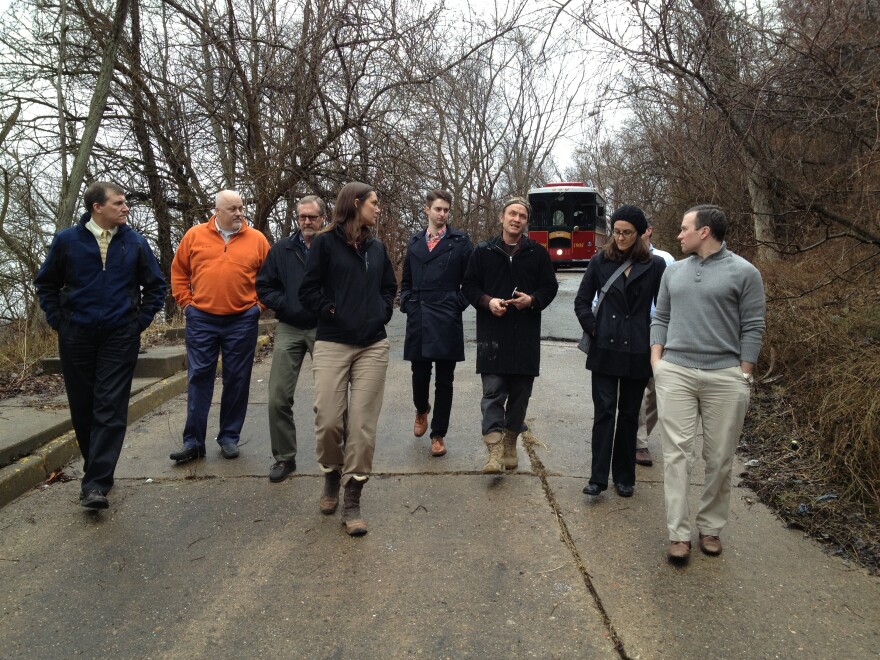
Local Food Local Places working group, made of representatives from federal, regional, state, and local organizations, tours Wheeling.
Early VISTAs in Appalachia
The War on Poverty also led to the creation of Volunteers in Service to America- or VISTA. VISTA was modeled on the Peace Corps, in which volunteers are deployed overseas. VISTA volunteers, however, stay in the United States for their service.
Gibbs Kinderman was one of the first supervisors for VISTA in West Virginia in the 1960s. In this episode we’ll hear a documentary he produced in the 1980s about the history of those early years in Kentucky and West Virginia, of which he was a part.
Credit Corporation for National and Community Service
/
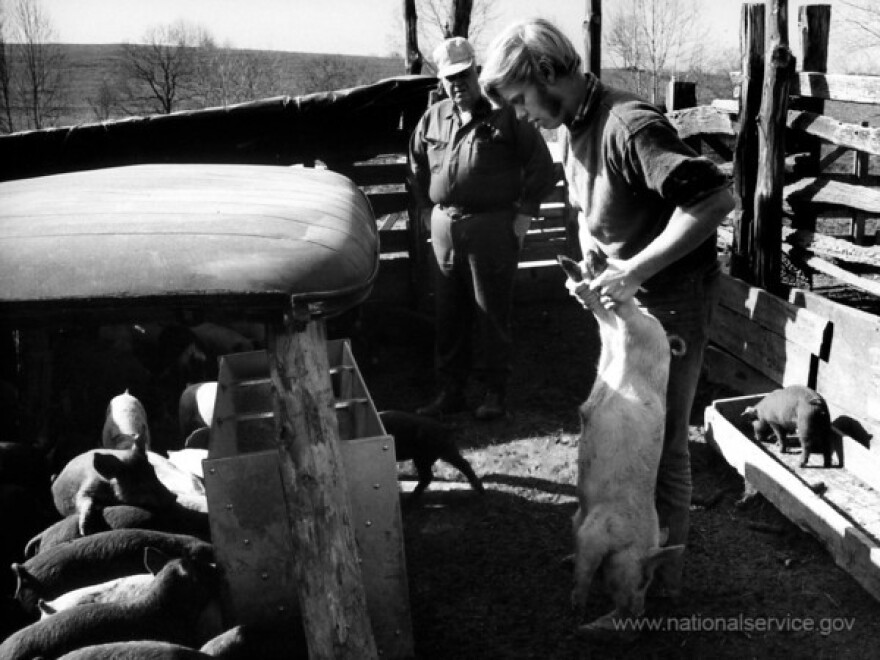
VISTA member Larry Barkdoll, 20, who spent two years with the Frakes Feeder Pig Co-op in Williamsburg, Kentucky, loads feed on a pickup truck in 1972 for delivery to a farmer. With him is farmer and co-op member Clarence Rice.
Written by a former slave ship captain, “Amazing Grace” has traveled far beyond its origins. In this encore episode, Us & Them traces how the hymn has become a powerful folk song and civil rights anthem — speaking to pain, forgiveness and the possibility of change.
Appalachia has had high rates of substance abuse and mental health disorders for years. After the problem reached a boiling point during the COVID-19 pandemic, a few communities tried using crisis response teams, and so far, that seems to be working. Last year, Inside Appalachia’s Mason Adams spent several months with some of these teams and has this story.
We explore the history of a song that’s become a universal anthem of hope and forgiveness. “Amazing Grace” was first written as a Christian hymn, and its beginnings in America come in the early 1800s. That’s when people traveled to revivals to worship with preachers from various denominations.
West Virginia is set to receive a nearly $200 million federal award for the state’s 2026 Rural Health Transformation Fund. It’s designed to transform rural health care, but against the backdrop of staggering cuts to Medicaid. There are significant questions about what the new program can accomplish – and how rural hospitals in the state may fare in the months and years ahead.