Alert (09/10/2026): Our Parkersburg TV transmitter is undergoing maintenance for a few days and will not be operational. We apologize for any inconvenience.
All our programming is available via our TV livestreams on our website and WVPB Passport. Thank you for your patience!
This week, one thing about Appalachians: we can get competitive. We’re proud of our local food. Love a good hunt. And enjoy competition with friends. We learn the rules and celebrate our victories. You'll hear these stories and more this week, Inside Appalachia.
What Water Options Are Available In The Coalfields?
Listen
Share this Article
While the chemical spill in Charleston left 300-thousand people without access to clean water, folks in the coalfields deal with water issues every day. We heard from folks in McDowell communities living off dated water systems that frequently go without water. Some communities have been on boil water advisories for years.
Credit Infrastructure
/
Infrastructure
Region One Planning and Development Council planned water and sewer projects.
Eric Combs with the Region One Planning and Development Council says there are 58 water and sewer projects expected in the near to distant future in McDowell, Wyoming, Monroe, Summers, and Mercer Counties.
“There is a great need through out the whole but it seems like there is a greater need per say in Southern West Virginia,” he said.
One re-occurring challenge is replacing dated systems left behind by coal companies. Jennifer Hause with the West Virginia Water Research Institute can vouch for the system in Gary, her hometown. Hause says during the 60’s, 70’s and early 80’s her father maintained the water system as an employee of U.S. Steel. Around that time, the company began to pull out and close mines in the area. In this video, local historian and Wyoming County Circuit Clerk David “Bugs” Stover explains that the region has an abundance of water. https://www.youtube.com/watch?v=yMiOH856-M8
It’s a common story throughout the coalfields of West Virginia although some communities didn’t necessarily keep water operators. In neighboring Wyoming, County Clerk Mike Goode explains.
“As the coal companies moved out they abandoned those utilities and the citizens had to take over those,” Goode said.
Goode and other elected officials made it a priority to replace the coal camp water systems and is proud to share success stories about places like Copperston, Wyoming and Glover where it was the folks in the communities making the repairs and doing what had to be done, to get water in their homes.
“Those people would get out in the middle of the night older people you know 70 and 80 years old in the middle of the night they’re out digging up a water lines trying to fix a leak. It’s not supposed to be that way in America.”
Despite the struggle to maintain these dated, crumbling systems, throughout the region, it seems the communities left with the coal company plumbing were the fortunate ones. Some places don’t have systems at all. But they make do with what they have. Jennifer Hause paints the picture she saw at Coal Mountain on the Wyoming, McDowell County border a few years ago.
"Their source of water was a reused gasoline tank that set up on the hillside that collected water from a spring," she said, "then a series of garden hosed brought it down the hill basically to another storage tank that someone would go and add a few gallons of bleach to ever so often.”
Hause says it’s pretty typical for the coalfield region.
Residents are resourceful and resilient with these circumstances. For some folks, it’s the Abandoned coal mines are often used for a source of drinking water too.
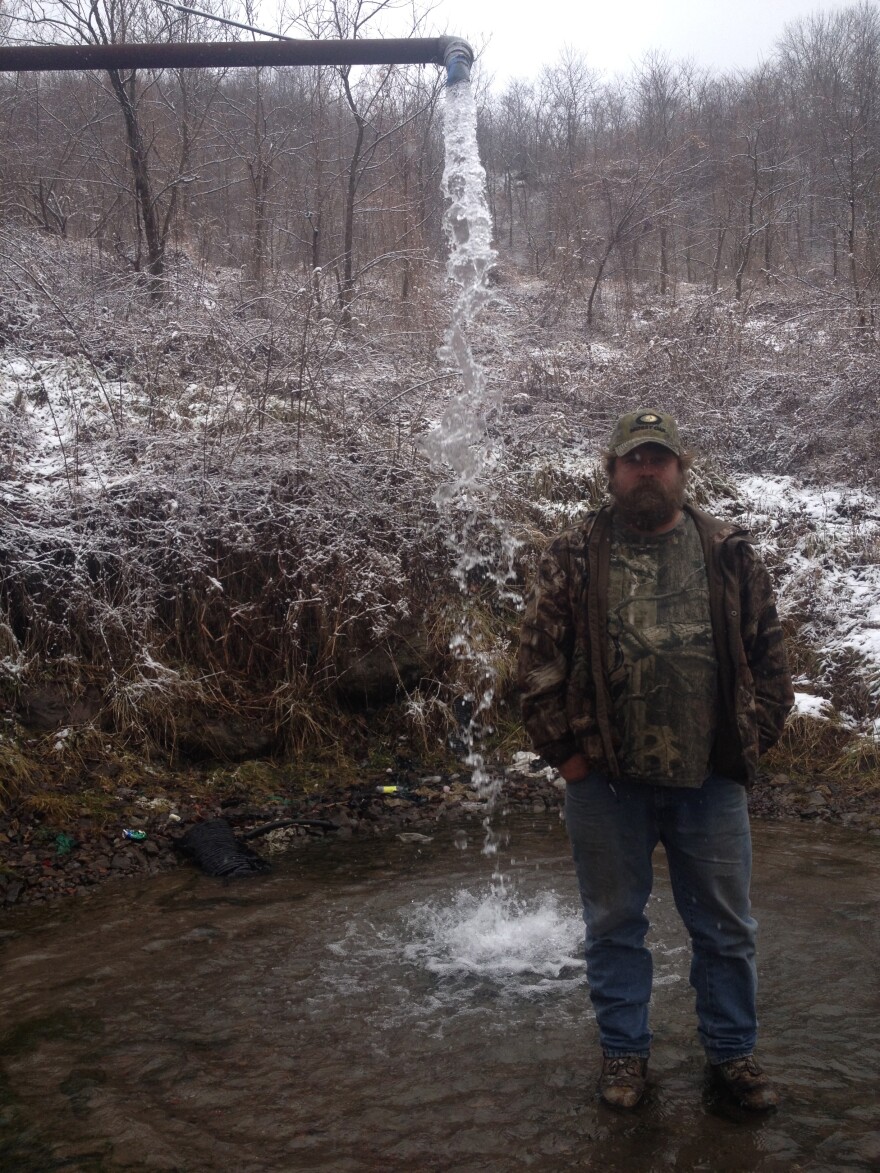
A pipe comes out of an old coal mine in Itmann in Wyoming County where some folks gather drinking water.
like this one in Itmann in Wyoming County where a pipe comes out of the side of the mountain on the side of the road.
Folks often stop to fill up. County Circuit Clerk David Bugs Stover grew up just a few miles from here in Pierpoint.
Abandoned coal mines are often used for a source of drinking water like the one at Pierpoint in Wyoming County, where County Circuit Clerk David Bugs Stover grew up.
“All that water gravity feeds and sometimes it’s treated and sometimes it’s not,” Stover said.
Stover says it was a true community system with its own set of challenges.
“I remember one time my mom didn’t have water for 3 months,” he said. “It can almost drive you to the point of insane.”
“So as much as I felt and did feel for the folks in Charleston, I know what it’s like to go months and if you want water you go carry it out of the creek.”
Credit Jessica Lilly
/
While pickup trucks hauling water was an unusual site in Charleston last year during the chemical spill, it’s common and a part of every day life for folks in the coalfields.
Self-Proclaimed “Mountain Folk”
Some folks use a cistern to store and collect water.
Credit Jessica Lilly
/
A cistern collects water carried from gutters off the house in McDowell County.
There are folks in the region proud of their independence.
Credit Jessica Lilly
/
Terry Johnson lives on Burke Mountain in McDowell County where resident haul water to use in their homes.
Terry Johnson is a self proclaimed “mountain man” and gathers water for his community. He says he wouldn’t have it any other way. Some folks accepting of what they call the sacrifice of ‘mountain living’ while others really aren’t interested, or can’t afford a water bill.
“You have people that are third or fourth generation that they have to carry their water and a well with a lot of iron and they don’t know that there’s a better life,” Mike Goode said.
Credit Jessica Lilly
/
Some folks are growing impatient on what they call “broken promises” for access to clean water.
While there are others that are growing impatient with what they call ’empty promises’ for access to public water. But mountain springs and abandoned mines can be good sources of water--some of the best water in the world, in fact. Marc Glass with Downstream Strategies says folks still should just be cautious.
“Your ground water needs to be protected the same way,” he said.
Several systems have been replaced but there is still more work to be done. For many folks in the coalfields today, a crumbling sometimes-abandoned coal industry water systems, mountain springs, streams, and store-bought bottled water are the options. And they can’t live without water.
Credit Jessica Lilly
/
A family stops to gather water for their home in McDowell County.
Add WVPB as a preferred source on Google to see more from our team
Kianoosh Nawai, an eighth grader at the West Virginia Virtual Academy, was the only West Virginia student chosen from close to 2,000 entrants from across the country for a national science competition.
News Director Eric Douglas sat down in a classroom studio with Marshall's Chuck Bailey, the student news director Emma Johnson, and the Director of the Marshall School of Journalism and Mass Communications Rob Quicke, to learn more.
The funding will help the West Virginia State Police increase the number of eligible DNA samples analyzed for entry into a federal database and will also help reduce turnaround times for forensic cases involving DNA evidence and prevent backlogs of forensic and DNA database samples.
West Virginia received $199 million in the first year of the Rural Health Transformation Program. Dr. Arvin Singh, secretary of the West Virginia Department of Health, told lawmakers he expects the state's level of funding to remain the same next year.