This week, a new generation is learning the story behind "Brown Hill," a song by influential bluegrass band The Lost and Found. Also, data centers are changing the landscape, and one project is planning to plow over an extremely rare stand of seed-producing American chestnut trees. And, small food producers embrace digital technology for the humble farm stand.
Home » Stories » W.Va. Justices Are a Hot Commodity for Outside Spenders
Published
W.Va. Justices Are a Hot Commodity for Outside Spenders
Listen
Share this Article
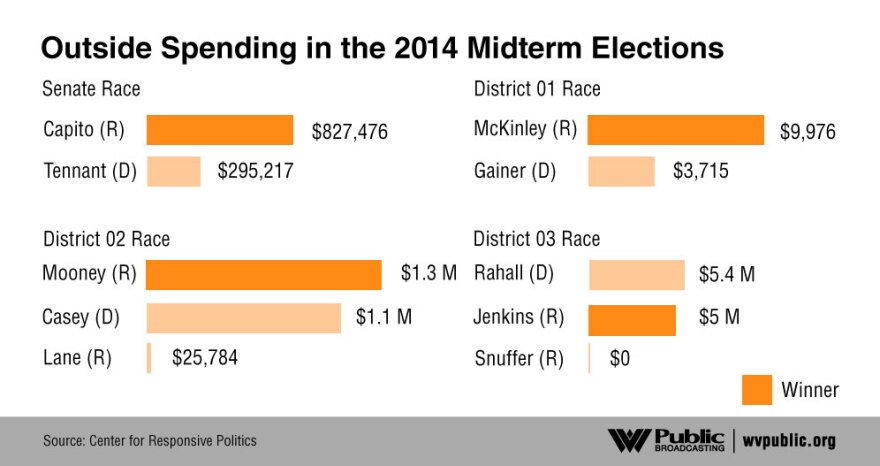
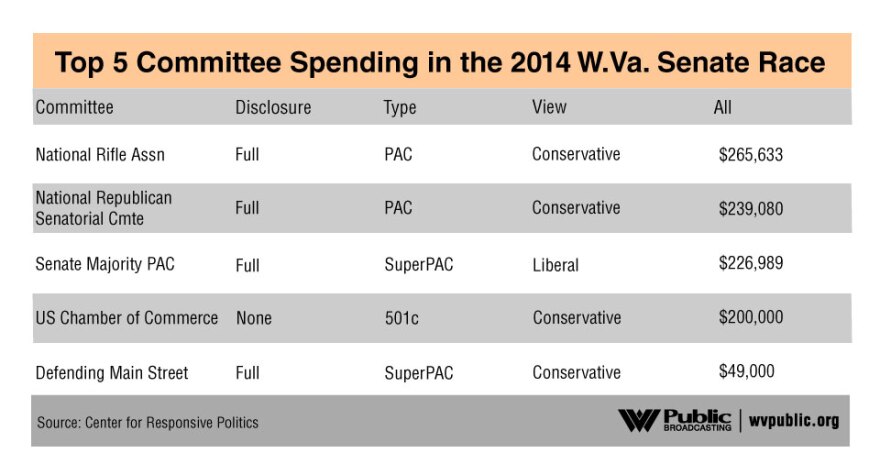
Out-of-state and dark money spenders (campaign contributions from nonprofits and super PACs that don’t have to disclose the sources of their funding) are contributing more money to judicial elections than they have in previous years.
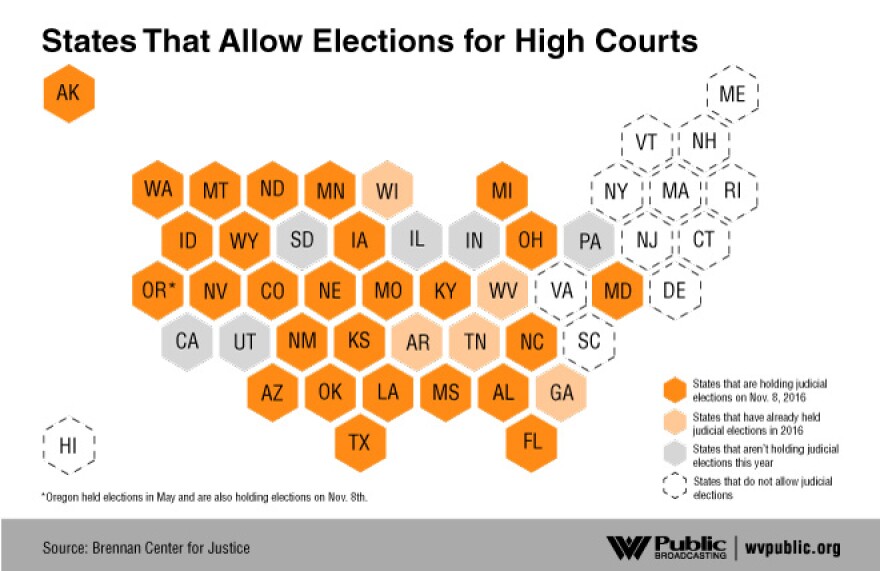
The Brennan Center for Justice, a nonpartisan law and policy institute at New York University, is worried that this money will influence the 27 out of the 38 states using a judicial election system for their high courts have positions up for election this November.
Credit Shayla Klein / West Virginia Public Broadcasting
/
West Virginia Public Broadcasting
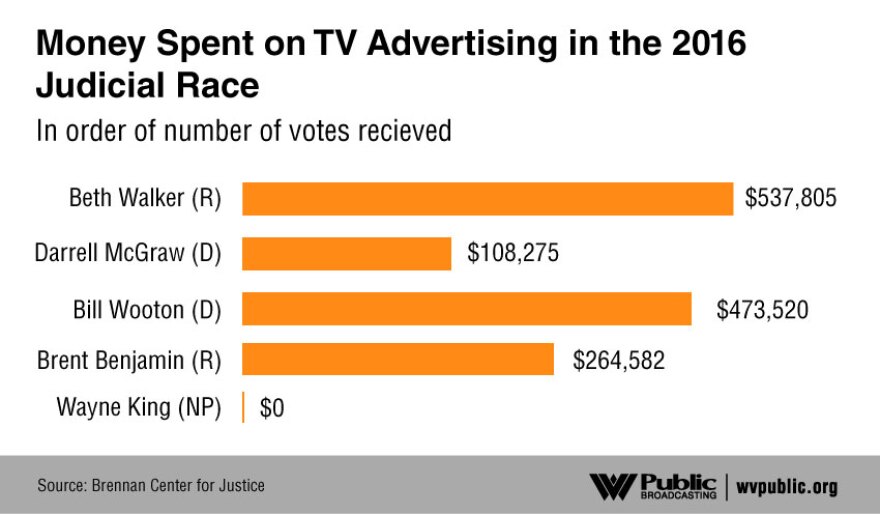
Though dark money sources can only spend a limited amount of money on a candidate, they can spend an unlimited amount on television advertisements. That’s why West Virginians may have noticed a high amount of negative advertising in May.
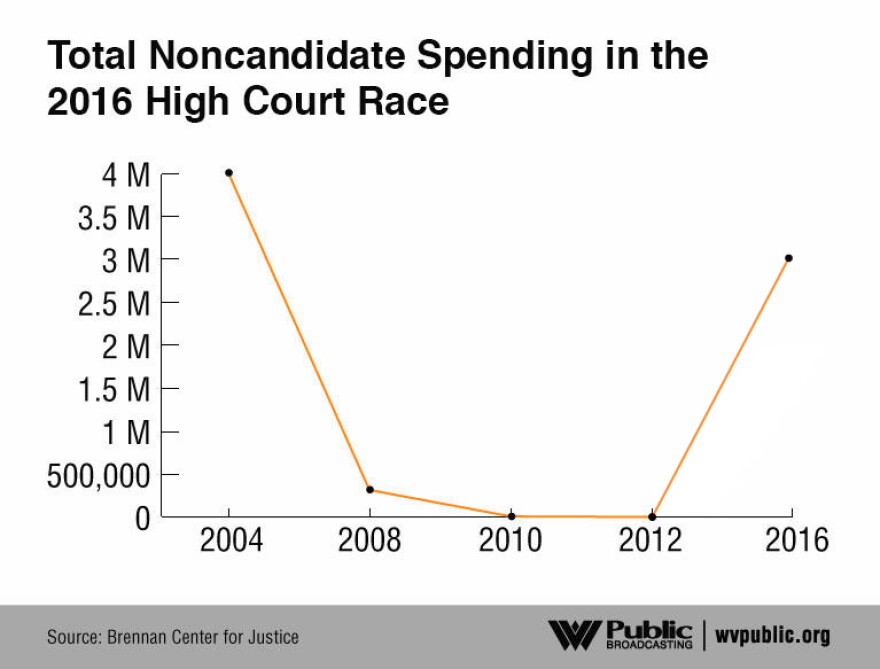
“We saw about 3 million dollars of spending by outside groups, much of it coming from the Republican State Leadership Committee which is a national group that spends money around the country in different kinds of elections, including judicial races,” said Alicia Bannon, senior counsel in the Democracy Program at the Brennan Center for Justice. “And I think their involvement has been interesting because they have been spending in races all over the country.”
Credit Shayla Klein / West Virginia Public Broadcasting
/
West Virginia Public Broadcasting
Elections nationwide saw a spike in outside spending and dark money contributions to downstream elections after the U.S Supreme Court ruled in the 2010 case Citizens United v. Federal Elections Commission that under the first amendment, it would be unconstitutional to prevent corporations or unions from contributing financially to campaigns.
Credit Shayla Klein / West Virginia Public Broadcasting
/
West Virginia Public Broadcasting
Notes: 1) In 2004, former Massey Energy chairman and CEO Don Blankenship contributed $3 million to Brent Benjamin’s campaign. 2) This chart has been updated to reflect that the data represents total noncandidate spending. The 2016 figure has also been updated.
Credit Shayla Klein / West Virginia Public Broadcasting
/
West Virginia Public Broadcasting
But the consequences of dark money’s impact is especially apparent in judicial elections. Studies show that judges’ decisions are influenced by campaign contributions. For example, then West Virginia Justice Brent Benjamin received $3 million in campaign contributions from former Massey Energy CEO Don Blankenship in the 2004 elections. When Blankenship went to trial for his role in the 2010 Upper Big Branch Mine disaster, Benjamin refused to recuse himself from the case and voted in favor of the defendant Massey Energy. His refusal was later ruled by the U.S. Supreme Court as a violation of due process of law.
Credit Shayla Klein / West Virginia Public Broadcasting
/
West Virginia Public Broadcasting
“In the end, we need to trust that judges are going to be able to make decisions based on the law, and not worrying about where they’re going to get money for the next election, not worry about what the next attack ad will be like,” Bannon said. “I think what we’ve been seeing is that these races are becoming more politicized. The public can reasonably ask questions – are our judges going to be reasonably insulated from the rough and tumble of politics to do their jobs as judges?”
In the meantime, Americans across the country, including West Virginia, can expect to hear more negative campaigning funded by dark money sources – until they turn out to cast their votes on Election Day.
Add WVPB as a preferred source on Google to see more from our team
On this West Virginia Week, former governor and longtime U.S. senator Jay Rockefeller has died, West Virginia voted in the general election, and a new anthology explores science fiction and fantasy in Appalachia.
Bob Thompson’s annual holiday jazz celebration is back! Joining Thompson on stage is his long-time bandmates Timothy Courts on drums, Ryan Kennedy on guitar, John Inghram on bass, plus special guest vocalist Lena Seikaly with James Moore on trumpet. Buy your tickets today!
Appalachia is full of ancient cave systems. Some are so deep nobody’s sure where they begin or end. For Inside Appalachia, Folkways Reporter Andrea “river” Peterson explored a once-privately owned underground landscape that recently became a Pennsylvania State Park.
In both the House of Delegates and the state Senate, the 2026 general election saw significant inroads for Democrats. At least one expert traces the reasons for those inroads to several key issues. Assistant News Director Maria Young spoke with Marshall University political science professor Marybeth Beller to learn more about the wins and the losses.